
 English
  русский
  Español
  Português

Industry News
Bailey Bridge Guide: Specs, Load Capacity, and Uses
Content
- 1 What Is a Bailey Bridge and Why It Still Matters Today
- 2 Origins and How the Design Evolved Into Modern Compact Systems
- 3 Technical Specifications: Panels, Steel Grade, and Span Range
- 4 Load Capacity: What a Bailey Bridge Can Actually Carry
- 5 How a Bailey Bridge Goes Up: The Launching Method
- 6 Steel Grade, Corrosion Protection, and Service Life
- 7 Where Bailey Bridges Get Used Today
- 8 Bailey Bridge vs Other Temporary Bridge Types
- 9 Cost Factors and Project Economics
- 10 Choosing the Right Configuration for a Project
- 11 Keeping a Panel Bridge Safe Over Its Service Life
- 12 Transporting and Storing Panel Stock
- 13 Frequently Asked Questions About Bailey Bridges
- 13.1 How long does it take to build a Bailey Bridge?
- 13.2 What is the maximum span a Bailey Bridge can cross?
- 13.3 Can a Bailey Bridge be reused after it is disassembled?
- 13.4 What is the difference between single, double, and triple truss configurations?
- 13.5 How much weight can a Bailey Bridge hold?
- 13.6 Do Bailey Bridges work for pedestrian and bicycle traffic, or only vehicles?
- 13.7 How is the steel protected from rust over the years the bridge is in service?
- 13.8 How many people are needed to assemble a Bailey Bridge?
- 13.9 Can a Bailey Bridge be used as a permanent structure, or only temporarily?
- 13.10 What foundation work is needed before a Bailey Bridge can be installed?
- 13.11 How does site access affect which bridge type is the better choice?
What Is a Bailey Bridge and Why It Still Matters Today
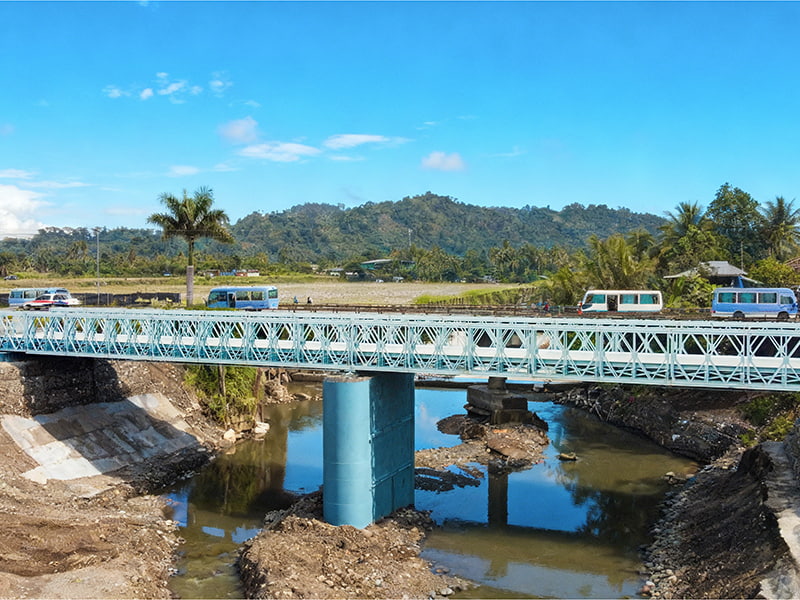
A Bailey Bridge is a prefabricated, modular steel truss bridge built from standardized panels that bolt together without welding or heavy cranes. A small crew can erect a working single-lane crossing over a 20 to 30 meter gap in a single day using hand tools, rollers, and a launching nose, then take it apart and move it to the next site once the job is done. That combination of speed, reusability, and load capacity is why the design has stayed in active service for more than eighty years, from wartime river crossings to modern mining roads, flood recovery projects, and rural access routes.
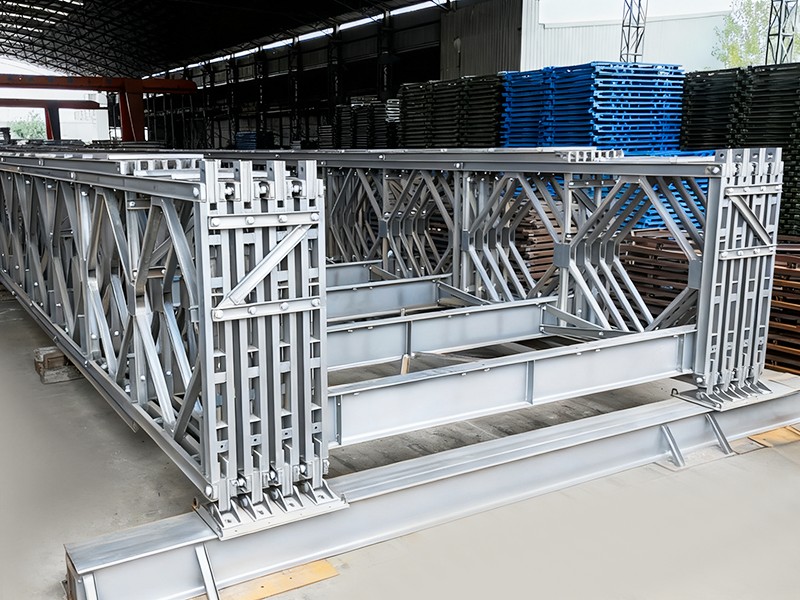
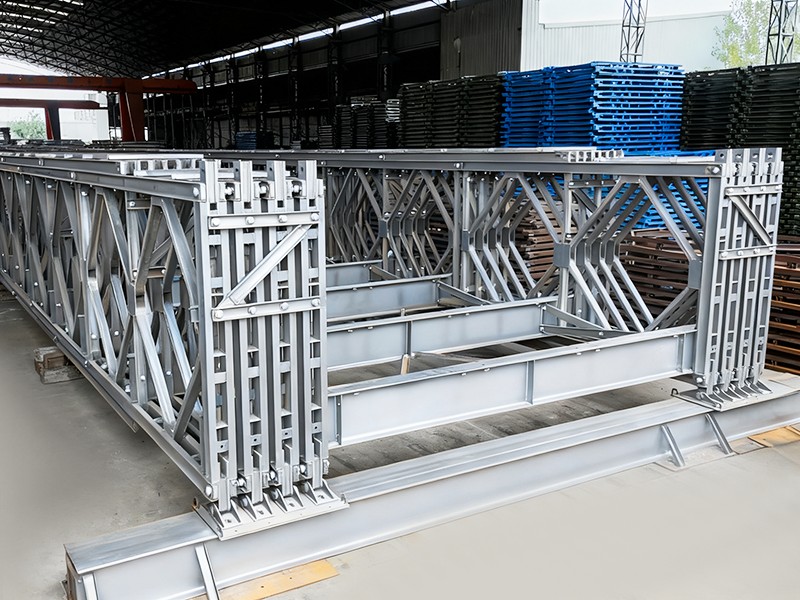
The panels themselves are the core of the system: each one measures 3.048 meters long and 2.15 meters high, and they pin together side by side and stacked in layers to build trusses of almost any strength. A single-single configuration handles light vehicle traffic over short spans, while double-double or triple-triple stacking pushes the same basic panel into a structure rated for heavy trucks, mining trailers, or military convoys crossing spans up to 60 meters on a standard kit, and well beyond that with reinforced or compact-series variants.
What makes the design worth understanding in detail is not just the panel dimensions but the underlying logic: every component is interchangeable, every connection is mechanical rather than welded on site, and the whole structure can be resized by adding or removing standardized parts rather than redesigning from scratch. That logic is what the rest of this guide unpacks, section by section, from the history of the system through to how a project team actually chooses and maintains one today.
Origins and How the Design Evolved Into Modern Compact Systems
The original Bailey Bridge was designed by British engineer Donald Bailey during the early 1940s to solve a battlefield problem: armies needed to cross blown bridges and flooded rivers faster than fixed steel structures could be built. The panel-and-pin system meant components could be manufactured identically at scale, shipped in standard trucks, and assembled by soldiers with no specialized training. Field reports from that period credit the design with letting advancing units keep pace with retreating forces instead of stalling at every damaged crossing.
Three design choices made that possible, and they are worth naming because they still define the modern product line:
- A single panel size that could be produced in volume at multiple factories and remain interchangeable between batches.
- A pin connection system that required no welding, no bolts needing precise torque specifications, and no skilled trades on site.
- A cantilever launch method that let the structure reach across a gap without needing a crane positioned on the far bank.
After the war, the same logic carried over into civil engineering. Disaster response agencies adopted it for washed-out roads, mining companies used it to reach remote ore bodies, and rural governments used it to replace collapsed timber bridges without waiting years for a permanent concrete structure. Manufacturers have since refined the original steel grade, panel tolerances, and connecting pins into lighter, higher-strength compact series that carry more load per kilogram of steel than the wartime originals, while keeping the same core assembly logic that made the bridge useful in the first place.
The most visible evolution in recent product generations is the shift toward compact panel families that reduce the total steel weight per meter of span while increasing the rated load. Where an early-generation panel bridge might need a triple-triple truss to carry a fully loaded highway truck, a modern compact panel achieves comparable capacity with fewer layers, which directly cuts assembly time and transport volume. That efficiency gain is a major reason the design has kept pace with heavier modern vehicle fleets instead of being replaced by newer bridging concepts.
Technical Specifications: Panels, Steel Grade, and Span Range
Modern Bailey-type panel bridges are typically fabricated from S355 high-strength structural steel, a grade chosen because it holds a favorable strength-to-weight ratio for components that still need to be lifted and carried by hand or light machinery on site. Cross members come in a small set of standard road widths so the same panel stock can support single-lane military and disaster-relief crossings or wider double-lane civilian roads.
| Component | Standard Dimension | Notes |
|---|---|---|
| Truss panel | 3.048m x 2.15m | Bolts side by side and in stacked layers |
| Road width, single lane | 3.15m | Common for rural and emergency crossings |
| Road width, standard | 4.20m | Fits most trucks and agricultural equipment |
| Road width, double lane | 7.35m | Two-way traffic on higher-volume routes |
| Typical span range | 10m to 60m (standard kit) | Compact and reinforced series extend well beyond this |
| Extended multi-span range | Up to 300m | Achieved with intermediate piers between sections |
Span and load are not fixed numbers for a Bailey Bridge; they are a function of how many panel layers and how many side-by-side chords are used in the truss. A single-single truss covers shorter gaps at lighter loads, a double-single or triple-single adds strength for medium spans, and a double-double or triple-double truss is what engineers reach for when the crossing needs to carry loaded trucks, mining trailers, or tracked vehicles over longer distances.
Reading the Truss Naming Convention
The naming pattern used across the industry follows a simple logic once it is spelled out. The first word describes how many panels sit side by side in the horizontal direction, and the second word describes how many layers are stacked vertically. A single-single truss has one panel wide and one panel high; a double-double has two panels wide and two panels high, and so on. Reading a specification sheet becomes much easier once that pattern is clear, because the same two words also tell you roughly how much steel, how much assembly time, and how much load capacity a given truss represents relative to the others in the family.
Panel Connection Hardware
Each panel connects to its neighbors through vertical steel pins driven through interlocking lugs cast into the panel ends, secured by a locking clip called a panel pin retainer. This connection method is what allows assembly without welding: the pins can be driven and removed with a hammer, and the retainer clips can be checked visually during inspection without any specialized tools. Transoms, the cross beams that span between the trusses and carry the deck, connect to the panels through a separate bracket system that also relies on pins rather than bolts requiring torque wrenches, keeping the entire structure field-serviceable with minimal equipment.
Load Capacity: What a Bailey Bridge Can Actually Carry
A common reference point is that a standard single-lane configuration supports loads in the 20 to 40 ton range, which covers most delivery trucks, farm equipment, and light military vehicles. Adding truss panels or moving to a double or triple configuration raises that ceiling considerably, and heavy-duty compact systems built for mining and highway logistics are engineered to carry up to 100-ton trailers across spans that can extend to 300 meters when built in multi-span sections with intermediate piers.
Four variables decide the real-world number for any given crossing:
- Truss configuration: single, double, or triple panel layers stacked and paired change the load path dramatically.
- Steel grade and panel condition: higher-strength steel and panels free of corrosion or fatigue cracking hold their rated capacity longer.
- Span length: longer unsupported spans need additional reinforcement or intermediate piers to keep deflection within safe limits.
- Deck and cross-member width: wider decks distribute axle loads differently than narrow single-lane decks.
Engineers size a bridge around the heaviest vehicle expected to cross it, not the average one, and it is standard practice to design in a margin above the maximum anticipated axle load rather than running a crossing at its theoretical limit.
How Load Rating Relates to Real Vehicles
Load figures on a spec sheet only become useful once translated into the vehicles a project actually expects. A loaded concrete mixer, for example, commonly sits in the 25 to 30 ton gross weight range, well within a standard single-lane rating. A fully loaded mining haul trailer, by contrast, can easily exceed 80 tons, which is why mining access roads almost always specify a double or triple configuration rather than the lightest kit available. Matching the truss to the heaviest realistic vehicle, including any oversized construction or emergency equipment that might cross occasionally, is the single most important calculation in the whole planning process.
Dynamic Loading and Vibration
Static load capacity is only part of the picture. Moving vehicles introduce dynamic loading, meaning the forces on the truss change as a vehicle accelerates, brakes, or crosses at speed, and repeated cycles of loading and unloading contribute to long-term metal fatigue at pin connections. This is why speed limits are typically posted on temporary panel bridges, and why heavier or more frequent traffic justifies more conservative truss selection than the bare static rating alone would suggest.
How a Bailey Bridge Goes Up: The Launching Method
The signature feature of the system is the cantilever launch. Crews assemble the truss on rollers on the near bank, attach a lightweight steel launching nose to the front end, and push the growing structure out over the gap section by section. Because the nose is lighter than the main truss, it reduces the tipping moment while the bridge is still unsupported on the far side, letting the structure reach across without a crane lifting it into place.
A typical sequence looks like this:
- Survey the site, confirm the gap distance, and grade a working platform with a roller track on the near bank.
- Bolt truss panels into the chosen configuration, adding transoms and stringers as the deck takes shape.
- Attach the launching nose and begin pushing the assembly forward on rollers, adding panels at the rear as the front advances.
- Once the nose reaches the far bank, lower the structure onto bearings and remove the rollers and nose.
- Install decking, guardrails, and approach ramps, then run a load check before opening the crossing to traffic.
Because every part bolts or pins together, the same crew can reverse the process just as quickly, which is why the design remains the default choice when a crossing is genuinely temporary or needs to be relocated as a project moves along a route.
Crew Size and Equipment Needs
One of the most practical advantages of the launching method is how little equipment it requires compared with lifting a finished span into place. A typical assembly crew for a single-lane crossing ranges from eight to fifteen people working with hand tools, panel dollies, and a simple roller track, without needing a crane rated for the full weight of the finished truss. Larger double or triple configurations and longer multi-span projects naturally call for larger crews and light machinery such as forklifts or small cranes to move panel stacks, but even those projects avoid the need for the heavy lifting equipment a conventional steel girder bridge installation would require.
Site Preparation and Abutment Considerations
Assembly speed depends heavily on how well the banks are prepared before the panels arrive. Abutments, the structures at each end that carry the bridge's weight into the ground, need a stable, level bearing surface capable of handling the concentrated reaction loads at each end of the truss. On soft or unstable ground, this often means placing timber or steel bearing pads, or in more demanding cases, pouring small concrete footings before assembly begins. Skipping proper abutment preparation is one of the most common causes of alignment problems during launch, so experienced crews treat bank preparation as equally important as the truss assembly itself.
Steel Grade, Corrosion Protection, and Service Life
Panel quality is what separates a bridge that lasts decades from one that needs early replacement. Most current manufacturers build panels from S355 steel and finish them with hot-dip galvanizing, a zinc coating process that protects the steel from rust in outdoor and wet environments. Galvanized panels commonly carry a service life estimate in the range of 10 to 25 years depending on climate exposure, traffic loading, and how consistently the crossing is inspected and maintained.
Coastal, tropical, and heavy-industrial sites accelerate corrosion, so bridges deployed in those conditions benefit from thicker galvanizing or supplementary coatings on top of the base zinc layer. Fireproof or intumescent coatings are also used on bridges that pass through or near facilities with fire risk, such as shipyards or industrial plants, where low-VOC water-based coatings have become common because they reduce maintenance downtime compared with older solvent-based products.
Why Steel Grade Choice Matters Beyond Strength
Steel grade affects more than raw tensile strength. Higher-grade steels like S355 also tend to offer better fatigue resistance at the pin connections, which matters enormously for a structure that experiences repeated loading cycles from crossing traffic rather than the constant, unchanging load of a building. A panel built from a lower-grade steel might meet the static load requirement on paper while wearing out faster at the connection points under real traffic, which is why reputable manufacturers specify fatigue performance alongside basic yield strength when describing their steel.
Galvanizing Thickness and Environmental Matching
Not all galvanized coatings are equal. Coating thickness, typically measured in microns, should be matched to the site's corrosion category rather than applied at a single default thickness across every project. A bridge deployed in a dry inland climate can perform well with a standard coating thickness, while a bridge deployed near seawater, industrial fumes, or in a consistently humid tropical climate benefits from a thicker zinc layer or an additional top coat to reach the same service life target. Treating galvanizing thickness as a site-specific decision rather than a fixed specification is one of the clearest ways to extend a bridge's usable years.
Where Bailey Bridges Get Used Today
The application list has grown well beyond its military roots. Five sectors account for most current demand:
Disaster Recovery and Flood Response
When a flood or earthquake takes out a road bridge, restoring the connection is often the single fastest way to get emergency supplies, medical transport, and repair crews moving again. Because panels can be stockpiled and shipped on short notice, a temporary crossing can be running again in days rather than the months a poured-concrete replacement would take. Emergency management agencies in flood-prone regions frequently keep panel stock in regional depots specifically so a crossing can be restored within 48 to 72 hours of a failure being reported.
Mining and Resource Access Roads
Mining operations frequently need to move loaded haul trucks and trailers across ravines, streams, or unstable ground where a permanent structure is not justified for the life of the operation. A double-double or triple truss configuration rated for 100-ton trailers keeps ore and equipment moving on a schedule the mine controls, and because the bridge can be relocated once a pit or haul road is exhausted, the capital investment carries forward into the next phase of the operation instead of becoming a stranded asset.
Rural and Municipal Road Replacement
Local governments use panel bridges to keep a route open while a permanent replacement is designed and funded, or as a lower-cost permanent solution on low-traffic rural roads where a full concrete structure is not economically justified. This use case has grown noticeably as rural infrastructure budgets face increasing pressure, since a panel bridge can be installed at a fraction of the time and often a fraction of the cost of a cast-in-place structure for the same span.
Military and Tactical Logistics
The original use case is still active: modular panel bridges remain part of combat engineering because they can be transported in standard trucks, assembled without cranes, and rated against defined load classifications for tracked and wheeled vehicles.
Construction and Utility Access
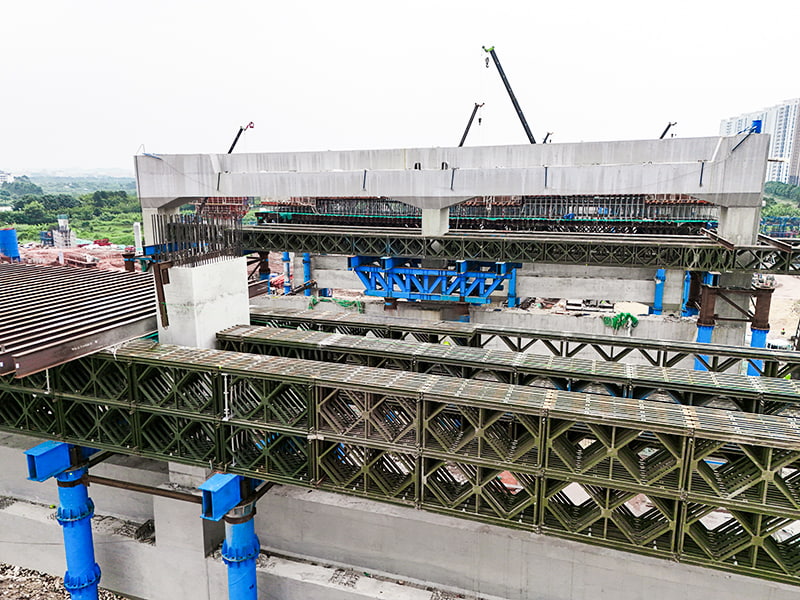
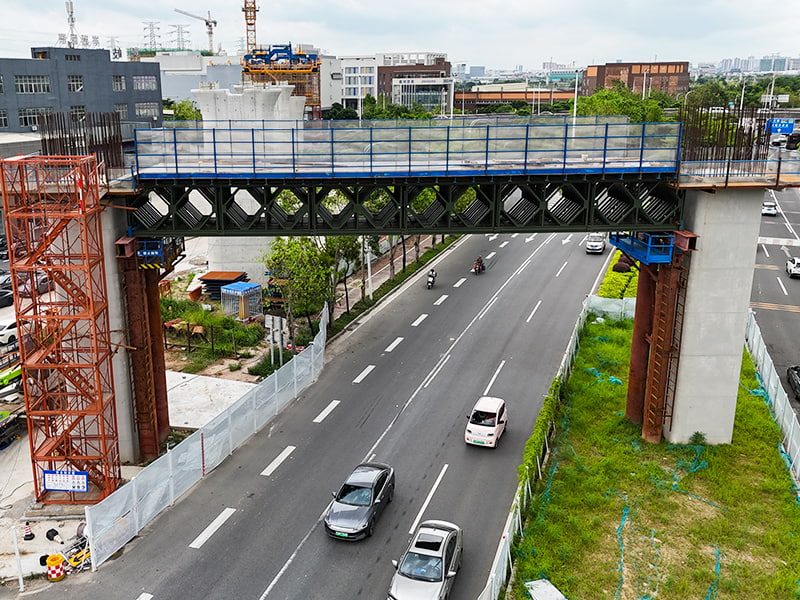
General contractors use panel bridges as temporary haul roads across excavations, streams, or utility corridors during large construction projects, then relocate the structure once that phase of the project is finished. Utility companies use the same approach to reach transmission towers or pipeline sections that cross water or ravines, where a permanent access bridge would never justify its cost for a project that only needs the crossing during construction and maintenance visits.
Bailey Bridge vs Other Temporary Bridge Types
Project teams comparing bridging options usually weigh a panel bridge against two alternatives: a modular steel beam bridge or a barge-supported floating crossing.
| Bridge Type | Typical Span | Assembly Speed | Best Fit |
|---|---|---|---|
| Bailey / panel bridge | 10m to 300m | Hours to a few days | Heavy vehicles, relocatable crossings, disaster response |
| Modular steel beam bridge | Up to 40m | 1 to 2 days | Shorter permanent-style crossings with crane access |
| Floating pontoon / barge bridge | Variable, water-dependent | Hours | Deep water, fluctuating water levels, marine logistics |
Panel bridges win on two fronts most alternatives cannot match at the same time: they handle genuinely heavy axle loads and they can be built without a crane, which matters enormously on sites where heavy lifting equipment is expensive or impossible to bring in.
When a Modular Beam Bridge Makes More Sense
A modular steel beam bridge, built from prefabricated girder sections lifted into place by crane, can be a better fit when crane access is already available on site, the span is short, and the crossing is expected to stay in place for many years without relocation. Because beam bridges use fewer, larger components rather than many small panels, on-site assembly labor is lower, though the tradeoff is a heavier reliance on lifting equipment that a panel bridge simply does not need.
When a Floating Bridge Makes More Sense
Floating pontoon bridges solve a different problem entirely: crossing water where the bottom is too deep, too soft, or too variable for fixed piers to be practical. They deploy extremely quickly and adapt to changing water levels, but they are not suited to heavy sustained truck traffic in the way a properly configured panel bridge is, and they are far more exposed to current, debris, and weather conditions than a fixed structure spanning above the water.
Cost Factors and Project Economics
Total project cost for a panel bridge breaks down into a handful of predictable categories, and understanding them helps project planners budget accurately instead of being surprised by line items that were not part of the initial estimate.
- Panel and hardware procurement, which scales with truss configuration and total span length rather than a flat per-meter rate.
- Transportation to site, which depends heavily on distance and site accessibility, since remote or mountainous sites can add significant logistics cost.
- Site preparation, including abutment grading, bearing pads, or footings needed to support the finished structure.
- Labor for assembly and launch, which varies with crew experience and truss complexity but remains modest compared with conventional bridge construction labor.
- Ongoing inspection and maintenance across the service life, including periodic recoating or hardware replacement as panels age.
The economic case for a panel bridge is usually strongest when the crossing is genuinely temporary, when the project timeline cannot absorb the months a permanent structure requires, or when the same panel stock will be reused across multiple sites over its service life. Because the steel components retain resale and reuse value, the effective cost per project drops substantially for organizations that redeploy the same inventory repeatedly rather than treating each crossing as a one-time purchase.
Choosing the Right Configuration for a Project
Selecting a configuration comes down to matching the truss layout and steel grade to three site realities rather than picking the biggest available kit by default.
- Confirm the actual gap distance and any need for intermediate piers on longer crossings.
- Identify the heaviest vehicle or axle load that will realistically cross, not just the average traffic.
- Account for site access: if cranes cannot reach the location, a bolt-together panel system is often the only practical option regardless of span.
- Factor in how long the crossing needs to remain in service, since that drives the choice of coating and steel grade.
- Plan the road width around actual traffic needs; a single-lane deck is lighter and faster to build when two-way flow is not required.
A useful rule of thumb from field experience: oversizing the truss configuration by one step above the calculated minimum load rarely adds significant cost or assembly time, and it gives a comfortable margin for unexpected loads such as construction equipment or emergency vehicles that were not part of the original traffic plan.
Single-Lane vs Double-Lane Decisions
Traffic volume, not span length, is usually what decides between a single-lane and double-lane deck. A crossing serving occasional truck trips or a single work site rarely needs two-way capacity, and a narrower deck reduces both panel count and assembly time. A double-lane deck becomes worthwhile once traffic volume is high enough that vehicles waiting for a single lane to clear would create meaningful delays, which is more common on public rural roads than on private mining or construction access routes.
Planning for Multi-Span Crossings
Very wide gaps, such as broad river valleys, often cannot be crossed economically with a single unsupported span even at maximum truss strength, because deflection and steel weight both increase sharply as span length grows. In these cases, engineers plan a multi-span layout using intermediate piers, which breaks the crossing into shorter, more efficient individual spans. This approach is what allows the overall system to reach documented span capabilities as long as 300 meters while keeping each individual span within an efficient, well-tested range.
Keeping a Panel Bridge Safe Over Its Service Life
A panel bridge is only as reliable as its upkeep. Regular inspection routines focus on three areas: the condition of the connecting pins and bolts, visible corrosion or coating wear on the panels, and any deflection or misalignment in the deck under load. Catching a loose pin or an early corrosion spot during a routine check is far cheaper than dealing with a structural issue after it has spread.
Sites in humid, coastal, or industrial environments should shorten the interval between inspections compared with dry inland locations, since corrosion accelerates faster where salt, moisture, or airborne chemicals are present. Bridges that see continuous heavy truck traffic, such as mining haul roads, also warrant more frequent connection checks than a lightly used rural crossing, simply because repeated heavy loading puts more cyclic stress on the pins and welds over time.
A Practical Inspection Checklist
| Inspection Point | What to Check | Suggested Frequency |
|---|---|---|
| Panel pins and retainers | Looseness, missing retainer clips, visible wear | Monthly on heavy-use crossings |
| Galvanized coating | Chipping, scratches exposing bare steel, rust spots | Quarterly |
| Deck and decking bolts | Loose fasteners, worn or cracked decking material | Monthly |
| Bearing points and abutments | Settlement, cracking, water pooling near footings | Quarterly, and after major storms |
| Overall deflection under load | Unusual sag or vibration compared with baseline readings | Annually, or after any known overload event |
Keeping a simple written log of inspection dates and findings makes it far easier to spot gradual trends, such as a coating that is wearing faster than expected in one section, before they become urgent problems. This is especially valuable for organizations that relocate the same panel stock between projects, since the maintenance history travels with the components rather than staying tied to a single site.
Transporting and Storing Panel Stock
Because the entire appeal of the system rests on portability, how panels are transported and stored between projects matters almost as much as how they are assembled. Panels stack efficiently on flatbed trucks or in standard shipping containers, and a well-organized inventory system, typically tracking panels by batch and inspection date, keeps a fleet ready to deploy without sorting through mismatched or unverified stock at the moment a crossing is needed urgently.
Storage conditions between deployments affect long-term coating performance as much as active service does. Panels stored outdoors in direct ground contact or standing water corrode faster than panels stored on raised racks with adequate drainage and airflow, even though they are not carrying traffic during that time. Organizations that keep large panel inventories for repeated disaster response or mining relocation projects generally find that a modest investment in proper racked storage pays for itself many times over in extended panel life.
Frequently Asked Questions About Bailey Bridges
How long does it take to build a Bailey Bridge?
A single-lane crossing over a 20 to 30 meter gap can typically be assembled and launched within a day by an experienced crew, though longer spans or multi-span layouts with intermediate piers naturally take longer to plan and build.
What is the maximum span a Bailey Bridge can cross?
A standard single-span kit generally covers up to around 60 meters, while compact and reinforced systems built with multiple spans and intermediate supports can extend to 300 meters for large-scale infrastructure projects.
Can a Bailey Bridge be reused after it is disassembled?
Yes. Reusability is one of the design's core advantages: panels, pins, and decking are built to be taken apart cleanly and reassembled at a different site, which is why many disaster-response and mining fleets keep a stock of panels ready to redeploy rather than buying new for every project.
What is the difference between single, double, and triple truss configurations?
The numbers describe how many panel layers are paired side by side (single, double, triple) and stacked vertically. More layers and stacking increase the load capacity and allow longer spans, at the cost of more panels, more assembly time, and a heavier finished structure.
How much weight can a Bailey Bridge hold?
A basic single-lane configuration commonly handles 20 to 40 tons, while heavy-duty double or triple configurations built for industrial and mining logistics can be engineered to carry loads up to 100-ton trailers, depending on span, steel grade, and truss layout.
Do Bailey Bridges work for pedestrian and bicycle traffic, or only vehicles?
The same modular system adapts easily to pedestrian and bicycle use, and lighter-duty configurations are commonly used for foot traffic, utility access, and light rail or maintenance crossings in addition to full vehicle roads.
How is the steel protected from rust over the years the bridge is in service?
Most panels are hot-dip galvanized, coating the steel in zinc to resist corrosion in outdoor conditions, and this treatment is generally what supports a service life estimate in the 10 to 25 year range depending on the environment the bridge sits in.
How many people are needed to assemble a Bailey Bridge?
A single-lane crossing is typically handled by a crew of eight to fifteen people using hand tools and a roller track, while larger double or triple configurations and multi-span projects call for larger crews and light machinery to move heavier panel stacks efficiently.
Can a Bailey Bridge be used as a permanent structure, or only temporarily?
While the design originated as a temporary military solution, properly maintained panel bridges with adequate coating and regular inspection routinely stay in continuous service for many years, and some rural and mining installations function as de facto permanent structures for the operational life of the road they serve.
What foundation work is needed before a Bailey Bridge can be installed?
At minimum, each bank needs a stable, level bearing surface capable of carrying the concentrated reaction load at the ends of the truss, which on soft ground often means timber or steel bearing pads and in more demanding cases a small concrete footing poured ahead of assembly.
How does site access affect which bridge type is the better choice?
Sites without room for a crane or without a stable crane pad favor a Bailey Bridge specifically because the cantilever launch method builds the structure from the near bank outward, whereas alternatives like modular beam bridges typically require lifting finished sections into place.

We respond quickly to all international requests and provide technical support when needed.
Product Category
Bailey Bridge/Modular Bridge Modular Steel Bridge Pedestrian Bridge Modular Pipe Bridge Truss Bridge Steel StructureContact Us

+86-511-84522866
+86-13921582699

zhwm@zjql.com

Building 1,83#, dantu New Town, Yanjiang Road, Dantu District, Zhenjiang, Jiangsu, China
Copyright © Jiangsu Zhonghai Bridge Equipment Co., Ltd. All
Rights
Reserved
China bailey bridge for sale
bailey bridge supplier from china
