
 English
 русский
 Español
 Português


Industry News
Bailey Bridge in WWII: Design History, Load Specifications, and Battlefield Impact
Content
- 1 The Origins and Wartime Development of the Bailey Bridge
- 2 Core Design Principles and Components of a WWII Bailey Bridge
- 3 Bailey Bridge Configurations, Load Capacities, and Maximum Spans
- 4 First Combat Use: Tunisia, Sicily, and the Italian Campaign
- 5 Normandy, Market Garden, and the Advance into Germany
- 6 Bailey Bridge vs. Pontoon Bridge: A Tactical Comparison
- 7 Field Assembly: Speed Without Heavy Lifting
- 8 The Bailey Bridge Legacy and Modern Modular Bridge Manufacturing
- 9 Frequently Asked Questions About the Bailey Bridge in WWII
- 9.1 Who invented the Bailey bridge?
- 9.2 How much weight could a WWII Bailey bridge carry?
- 9.3 How long did it take to build a Bailey bridge in WWII?
- 9.4 How many Bailey bridges were built during World War II?
- 9.5 Are Bailey bridges still used today?
- 9.6 What is the difference between a Bailey bridge and a panel bridge?
The Bailey bridge was the most decisive military bridging system of World War II, and it remains one of the few wartime engineering inventions still in continuous production today. Designed by British engineer Sir Donald Bailey, this prefabricated steel truss bridge let Allied armies cross bombed rivers and shattered gaps in hours without heavy cranes. During the conflict, more than 500,000 tons of Bailey components were manufactured, and the system's modular panel architecture directly shaped the modern modular steel bridge industry.
Once assembled, a Bailey bridge could carry loads ranging from a jeep to a 50-ton tank, depending on its configuration. Because every component was standardized and interchangeable, military engineers could erect a bridge with simple pins and hand tools, often under direct enemy fire. This article covers the origins, design principles, combat record, load specifications, and the lasting engineering legacy of the Bailey bridge in WWII.
The Origins and Wartime Development of the Bailey Bridge
Sir Donald Coleman Bailey, a civil engineer working at the British War Office's Experimental Bridging Establishment (EBE) in Christchurch, Dorset, designed the bridge in 1940. The British Army urgently needed a bridging system that could keep pace with armored advances and could be carried in ordinary military trucks. The traditional steel-girder and pontoon bridges of the time were too heavy, too slow, and too dependent on workshops and cranes.
Bailey's answer was a bridge built from identical steel truss panels connected by steel pins. His prototype was tested in early 1941, and full production began the same year. By 1945, more than 500,000 tons of Bailey bridge components had been manufactured across Britain, Canada, and the United States, according to wartime engineering records.
The panel system had a decisive practical advantage over its competitors, including the parallel Hamilton bridge design developed by the British Ministry of Supply. Bailey panels required no site welding, no riveting, and no lifting crane. A small crew with simple tools could build it, which made it the only bridge system that could be pushed right to the front line and assembled under fire.
Core Design Principles and Components of a WWII Bailey Bridge
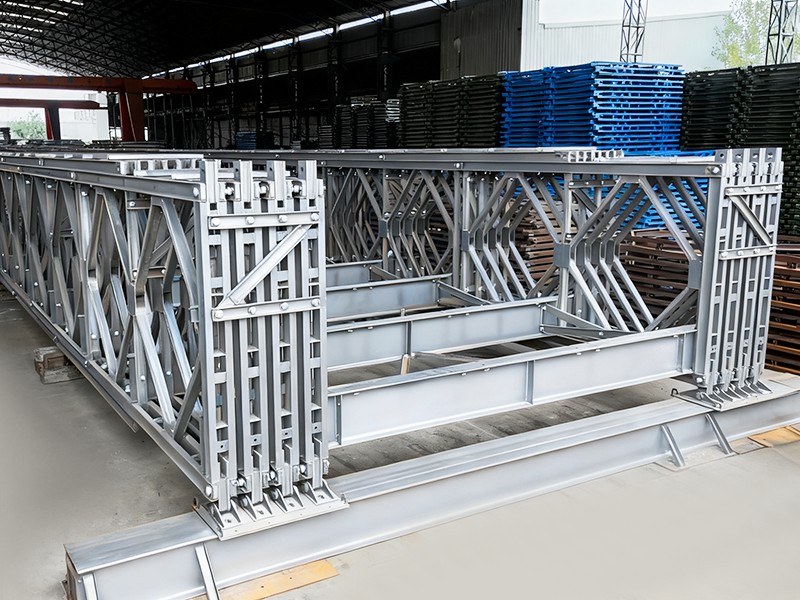
A Bailey bridge is built from standardized structural panels. Each panel is a welded steel truss frame measuring 10 ft (3.05 m) long and 5 ft (1.52 m) high, weighing about 570 lb (259 kg). Panels are connected end-to-end and side-by-side using steel panel pins, forming a deep lattice girder.
- Panels - the primary vertical truss frames that transfer load to the supports.
- Transoms - transverse steel beams that sit on the lower chord of the panels and carry the deck.
- Stringers - longitudinal beams laid over the transoms to support the road deck.
- Bracing frames - sway and cross bracing that keep the bridge rigid against lateral wind and movement.
- Deck units - timber or steel deck panels that form the road surface.
- End posts and bearing plates - the support components that transfer load to the ground or abutments.
The genius of the system is total interchangeability: a panel manufactured in Canada could be mated with a panel from Britain, and crew members needed no machinist skills. Repairs were made by replacing individual damaged panels in the field rather than rebuilding an entire span.
Bailey Bridge Configurations, Load Capacities, and Maximum Spans
A Bailey bridge's capacity depends on how many panels are stacked in height (single story, double story, or triple story) and how many rows of panels are used across the width (single, double, triple, or quadruple). Engineers described configurations with a two-part name: for example, "Double-Single" means two stories high and one panel row wide on each side.
| Configuration | Maximum Span (ft / m) | Safe Load at Max Span (tons) |
|---|---|---|
| Single-Single (SS) | 100 ft / 30.5 m | 10.9 tons |
| Double-Single (DS) | 170 ft / 51.8 m | 18.4 tons |
| Triple-Single (TS) | 216 ft / 65.8 m | 27.4 tons |
| Double-Double (DD) | 195 ft / 59.4 m | 32.7 tons |
| Triple-Double (TD) | 255 ft / 77.7 m | 42.5 tons |
| Quadruple-Double (QD) | 300 ft / 91.4 m | 53.8 tons |
In practice, engineers reduced the span to gain payload. A Double-Single bridge at 100 ft (30 m) could comfortably take closer to 18 tons, while a Triple-Single at 140 ft (42 m) handled about 25 tons. For tank crossings, a class-40 or class-70 classification was assigned, meaning the bridge was designed to carry a 40-ton or 70-ton tracked vehicle.
First Combat Use: Tunisia, Sicily, and the Italian Campaign
The Bailey bridge saw its first operational action in November 1942, when British Royal Engineers erected a bridge across the Medjerda River in Tunisia, according to contemporary war diaries. The crossing was built at night under intermittent enemy fire, and light vehicles passed within a few hours of the start of assembly, a speed that was unprecedented for a steel bridge.
The system proved itself again during the Allied invasion of Sicily in July 1943 and the grinding Italian campaign that followed. Italy's rivers and demolished masonry bridges forced engineers to throw up dozens of temporary crossings. The US 5th Army and the British 8th Army both relied on Bailey bridges for almost every river crossing. Units often carried prefabricated components on their vehicles, ready to assemble as soon as a river was reached.
By the end of the Italian campaign, the Bailey bridge had become more than an engineering asset. It was a tactical tool that let commanders choose their axis of advance independently of the existing road network.
Normandy, Market Garden, and the Advance into Germany
After D-Day, Allied engineers in Normandy used Bailey bridges on an industrial scale. The bocage country, with its sunken lanes, flooded fields, and destroyed stone bridges, demanded an instantly deployable crossing. Thousands of pre-assembled components were shipped from England, and mobile bridging parks were organized to supply units at the front.
One of the most famous surviving examples is the Bailey bridge at Carentan, installed by US Army Engineers in 1944, which remained in continuous roadway service in Normandy for decades and is documented as still in place.
During Operation Market Garden in September 1944, the Allies needed to cross the Waal at Nijmegen. There, Canadian and British engineers built a composite Bailey crossing more than 1,200 ft (366 m) long, at the time the longest Bailey bridge ever constructed, according to Royal Engineers records.
In March 1945, Montgomery's 21st Army Group crossed the Rhine in Operation Plunder using class-40 and class-70 Bailey bridges erected in a matter of days. During the final eleven months of the war in northwest Europe, the 21st Army Group erected over 1,000 Bailey bridges totaling roughly 10 km of bridge deck, based on postwar Royal Engineers reports.
Bailey Bridge vs. Pontoon Bridge: A Tactical Comparison
Allied engineers used both Bailey bridges and pontoon floating bridges during WWII. Each had strengths, but the Bailey bridge dominated where speed, durability, and obstacle conditions mattered most.
| Factor | Bailey Bridge | Pontoon Bridge |
|---|---|---|
| Heavy equipment needed | No (hand assembly) | Often yes (cranes and boats) |
| River current tolerance | High (fixed structure) | Low to moderate |
| Typical short-span assembly time | About 6 hours | 4 to 8 hours |
| Maximum practical span | Up to 300 ft (91 m) | Unlimited with more pontoons |
| Vulnerability to artillery fire | Moderate (repairable by panel replacement) | High (sinking pontoons) |
In practice, the two systems were complementary. Pontoon bridges carried heavy traffic across wide rivers where a fixed-span Bailey would have been too long, while Bailey bridges handled fast, durable crossings over streams, canals, and gaps where pontoons were impractical. The Bailey bridge's repairability gave it a unique advantage under sustained fire.
Field Assembly: Speed Without Heavy Lifting
The speed of Bailey bridge assembly was its military superpower. No welding equipment, no workshops, and often no crane were required. A trained field crew of about 30 to 40 men could launch a double-single bridge of roughly 90 ft (27 m) in about six hours. With a crane assisting, the same bridge could be assembled and launched even faster.
- Site preparation - level the abutment areas and place steel bearing plates or timber grillage.
- Panel assembly - connect panels on each side of the gap to form the two main trusses.
- Transoms and stringers - install cross beams and longitudinal beams over the trusses.
- Bracing - fix sway frames and transom clamps to rigidify the box structure.
- Decking - bolt down timber or steel deck units.
- Launching - push or pull the assembled span across rollers on the far bank; add a launching nose for longer spans.
Because the bridge was prefabricated in small, standardized units, each component could be manhandled. A single steel panel weighing 570 lb (259 kg) was carried by a six- to eight-man team or slid along the ground. The tactical consequence was that rivers and craters no longer dictated where armies could advance.
The Bailey Bridge Legacy and Modern Modular Bridge Manufacturing
After 1945, surplus Bailey bridges became a civilian workhorse. Rural roads in Australia, Africa, and South America were rebuilt with military-surplus Bailey spans, and many remained in service into the 21st century. In France, the Carentan bridge was still carrying traffic after nearly eight decades. The design also lives on in engineering textbooks as the classic example of a modular panel bridge.
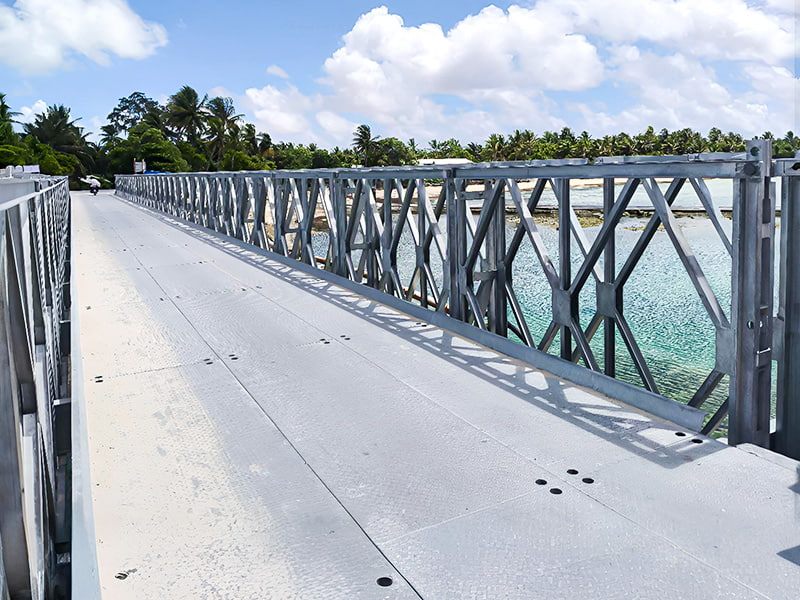
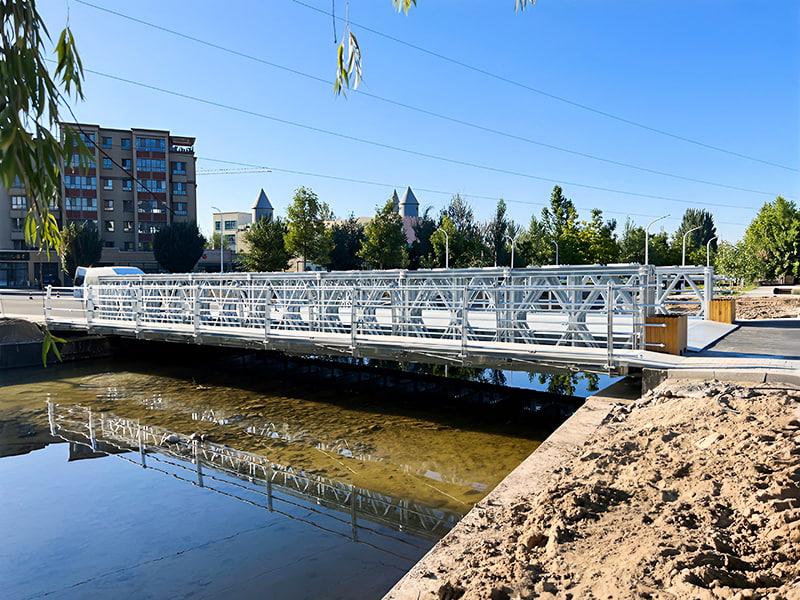
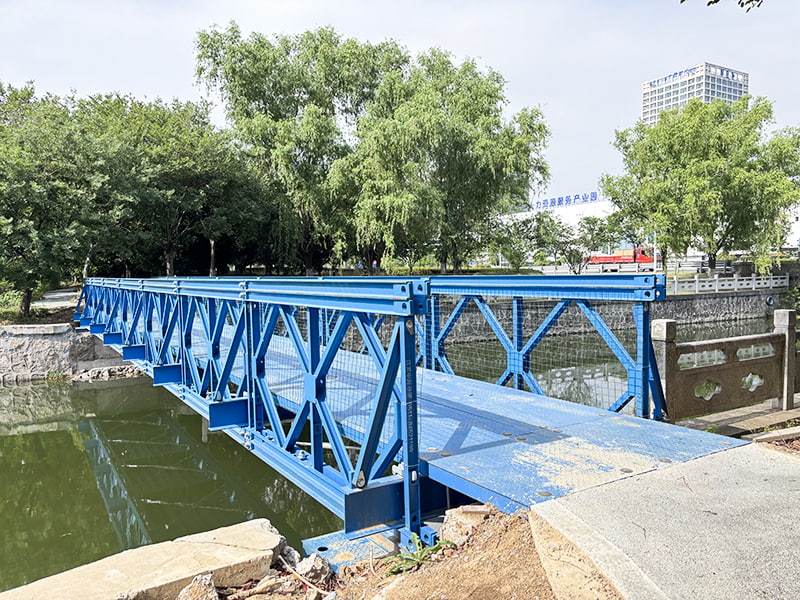
This panel-based philosophy has evolved directly into modern modular steel bridge systems. For readers who want current specifications, a practical starting point is this Bailey bridge guide covering specifications, load capacity, and uses, and an overview of the engineering versatility of modern Bailey bridges.
Manufacturers such as Jiangsu Zhonghai Bridge Equipment Co., Ltd., an engineering-led bridge manufacturer based in Zhenjiang, China, carry the same lineage forward. Their product lines mirror the classic Bailey configurations developed for WWII:
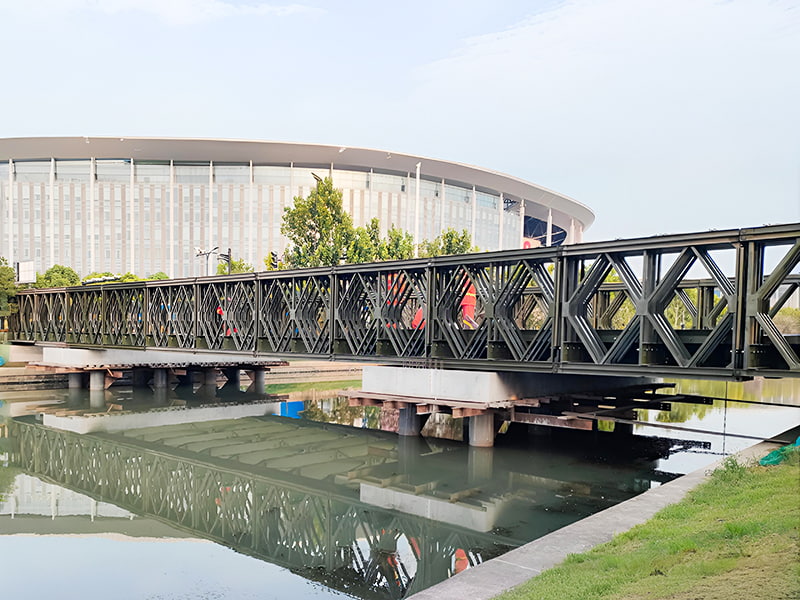 CB 100 (321) Bailey Bridge with Multiple Reinforced ConfigurationsThis supplier offers a range of CB 100 Bailey bridge variants, including double-row, triple-row, and custom galvanized options, matching classic WWII-era truss panel designs with modern corrosion protection for temporary or semi-permanent use.View Product →
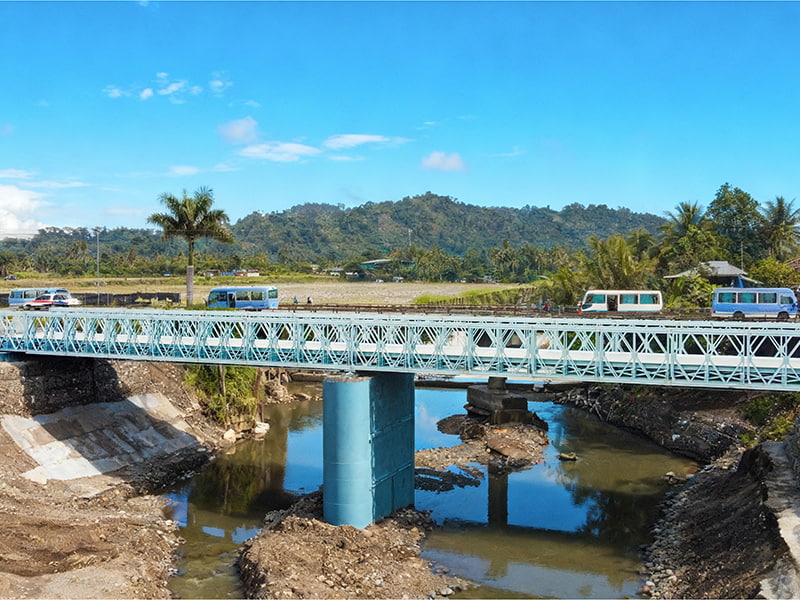 CB 200 Bailey Bridge with Flexible Modular Span ConfigurationsThe CB 200 supports spans from 21 to 60 meters through modular combinations, with options for galvanized or reinforced double-row and four-row layouts. It follows GB, ANSI, or EN standards for rapid assembly and repeated reuse.View Product →
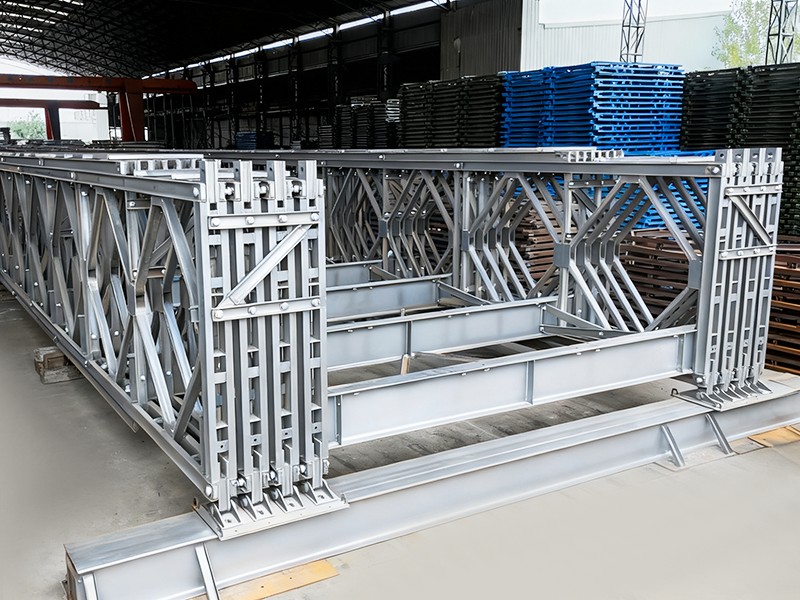 CB 450 Bailey Bridge for Large-Span Heavy-Load ApplicationsDeveloped for permanent or semi-permanent use, the CB 450 reaches spans up to 81 meters and supports 80-ton loads. Its standardized components enable rapid assembly, filling a gap in large-span modular steel bridge solutions.View Product →
These modern bridges use the same truss-panel and pin-connection logic, updated with computer-designed connections, hot-dip galvanized finishes, and engineered steel deck systems. The difference is that manufacturing tolerances, load testing, and steel grades are now governed by contemporary civil engineering standards rather than wartime expediency.
Frequently Asked Questions About the Bailey Bridge in WWII
Who invented the Bailey bridge?
The Bailey bridge was invented by Sir Donald Coleman Bailey, a civil engineer at the British War Office's Experimental Bridging Establishment, who designed the system in 1940. It was first deployed in combat in November 1942 in Tunisia.
How much weight could a WWII Bailey bridge carry?
A Bailey bridge's capacity depended on configuration. A Single-Single at its maximum span carried about 10 tons, while a Quadruple-Double could handle over 50 tons. In practice, bridges were classified for 40-ton or 70-ton tracked vehicle crossings.
How long did it take to build a Bailey bridge in WWII?
A trained crew of 30 to 40 men could launch a 90 ft (27 m) Double-Single bridge in about six hours without a crane. With crane assistance, even longer spans were completed within one day.
How many Bailey bridges were built during World War II?
Wartime production records indicate that more than 500,000 tons of Bailey bridge components were produced in Britain, Canada, and the United States. Individual bridges numbered in the many thousands, with the 21st Army Group alone erecting over 1,000 in northwest Europe.
Are Bailey bridges still used today?
Yes. The original WWII design and its descendants remain in service worldwide. Modern manufacturers produce panel-based modular steel bridges using Bailey's architecture, and some wartime-installed bridges were still carrying traffic in the 2020s.
What is the difference between a Bailey bridge and a panel bridge?
A Bailey bridge is the original WWII design. A panel bridge is the broader category of modular truss bridges that use identical prefabricated panels and pins, which includes both original Bailey bridges and modern derivatives such as the CB-100, CB-200, and CB-450 series.
The Bailey bridge was not the heaviest, nor the longest, nor the most elegant bridge of the Second World War, but it was the most flexible, the most transportable, and the most strategically consequential. It allowed armies to keep moving when the terrain said stop, and its modular logic is still shaping the way engineers span rivers around the world today. That is why the Bailey bridge remains one of the most significant engineering achievements to emerge from the conflict.

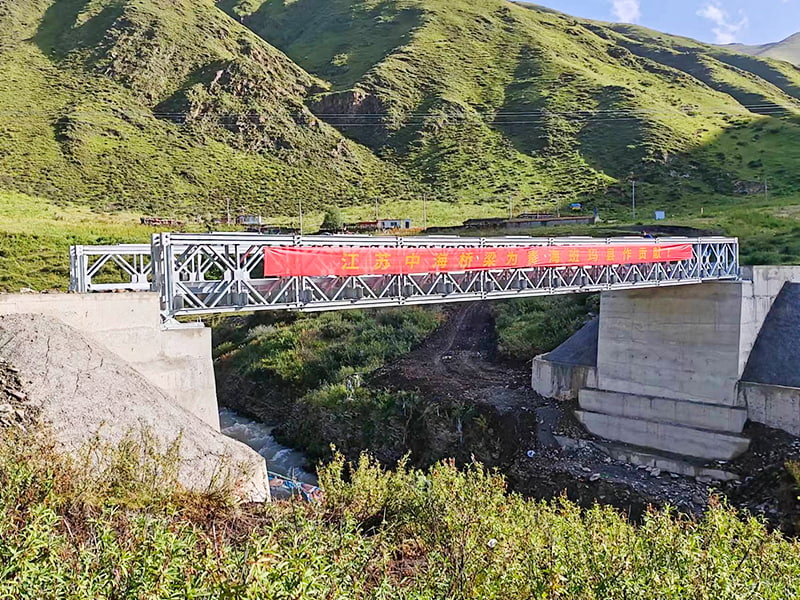

We respond quickly to all international requests and provide technical support when needed.
Product Category
Bailey Bridge/Modular Bridge Modular Steel Bridge Pedestrian Bridge Modular Pipe Bridge Truss Bridge Steel StructureContact Us

+86-511-84522866
+86-13921582699

zhwm@zjql.com

Building 1,83#, dantu New Town, Yanjiang Road, Dantu District, Zhenjiang, Jiangsu, China
Copyright © Jiangsu Zhonghai Bridge Equipment Co., Ltd. All
Rights
Reserved
China bailey bridge for sale
bailey bridge supplier from china
