
 English
 русский
 Español
 Português


Industry News
Double Single Bailey Bridge: Configuration, Load Capacity, and Applications
Content
- 1 What Exactly Is a Double Single Bailey Bridge?
- 2 Double Single vs. Other Bailey Configurations
- 3 Load Capacity and Span of a Double Single Bailey Bridge
- 4 Core Components of a Double Single Bailey Bridge
- 5 Where Double Single Bailey Bridges Are Used
- 6 How a Double Single Bailey Bridge Is Erected
- 7 Procurement Checklist for a Double Single Bailey Bridge
- 8 Frequently Asked Questions About Double Single Bailey Bridges
- 8.1 What does "double single" mean in a Bailey bridge?
- 8.2 How much weight can a double single Bailey bridge carry?
- 8.3 What is the maximum span of a double single Bailey bridge?
- 8.4 What is the difference between double single and double double?
- 8.5 How long does it take to erect a double single Bailey bridge?
- 8.6 Can a double single Bailey bridge be reused?
A double single Bailey bridge is a modular steel truss bridge built with two truss panels pinned side by side on each side of the deck, assembled one storey high. This configuration is the first choice for medium-span temporary and permanent crossings because it roughly doubles the load capacity of a single-truss layout without adding the height, weight, or erection time of a two-storey bridge.
If you are planning an emergency replacement, a construction access crossing, or a permanent rural bridge, the double single layout is usually the option engineers evaluate first. The sections below cover its definition, comparative strength, span limits, components, installation, and buying checklist.
What Exactly Is a Double Single Bailey Bridge?
The name comes from the original British Bailey bridge nomenclature. "Double" refers to the number of truss panels on each side of the roadway; "single" refers to the number of storeys. A double single bridge therefore has two truss lines on the left side and two on the right, each one panel high. Chinese manufacturers describe the same layout as double-row single-layer.
Each standard panel measures 3.048 m long and about 1.5 m high, built from a lattice of high-strength steel. Panels are connected with hardened steel pins, so the entire bridge dismantles into truck-sized components and can be re-erected on another site. Because only the number and position of panels change, one component inventory can form single-single, double-single, triple-single, double-double, or triple-double bridges on demand.
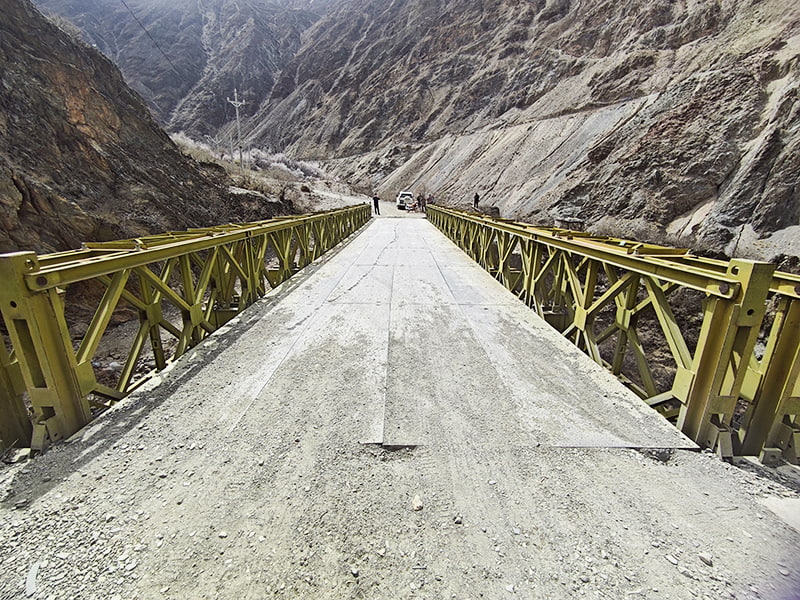
The reinforced version of the double single bolts additional chord segments onto the top and bottom panel chords, which raises the allowable bending moment by about one-third compared with a standard DS layout. This is the most frequently ordered type for highway-class loading. Manufacturers such as Jiangsu Zhonghai Bridge Equipment Co., Ltd. supply it as a standard configuration.
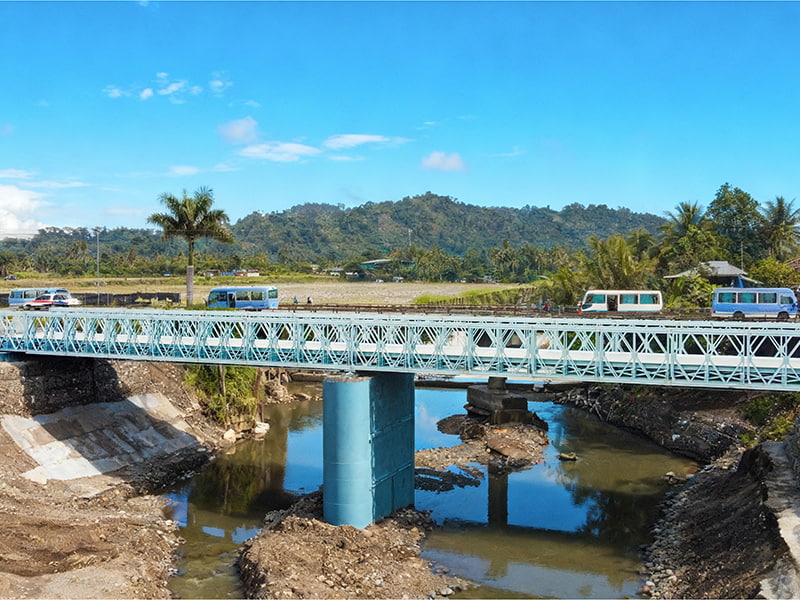
 Reinforced Galvanized Double-Single CB100 Bailey Bridge for Highway-Class LoadingThis is the standard reinforced double-row single-layer CB100 configuration, which adds chord segments to raise bending moment by about a third. Its galvanized finish suits humid or coastal sites without field painting.View Product →
In the CB100/321 product family, the reinforced double-row single-layer galvanized Bailey bridge is used for both temporary access and long-term installation. The galvanized finish eliminates field painting and protects the steel in humid, coastal, or high-salt environments.
Double Single vs. Other Bailey Configurations
Bailey bridges are classified by truss arrangement because that is what determines bending strength and shear capacity. Five configurations appear in most engineering tables and manufacturer datasheets.
| Configuration | Trusses per side | Storeys | Typical span range | Relative moment capacity |
|---|---|---|---|---|
| Single-single (SS) | 1 | 1 | 15-30 m | 1.0 |
| Double-single (DS) | 2 | 1 | 21-42 m | 2.0 |
| Triple-single (TS) | 3 | 1 | 24-50 m | 2.7 |
| Double-double (DD) | 2 | 2 | 24-55 m | 4.0 |
| Triple-double (TD) | 3 | 2 | 30-70 m | 5.6 |
The double single sits between the single-single and the triple-single. Engineers choose it when a single-single is too weak but a triple-single or double-double is unnecessarily heavy and expensive to ship. For spans of roughly 21 to 42 m, the reinforced double single is frequently the lightest arrangement that still satisfies highway load requirements.
Load Capacity and Span of a Double Single Bailey Bridge
Load capacity must always be quoted together with span, because the same bridge carries a very heavy vehicle on a short span and only a light vehicle on a long span. In the CB100/321 panel class, a reinforced double single bridge is typically rated for tracked vehicle loads in the range of 55 to 65 tonnes at a 30 m span, with a practical maximum span around 42 m. U.S. Army Field Manual FM 5-277 confirms that allowable load falls continuously as span grows, which is why military specifications always pair a load class with a span.
The relationship between span and the governing design factor is summarized below.
| Span range | Governing consideration |
|---|---|
| 15-24 m | Bending strength is comfortable; deck and bearings usually govern the design |
| 25-33 m | Midspan bending dominates; reinforced panels recommended for highway traffic |
| 34-42 m | Bending governs; restrict vehicle speed, spacing, and empty return loads |
| Over 42 m | Move to triple-single, double-double, or a heavier panel class such as CB200 |
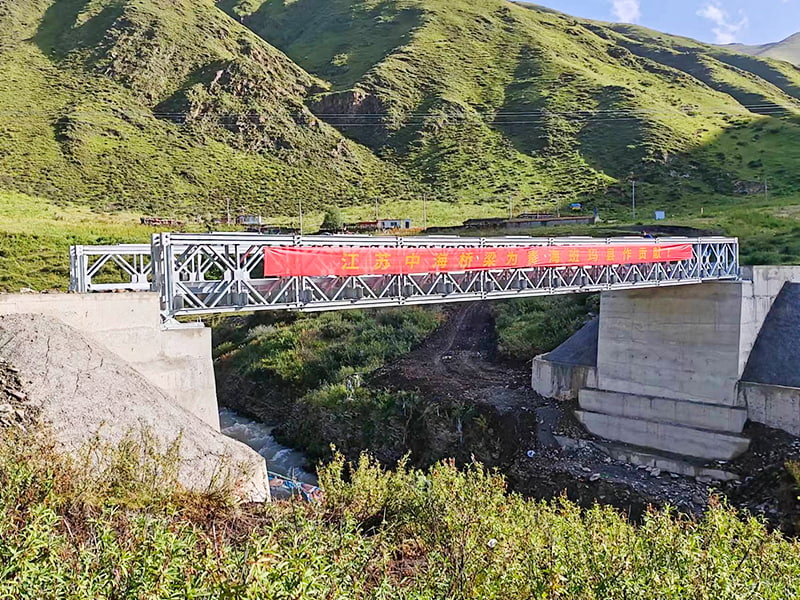
When the clear span exceeds the CB100 range, the same double single geometry can be produced with heavier panels. The CB200 double-row single-layer galvanized Bailey bridge is a direct example, and reinforced CB200 double single bridges have been supplied for 48 m spans. For the full background on rating, the guide on Bailey bridge specifications, load capacity, and uses provides practical planning data.
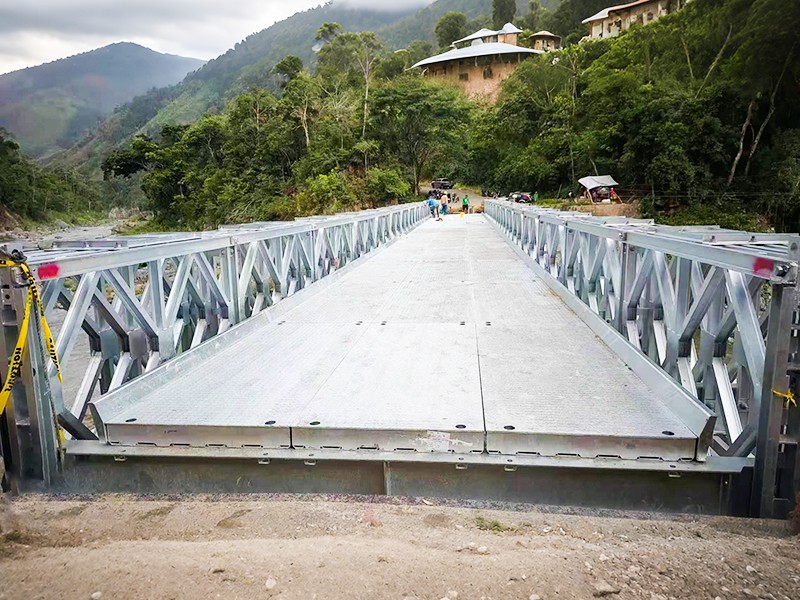
 Galvanized CB200 Double-Row Single-Layer Bailey Bridge for Longer SpansThe CB200 double single uses heavier panels for spans beyond the CB100 range, with hot-dip galvanizing for high-humidity climates. It is a direct example of the same geometry scaled up for larger clearances.View Product →
Core Components of a Double Single Bailey Bridge
A double single bridge uses the same component set as every other Bailey layout; only the quantities and arrangement differ. The following parts are found on a typical 30 m DS bridge:
- Truss panels: 3.048 m by 1.5 m lattice panels; two are pinned side by side on each side to form the DS truss.
- Panel pins: hardened steel pins that lock panels together end-to-end and side-by-side; no welding is needed on site.
- Reinforcement chord: bolted chord segments that increase the section modulus of reinforced DS bridges.
- Transoms: transverse beams that transfer deck loads into the truss panel joints.
- Stringers: longitudinal bearers that sit on the transoms and support the deck planks.
- Sway braces and cross frames: bracing that keeps the two side trusses vertical and prevents lateral buckling.
- Deck units: timber, steel, or aluminium planks bolted to the stringers.
- End posts and base plates: components at each end that transfer loads into the abutment or bearing.
Standardization is the practical advantage: an existing Bailey inventory can be reconfigured into DS with no special parts other than reinforcement chords. When buying new, a complete package from one supplier avoids compatibility problems between panel classes.
Where Double Single Bailey Bridges Are Used
The double single configuration appears whenever a crossing must be delivered quickly, assembled by a small crew, and frequently moved again later. Five application areas cover most orders.
- Military and disaster relief: field units carry DS bridges on standard trucks and launch them without cranes, restoring routes in hours rather than weeks.
- Emergency road replacement: a washed-out bridge on a rural road is exchanged for a DS bridge within days, while the permanent structure goes through design and funding.
- Construction site access: contractors use DS bridges for haul roads over rivers, deep excavations, and pipeline corridors; the bridge is dismantled when the project finishes.
- Water and utility crossings: the DS bridge platform carries water pipes, slurry lines, and cable conduits, often as a modular pipe bridge.
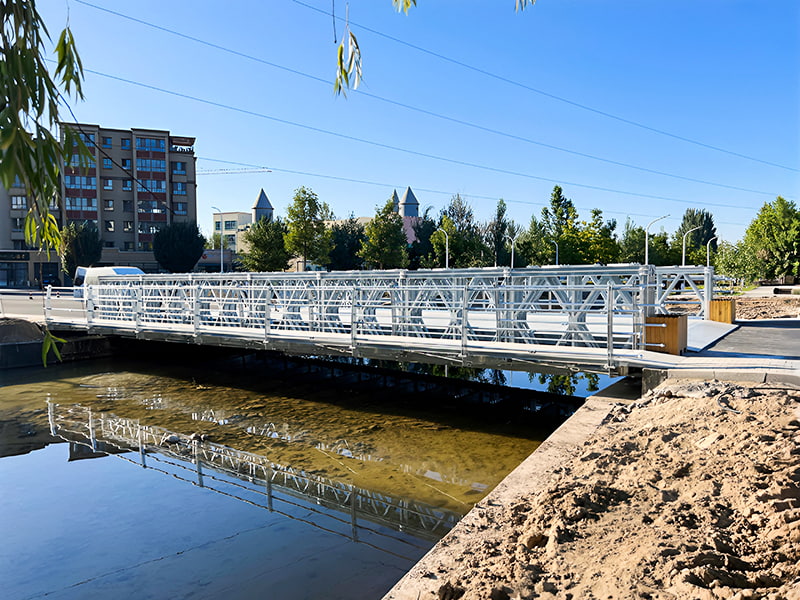
- Pedestrian and light vehicle crossings: for boardwalk access, forest roads, and event sites, the DS layout provides a stiff deck with low deflection.
For a ready example, the CB200 27-metre double-row single-layer reinforced Bailey bridge is a common product choice for medium-span construction access and temporary traffic diversion.
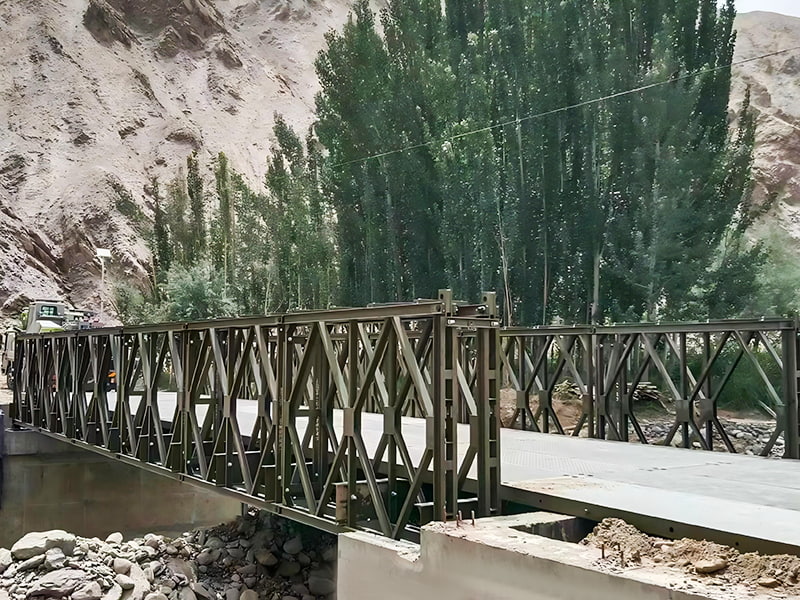
 27-Meter Reinforced Double-Single CB200 Bailey Bridge for Medium-Span AccessThis 27-meter reinforced CB200 double-single bridge is a common choice for construction access and traffic diversion. Its galvanized truss resists high-salt coastal conditions and supports loads from HS-15 to Track-50.View Product →
How a Double Single Bailey Bridge Is Erected
The most economical erection method is cantilever launching. The bridge is assembled in a build-up area behind the launching abutment, fitted with a light launching nose, and pushed forward on steel rollers until the nose lands on the far abutment. Because the DS layout is stiff in bending, it cantilevers safely throughout the launch.
- Prepare the abutments: cast or compact a level bearing surface, place timber grillage or concrete pads, and set the base plates to the correct height.
- Assemble the DS trusses on rollers: build both side trusses on rollers, connect the panels, and fit transoms, stringers, and bracing progressively.
- Fit the launching nose: bolt a truss extension to the front end to reduce the cantilever moment during the first half of the launch.
- Launch with a winch or excavator: pull or push the bridge steadily across, keeping the two trusses aligned and checking the rollers.
- Seat and complete: lower the bridge onto the far bearing, remove the nose, tighten all pins, fit the deck units, and add curbs or handrails.
With an experienced crew of six to eight people, a 30 m DS bridge is typically erected and opened to traffic in one to two days, excluding deck finishing and approach works.
Procurement Checklist for a Double Single Bailey Bridge
Most Bailey bridge project delays come from incomplete specifications rather than manufacturing quality. Use this checklist when requesting a quote:
- Design load class and vehicle: specify tracked or wheeled loads, axle configuration, and whether the load class is HS-20, Class 40, or a local standard.
- Clear span: measure between bearing points at both abutments; do not use the overall bridge length.
- Panel class and reinforcement: choose CB100, CB200, or CB450 and state whether reinforced chords are required.
- Surface protection: hot-dip galvanized, painted, or a combination; galvanized is recommended for humid and coastal sites.
- Deck system: steel, timber, or aluminium; confirm whether decking is included in the price.
- Accessories: launch nose, rollers, base plates, curbs, handrails, and pedestrian walkway brackets.
- Installation support: ask about on-site supervision and installation guidance; this affects the schedule more than the hardware cost.
- Relocatability: if the bridge will be moved, request a component inventory that keeps panels and pins exchangeable.
For a bridge that will stay in place for several years, specify hot-dip galvanizing and standard 3.048 m panels; this combination reduces maintenance cost far more than the initial price difference.
Frequently Asked Questions About Double Single Bailey Bridges
What does "double single" mean in a Bailey bridge?
It describes the truss arrangement: two panels pinned side by side on each side of the deck, one storey high. The abbreviation is DS, and Chinese manufacturers often list it as double-row single-layer.
How much weight can a double single Bailey bridge carry?
In the CB100/321 class, a reinforced DS bridge is typically rated for about 60 tonnes of tracked load at a 30 m span. At its maximum span of about 42 m, the allowable load drops, so the design vehicle must always be checked against the span.
What is the maximum span of a double single Bailey bridge?
About 42 m with reinforced CB100 panels. With the heavier CB200 panels, the same DS layout can reach approximately 48 m. Beyond these figures, a triple-single, double-double, or a stronger panel class is needed.
What is the difference between double single and double double?
A double-double (DD) bridge has two trusses per side and two storeys. The second storey adds roughly twice the moment capacity but makes the bridge taller, heavier, and slower to erect. DS is chosen when one storey is enough.
How long does it take to erect a double single Bailey bridge?
With six to eight workers and standard launching equipment, a 30 m DS bridge is typically open to traffic in one to two days. Assembly on rollers and a single continuous launch is the fastest method.
Can a double single Bailey bridge be reused?
Yes. The pinned and bolted connections allow full dismantling and re-erection. Agencies building disaster-response fleets often choose DS configurations precisely because the same components can serve different spans in different years.

We respond quickly to all international requests and provide technical support when needed.
Product Category
Bailey Bridge/Modular Bridge Modular Steel Bridge Pedestrian Bridge Modular Pipe Bridge Truss Bridge Steel StructureContact Us

+86-511-84522866
+86-13921582699

zhwm@zjql.com

Building 1,83#, dantu New Town, Yanjiang Road, Dantu District, Zhenjiang, Jiangsu, China
Copyright © Jiangsu Zhonghai Bridge Equipment Co., Ltd. All
Rights
Reserved
China bailey bridge for sale
bailey bridge supplier from china
