
 English
 русский
 Español
 Português


Industry News
How Much Weight Can a Bridge Hold? Load Ratings & Safety Factors Explained
Content
- 1 What Determines How Much Weight a Bridge Can Hold?
- 2 Inventory Rating vs. Operating Rating: Two Numbers Engineers Use
- 3 How Design Loads Work: HS20-44, HL-93, and What They Mean
- 4 Gross Weight, Axle Weight, and the Bridge Formula
- 5 How Modular Panel Bridges Reach High Load Capacities
- 6 Why a Bridge Needs an Engineered Load Rating Rather Than a Guess
- 7 Frequently Asked Questions
- 7.1 How much weight can a regular highway bridge hold?
- 7.2 What does a posted weight limit such as 10 tons mean?
- 7.3 How is the weight limit of a bridge calculated?
- 7.4 Can an 80,000 lb truck cross any bridge?
- 7.5 Are modular steel panel bridges strong enough for heavy trucks and construction equipment?
- 7.6 How much stronger is a bridge than its rated weight?
- 8 Bottom Line
There is no single weight that every bridge can hold. The safe capacity of a bridge depends on its structural design, span length, materials, current condition, and the way a load is spread across axles and over the span. Instead of a universal number, engineers use a load rating, which states the maximum live load a bridge can safely carry without overstress or damage.
For a concrete reference, many highway bridges in the United States are designed around the HS20-44 loading: a design truck with an 8,000 lb front axle, two 32,000 lb rear axles, and a gross weight of 72,000 lb (about 32.6 metric tons). Engineered bridges are also built with a margin of safety that typically ranges from 1.5 to 2 times the theoretical required strength. That is why a bridge posted at 10 tons will not usually collapse at 10.1 tons; the posted value is a control limit, not an exact breaking point.
What Determines How Much Weight a Bridge Can Hold?
Before reading a rated value, it helps to understand the variables that produce it. The capacity of any bridge is the result of several contributions, some of which relate to the structure itself and some to the vehicles crossing it.
- Dead load: the permanent weight of the deck, girders, trusses, and attachments. A heavier self-weight leaves less reserve for vehicles.
- Live load: the moving weight of trucks, cars, pedestrians, or equipment. Standards define the design vehicles and lane loads used to size the members.
- Dynamic and impact effects: a moving vehicle creates a dynamic overload that can be significantly higher than the static weight, especially on short spans and uneven decks.
- Load distribution: how closely axles are spaced and how cargo is arranged affects bending moments. Two trucks side by side are usually more critical than a single heavy axle group.
- Structural condition: corrosion, cracking, fatigue damage, failed bearings, or impact damage reduce the original capacity of a bridge.
In short, the answer to "how much weight can a bridge hold" is always a combination of an original design loading and a current field evaluation, not just a number printed on a nameplate.
Inventory Rating vs. Operating Rating: Two Numbers Engineers Use
AASHTO's bridge evaluation practice produces two main figures for every rated bridge (Source: AASHTO Manual for Bridge Evaluation):
- Inventory rating: the live load a bridge may carry over an indefinite period without damage or needing load restrictions. This is the conservative number tied to normal daily service.
- Operating rating: the maximum load that may pass occasionally under controlled conditions. Traditional allowable-stress rating uses about 75 percent of the allowable stress for operating loads versus 55 percent for inventory, so the operating value is usually around 36 percent higher.
When the operating rating is lower than the legal limit for the road, the bridge is "posted": a sign indicates the maximum gross vehicle weight allowed. Posting protects both the public and the bridge owner. The rating process looks at the weakest member, including the deck, floor beams, main girders, truss chords, and connections.
How Design Loads Work: HS20-44, HL-93, and What They Mean
A bridge's capacity is tied to the design load used when it was built or checked. The two most common design load systems in the United States are HS20-44 and HL-93 (Source: AASHTO Standard Specifications and AASHTO LRFD Bridge Design Specifications).
| Design load | Truck arrangement | Gross vehicle weight | Typical use |
|---|---|---|---|
| HS20-44 | 8,000 lb front axle + 32,000 lb + 32,000 lb rear axles | 72,000 lb (32.6 t) | Design of many bridges built from the 1940s onward |
| HL-93 | HS20 truck + 640 lb/ft lane load, or two 25,000 lb axles spaced 4 ft apart + lane load | Truck portion 72,000 lb, plus distributed lane load | AASHTO LRFD design and evaluation since 1993 |
In practical terms, HL-93 produces roughly 25-30 percent more severe loading effects than HS20-44 on typical simple and continuous spans, because it combines the design truck with an additional lane load and an alternative tandem loading. A bridge built to the old HS20 standard is not automatically able to satisfy a new HL-93 rating, which is why structure owners check capacity against both legal loads and current design standards.
Gross Weight, Axle Weight, and the Bridge Formula
A vehicle with a legal gross weight can still be too heavy for a bridge if the weight is concentrated on too few axles. In the United States, the Federal Bridge Gross Weight Formula is used to keep axle groups and total weights within limits that protect bridges (Source: FHWA, Bridge Formula Weights). The basic formula is:
W = 500 x [ (L x N) / (N - 1) + 12N + 36 ]
where W is the maximum allowed gross weight in pounds for a group of axles, L is the distance in feet between the outer axles of the group, and N is the number of axles in the group. Federal limits also cap a single axle at 20,000 lb, a tandem axle at 34,000 lb, and the total gross vehicle weight at 80,000 lb on Interstate highways.
- Identify the axle group with the largest number of axles N and its outer axle spacing L in feet.
- Put the values into the formula above and solve for W.
- Use the smallest limit from the formula, the axle group limits, and the gross weight limit as the vehicle's allowable loading.
A typical five-axle tractor-semitrailer with outer axles 51 ft apart works out as follows: W = 500 x [ (51 x 5) / 4 + (12 x 5) + 36 ] = 500 x 159.75 = 79,875 lb. That is why the familiar five-axle combination is limited to about 80,000 lb. If the same cargo were placed on a shorter axle group, the formula would allow less weight; the FHWA notes that, without an exception, the formula would allow only about 66,000 to 67,500 lb on axle groups spaced 36 to 38 ft apart (Source: FHWA, Bridge Formula Weights).
| Axles in group (N) | Outer axle spacing (L) | Formula limit (lb) | Also governed by |
|---|---|---|---|
| 2 | 8 ft | 38,000 | 34,000 lb tandem limit |
| 3 | 20 ft | 51,000 | Distribution of loads |
| 4 | 28 ft | 60,667 | Gross weight limit |
| 5 | 51 ft | 79,875 | 80,000 lb gross limit |
The lesson for anyone asking "how much weight can a bridge hold" is that weight distribution is as important as total weight. A long, well-spread axle configuration stresses a bridge far less than the same cargo concentrated on two closely spaced axles.
How Modular Panel Bridges Reach High Load Capacities
For temporary crossings, detours, emergency restoration, and even permanent rural routes, modular steel panel bridges are widely chosen because their capacity can be scaled by adding or reinforcing standard truss components. A panel bridge such as the Bailey-type system builds its load capacity from three structural ideas:
- Wider truss layouts: moving from a single truss row to double or triple rows approximately doubles or triples the number of load paths sharing the live load.
- Multiple storeys: stacking a second storey of panels increases the effective depth of the truss, which sharply increases bending resistance.
- Stiffening details: closer transom spacing, sway bracing, and a proper deck system distribute wheel loads to the main trusses more evenly.
Because of this modular logic, one bridge product family can cover capacities from light single-lane pedestrian or utility crossings up to multi-lane heavy-load crossing for large construction equipment, military traffic, and highway detours. When a project team asks how much weight a modular bridge can hold, the answer starts with the recommended configuration: for example, a longer span usually needs a deeper truss or an additional row to keep stresses within the rating. Our modular panel-bridge specification and load-capacity guide explains how these configurations translate into useful load classes.
In practical terms, the CB-100 (321-type) series handles light-to-medium single-lane applications, the CB-200 series is a standard choice for normal highway and construction loads, and the CB-450 series is built for large-span, heavy-load requirements where high gross weights and long crossings must be checked simultaneously.
 CB 200 Modular Bailey Bridge for Flexible Span ConfigurationsThis modular bridge supports spans from 21 to 60 meters and suits emergency restoration or infrastructure projects. Its adaptable design allows quick assembly and reuse, making it a practical option when bridge condition assessments require reliable, documented capacity.View Product →
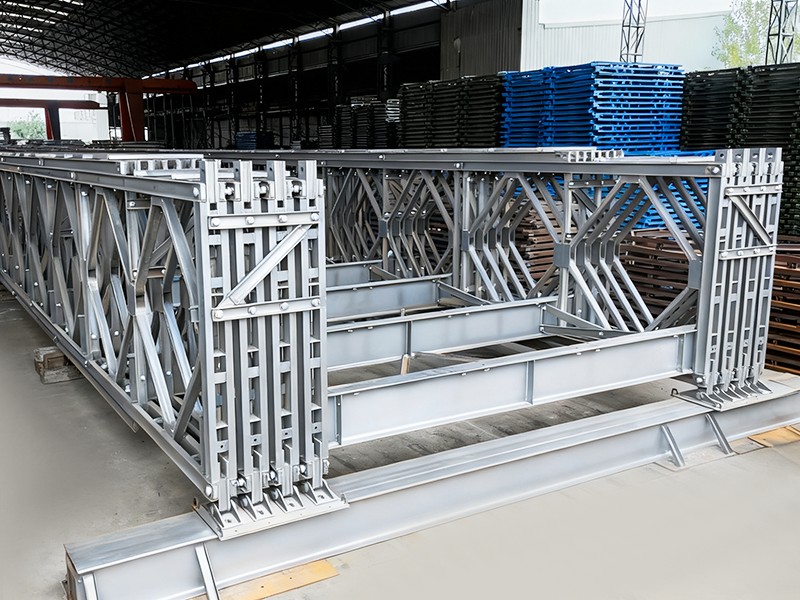 CB 450 Heavy-Duty Bailey Bridge for Long-Span LoadsEngineered for permanent or semi-permanent use, this steel bridge reaches spans up to 81 meters and carries up to 80 tons. It addresses large-scale transport and infrastructure needs where standard modular bridges may not meet span and load requirements.View Product →
Why a Bridge Needs an Engineered Load Rating Rather Than a Guess
No responsible decision about vehicle crossing should rely on the way a bridge "looks." A bridge can appear sound and still have hidden corrosion in the end bearings, cracked welds in the connections, or section loss in the bottom chord. In the United States, the National Bridge Inspection Standards generally call for inspection at least every 24 months, and the load rating is updated whenever the inspection reveals a change in condition (Source: Federal Highway Administration).
A proper rating combines the as-built drawings, material tests, member sizes, and the current loss of section into a calculation per member and per load case. If the rating is below the legal load, the bridge is posted. If a heavier load must cross, an engineer performs a permit review, which may allow a single controlled crossing at the operating rating with reduced speed, no other traffic, and specific lane positioning.
This is also where modular bridge experience shows its value. Standard panel bridges can be re-analyzed quickly because the components are known and replaceable; a damaged chord or end post can be swapped, and the rating can be restored. When a project requires a non-standard span, load, or site condition, a custom-engineered modular bridge is a practical route to get a documented capacity instead of adapting an unrelated structure.
 Customized Modular Steel Bridge Tailored to Site ConditionsThis service designs bridges around specific span, load, terrain, and climate requirements, using client-provided details to produce a stable structure. It is a practical route for non-standard crossings where off-the-shelf panels need documented capacity.View Product →
Frequently Asked Questions
How much weight can a regular highway bridge hold?
A bridge designed under HS20-44 is built to carry a design truck of 72,000 lb (about 32.6 t), plus additional lane loading in many cases. Modern bridges designed to HL-93 support an even higher combination of truck, tandem, and distributed lane load. In practice, rated capacities of individual bridges vary from about 20 tons for light structures to well over 100 tons for heavy-duty crossings.
What does a posted weight limit such as 10 tons mean?
A posted limit is the maximum gross vehicle weight that the bridge owner allows to cross. It is derived from the load rating and is lower than the rating in many cases to provide a comfortable margin for dynamic effects and ordinary traffic. Crossing a posted bridge at a slightly higher weight does not guarantee an immediate failure, but it is unsafe and accelerates fatigue and damage.
How is the weight limit of a bridge calculated?
Engineers take the actual member sizes and materials, apply dead and live load, include dynamic effects, and check each member using the AASHTO rating methods. The controlling member determines the bridge rating. The calculation is repeated for every load effect, including shear, bending, and stability, and then the bridge is posted if the rating falls below the legal load.
Can an 80,000 lb truck cross any bridge?
No. The federal gross weight limits apply to Interstate highways and many federal-aid routes, but each bridge still has its own rating. Many older or rural bridges have posted limits below 80,000 lb, which is why heavy trucks must plan routing based on bridge postings instead of assuming the legal road limit is available everywhere.
Are modular steel panel bridges strong enough for heavy trucks and construction equipment?
Yes, when the configuration is chosen correctly. Single-lane or utility crossings use lighter configurations, while double-row, triple-row, and multi-storey layouts handle heavy trucks and construction machinery. The capacity is always a function of span, configuration, deck, and condition, so suppliers provide a documented configuration instead of a single universal number.
How much stronger is a bridge than its rated weight?
Engineered bridges are generally designed with overall margins on the order of 1.5 to 2 times the nominal demand, and the operating rating itself is about 36 percent higher than the inventory rating under traditional AASHTO allowable-stress practice. The reserve should be treated as a safety margin for design uncertainties, not as free extra capacity for routine overloads.
Bottom Line
So, how much weight can a bridge hold? The honest answer is: as much as its verified load rating allows. That rating is a combination of design standards such as HS20-44 or HL-93, axle distribution rules like the federal bridge formula, the structure's condition, and the margin assumed for safety. For a temporary crossing or a new permanent structure, modular panel bridges provide a predictable way to match capacity to the actual vehicles: choose the truss configuration, verify the rating with an engineering check, and keep the structure inspected so the rating stays true over time.




We respond quickly to all international requests and provide technical support when needed.
Product Category
Bailey Bridge/Modular Bridge Modular Steel Bridge Pedestrian Bridge Modular Pipe Bridge Truss Bridge Steel StructureContact Us

+86-511-84522866
+86-13921582699

zhwm@zjql.com

Building 1,83#, dantu New Town, Yanjiang Road, Dantu District, Zhenjiang, Jiangsu, China
Copyright © Jiangsu Zhonghai Bridge Equipment Co., Ltd. All
Rights
Reserved
China bailey bridge for sale
bailey bridge supplier from china
