
 English
  русский
  Español
  Português

Industry News
Truss Bridges Explained: Types, Design, Load Capacity, and Selection Guide
Content
- 1 What Is a Truss Bridge and How Does It Work?
- 2 Primary Truss Types Compared: Pratt, Warren, Howe, and K
- 3 Deck, Through, and Pony Configurations: Which Layout Fits the Site?
- 4 Steel Grades and Coating Systems: Galvanized, Painted, or Weathering Steel?
- 5 Advantages and Limitations of Steel Truss Bridges
- 6 The Bailey Truss: The Modular Form of Truss Bridge Engineering
- 7 How to Select a Truss Bridge: Span, Load, Access, and Budget
- 8 Custom Large-Span Truss Bridges: When Standard Modules Need Modification
- 9 Frequently Asked Questions About Truss Bridges
- 9.1 What is the typical span range for a steel truss bridge?
- 9.2 How long does a galvanized truss bridge last?
- 9.3 What is the difference between a Pratt and a Warren truss?
- 9.4 Can a truss bridge be used as a temporary or emergency structure?
- 9.5 How much does a steel truss bridge cost compared with other types?
- 9.6 Which is better: a truss bridge or a beam bridge?
- 10 Final Recommendations for Your Truss Bridge Project
A truss bridge is the most material-efficient bridge form for medium and long spans, and for most project buyers the direct answer is simple: once your crossing exceeds roughly 20 meters, a steel truss bridge will almost always beat a plate girder on weight, cost, and erection speed. Britannica defines a truss bridge as a bridge whose load-bearing superstructure is composed of interconnected triangular units, and that geometry is exactly why these structures work so well. Four decisions determine the success of your project: the truss topology (Pratt, Warren, Howe, or K), the deck configuration (deck, through, or pony), the corrosion protection system (galvanized, painted, or weathering steel), and the supplier's ability to deliver modular prefabricated sections that fit your site. This guide explains each decision with engineering reasoning and the practical trade-offs that actually affect procurement, fabrication, and field assembly.
What Is a Truss Bridge and How Does It Work?
A truss bridge is characterized by the joining of numerous relatively small structural members into a series of interconnected triangles, a definition used by the North Carolina Department of Transportation (NCDOT) in its historic bridge reference. The triangle is the only geometric shape that will not deform when loaded, which allows a truss to convert bending forces into pure compression and tension along straight members. When a vehicle crosses, the top chord carries compression, the bottom chord carries tension, and the diagonal web members transmit shear between the two chords.
Because every member is loaded axially instead of in bending, steel in a truss can work very close to its full yield strength. In real terms, a 30-meter steel truss bridge can be roughly 25 to 40 percent lighter than a plate-girder alternative with the same load rating, depending on panel geometry and joint detailing. Less steel means smaller foundations, lighter cranes, fewer transport trucks, and a shorter installation window. That efficiency is why truss forms dominate not only permanent highway bridges but also temporary detours, emergency crossings, and military logistics bridges, where speed and low logistics demand matter as much as structural capacity.
Primary Truss Types Compared: Pratt, Warren, Howe, and K
Four configurations dominate steel truss design, and the difference between them is mainly the direction of the diagonal members. That direction determines which members are in tension and which are in compression, which in turn drives steel quantity, fabrication cost, and application range.
Pratt Truss
In a Pratt truss, vertical members are in compression and diagonal members are in tension. Since steel is extremely strong in tension and slender tension members carry no buckling risk, the Pratt is an efficient and predictable choice for highway and railway spans in the 20-to-50-meter range. Its popularity in historic American steel truss bridges has been documented by state transportation authorities, including the Tennessee Department of Transportation in its bridge history resources.
Warren Truss
The Warren truss uses a continuous series of equilateral triangles, so the diagonals alternate between tension and compression and no verticals are strictly required. With verticals added at panel points, the Warren is the most common layout in modular and Bailey-type steel fabrication because it uses the fewest individual members and therefore the least welding. For an identical span and load, a Warren design frequently uses 10 to 20 percent less steel than a Pratt, depending on panel proportions and connection detailing.
Howe Truss
The Howe truss reverses the Pratt pattern: diagonals are in compression and verticals are in tension. It was historically successful in timber and hybrid timber-steel bridges because wood performs well in compression. In an all-steel bridge the Howe is less efficient, since compression diagonals need larger cross-sections to avoid buckling, but it appears in rehabilitation projects and historic reconstruction where matching the original geometry matters.
K Truss
The K truss subdivides each panel into a K shape to shorten the unsupported length of compression members. It is used mainly on very deep through trusses with spans beyond 60 meters, where a conventional Warren or Pratt web would force oversized compression members and excessive steel weight.
| Truss Type | Typical Span | Diagonal Behavior | Best Suited For |
|---|---|---|---|
| Pratt | 20-50 m | Tension | Highway and railway bridges |
| Warren | 30-60 m | Alternates tension/compression | Modular steel bridges, long clear spans |
| Howe | 10-40 m | Compression | Historic rehabilitation, hybrid spans |
| K | 60-100 m | Subdivided alternating | Deep through trusses, heavy rail loads |
For buyers of modular and Bailey-style bridges, the Warren lattice is the pattern you will encounter most often. It packs maximum stiffness into the fewest prefabricated parts, which is exactly what a factory-made panel system needs.
Deck, Through, and Pony Configurations: Which Layout Fits the Site?
The same truss frame can be arranged three ways around the roadway, and this choice affects vertical clearance, maintenance access, and construction cost every bit as much as the truss type.
- Deck truss: traffic rides on top of the trusses, so the structure sits entirely below the deck and vertical clearance above the roadway is unlimited. This is the preferred layout for long river crossings and sites with tight under-clearance profiles. The trade-off is harder access for underside inspection and heavier foundations.
- Through truss: traffic runs between two trusses connected by top lateral bracing. The two sides brace each other, which is why the through configuration is so efficient for 30-to-70-meter spans. It requires enough height between the deck and the top bracing to fit the design vehicle envelope.
- Pony truss, also called half-through: the trusses rise above deck level but have no top bracing. This suits short and medium spans where overhead clearance is restricted, but the open top places greater demand on connection stiffness to resist lateral deformation.
For temporary and permanent modular steel bridges, the through configuration dominates because it makes the best use of standardized side panels with a prefabricated floor system. If your site has a hard height limit, start with the pony option and confirm the connection design with the supplier before going further.
Steel Grades and Coating Systems: Galvanized, Painted, or Weathering Steel?
The longest-term decision in any truss bridge purchase is not geometry but corrosion protection. A steel truss exposed to humidity, road salts, or coastal air will lose section thickness steadily if the coating fails. Three protection strategies are widely used, and the difference in life-cycle cost is substantial.
- Hot-dip galvanizing: the complete truss or its panels are dipped in molten zinc to produce a metallurgically bonded coating. As the American Galvanizers Association reports, a galvanized steel structure can remain maintenance-free for 50 to more than 70 years in typical rural and industrial environments. For modular bridges, galvanizing is the default because the zinc reaches joints and pockets that brush-applied paint cannot cover.
- Painted systems: a three-coat paint system gives predictable aesthetic control and touch-up repairability, with typical maintenance intervals of 15 to 25 years. Painted trusses suit urban and architectural settings, but surface preparation and coating inspection are critical to lifespan.
- Weathering steel: this alloy develops a stable oxide layer and needs no coating, which appeals to low-maintenance owners. It is unsuitable for marine, coastal, or persistently wet environments, and detailing must avoid water traps at connections.
The pragmatic rule: choose galvanized when the bridge is modular, site-erected, or located in a moist or de-iced environment; choose painted when architectural integration is the priority. Our large-span truss configurations are available in fully galvanized execution for projects where maintenance-free service life is the controlling requirement.
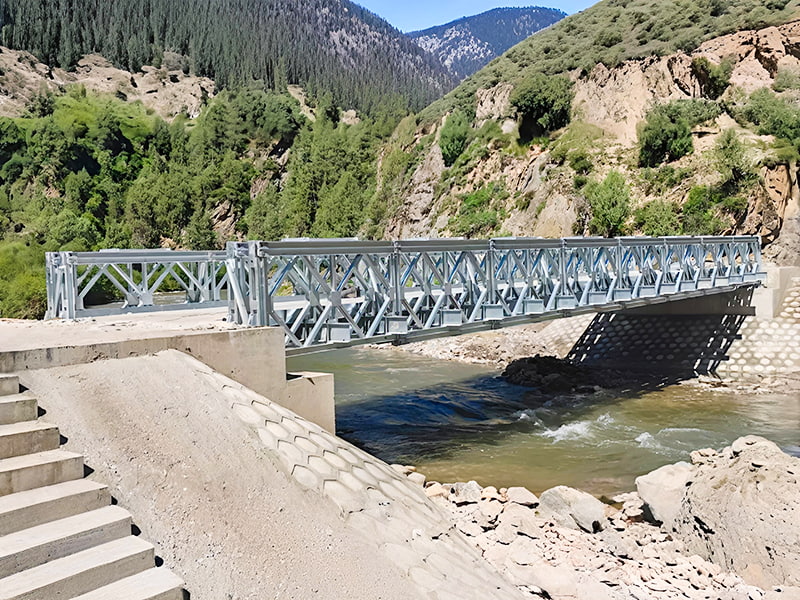
 Large Span Galvanized Steel Truss Bridge for Heavy LoadsThis galvanized truss bridge supports HS-15 to Track-50 loads and suits large-span sites. Its hot-dip coating resists corrosion and reduces maintenance, making it a practical choice where long service life matters.View Product →
Advantages and Limitations of Steel Truss Bridges
Procurement teams select steel trusses for a measurable set of reasons that are confirmed in industry references such as the Short Span Steel Bridge Alliance's construction guides. The main advantages are:
- Strong load-bearing capacity: axial member behavior lets steel work near its full yield strength, so trusses handle heavy axle loads and dynamic traffic efficiently.
- Effective use of materials: the triangular layout places steel only where forces act, giving trusses one of the best strength-to-weight ratios of any bridge form.
- Affordable construction: individual members are lighter than equivalent girder segments, which means smaller cranes, shallower foundations, and lower transport costs. Modular truss systems extend that saving into the field by replacing welding with bolted or pinned assembly.
- Versatile and adaptable design: spans can be lengthened or reinforced by adding panels, and the same truss family can serve single-lane, double-lane, pedestrian, and pipeline applications.
The limitations are equally well known: compared with a plate girder, a truss requires more fabricated joints, welded connections need careful fatigue detailing under repeated loading, and inspections must cover a higher number of members. These issues are manageable with modular fabrication and proper inspection access, which is why trusses remain dominant for long-span temporary structures and steel replacement bridges.
The Bailey Truss: The Modular Form of Truss Bridge Engineering
The Bailey truss is the most successful modular truss system in bridge history. It was designed by British engineer Donald Bailey in the early 1940s and adopted by the British Army in 1941, with thousands of Bailey bridges erected during World War II, according to Britannica. The core innovation is standardization: every panel is identical and connected by steel pins, so bridges can be assembled by hand crews without heavy cranes. The same logic still drives modern modular steel bridge supply.
Today the Bailey concept has been industrialized into the CB-100 (321 type), CB-200, and CB-450 series used in modular steel bridge production. A double-row, single-story, reinforced CB-100 panel bridge is a common single-lane specification in the 30-meter span class, while a four-row, double-story reinforced CB-200 unit belongs to substantially higher load classes. Because the panels are factory-made in high-strength steel, site work becomes mechanical assembly rather than welding, and the same panels can be reused on multiple projects.
If your project needs a rapid crossing, a disaster-recovery detour, or a temporary road diversion, a Bailey-type truss is usually the fastest and most economical solution. It is a classic truss taken to the logical conclusion of modularity. For a closer look at the CB-100, CB-200, and CB-450 families, see our modular Bailey bridge systems.
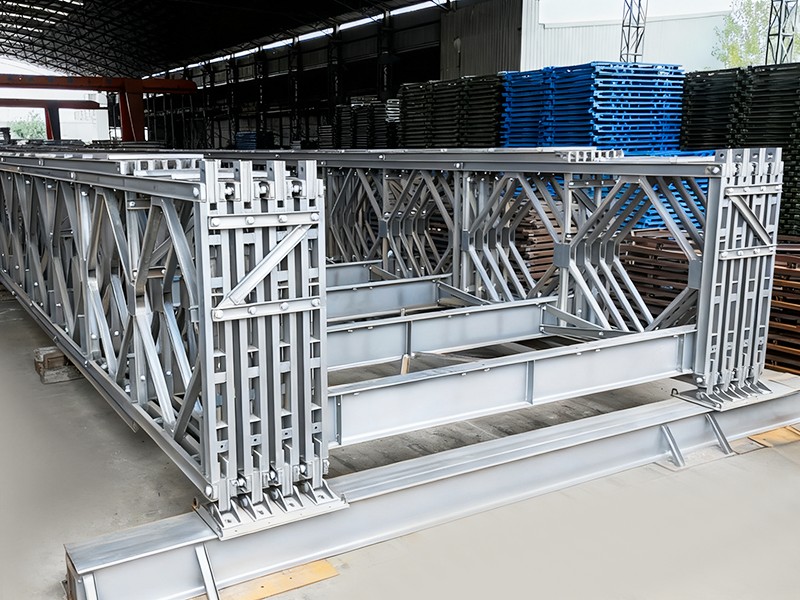
 CB100 Modular Galvanized Bailey Bridge with Interchangeable ComponentsA 321-type modular steel bridge with galvanized high-strength parts, the CB100 is designed for quick assembly and reuse. It meets multiple load standards and fits temporary crossings, emergency rescue, and coastal projects.View Product →
How to Select a Truss Bridge: Span, Load, Access, and Budget
You can reduce any truss bridge decision to five controllable parameters. Working through them in order prevents expensive surprises at site mobilization.
- Span and depth ratio: an economic steel through-truss uses a depth-to-span ratio of roughly 1:8 to 1:12. A 36-meter span therefore suits a truss depth of about 3 to 4.5 meters. If vertical clearance is tight, reduce the depth and plan for heavier chords.
- Load class: define the design vehicle before requesting quotes. Highway load classes such as HS-20 or the newer HL-93 envelope matter more than total tonnage, because axle spacing drives member forces in a truss. For remote or temporary routes, a 200-to-400 kN axle load class is a common starting point.
- Site access and erection: pin-connected modular trusses can be launched with winches and rollers; welded trusses require cranes at the site. If your site is off-road or restricted, the modular route is usually the only economical option.
- Deck system: a steel orthotropic deck keeps dead load low but adds fabrication cost; a reinforced concrete slab is cheaper and stiffer but adds significant weight that must be included in the truss design.
- Life-cycle coating: check your site's corrosivity category. If the location is near a coastline or exposed to de-icing salts, galvanizing or a high-performance paint system is mandatory, not optional.
When quotes arrive, compare these five parameters line by line. The lowest first cost is rarely the lowest installed cost once foundations, erection, coating, and future maintenance are included.
Custom Large-Span Truss Bridges: When Standard Modules Need Modification
When a project's geometry or loading falls outside standard product tables, the supplier's engineering capacity becomes the deciding factor. Custom steel truss bridges allow the designer to adjust the number of panels, truss depth, deck width, and coating specification to the project rather than the reverse. Typical custom requirements include clearance restrictions that force a nonstandard truss depth, mixed pedestrian and vehicular loading, skewed or curved spans, and foundation thrust limits that require a tied arrangement.
Custom fabrication is also the route for very large spans where standard modules would need too many intermediate piers. A customized large-span truss bridge is engineered panel by panel, using the same modular component philosophy but with strengthened chords and additional web members, so it remains shippable in containers and assemblable with the same pinned connections.
 Customized Large Span Truss Bridge with Galvanized Steel ConstructionEngineered panel by panel with strengthened chords and extra web members, this customized truss bridge enables larger spans while remaining shippable in containers. Its galvanized coating ensures durability across varied terrains.View Product →
Frequently Asked Questions About Truss Bridges
What is the typical span range for a steel truss bridge?
Steel trusses are economical from about 12 meters to well over 100 meters. Warren and Pratt designs cover most road bridges in the 15-to-60-meter range; deeper trusses with K or subdivided webs handle 60 to 120 meters. Modular Bailey-type trusses overlap the same range, with multi-story, multi-row configurations used at the longer end.
How long does a galvanized truss bridge last?
A hot-dip galvanized steel truss can remain maintenance-free for 50 to more than 70 years in typical rural and industrial environments, and coating life can exceed 75 years in dry inland sites, according to the American Galvanizers Association. Coastal salt exposure shortens the interval, so always verify the zinc coating specification against your site's corrosivity category.
What is the difference between a Pratt and a Warren truss?
The Pratt uses tension diagonals and compression verticals; the Warren uses a continuous series of triangles with diagonals alternating between tension and compression. Warren trusses use fewer members and generally less steel, while Pratt trusses are historically common in highway spans and remain a standard for rail applications. Both are produced in modern modular systems.
Can a truss bridge be used as a temporary or emergency structure?
Yes. Modular Bailey-type trusses are designed specifically for rapid deployment. Pin connections mean no welding on site, panels can be launched from one bank, and the same structure can be dismantled and relocated. Military and disaster-response agencies have used this system for decades precisely because of that relocation capability.
How much does a steel truss bridge cost compared with other types?
For medium spans, a steel truss is often the cheapest option per square meter of deck because it minimizes material. The decisive cost factors are steel grade, coating, and depth-to-span ratio. Below 12 meters a rolled beam bridge is usually simpler and cheaper; from 20 to 60 meters a truss becomes increasingly competitive, especially when modular prefabrication shortens site time.
Which is better: a truss bridge or a beam bridge?
For spans under 12 meters, a rolled beam is usually the most practical solution. Once the span passes 20 to 30 meters, a truss beats a plate girder on both weight and installed cost, particularly when modular panels can be delivered to a constrained site and assembled without heavy cranes. The beam is not worse; it is simply optimized for a different span range.
Final Recommendations for Your Truss Bridge Project
A truss bridge is a proven, data-driven solution for medium and long spans. Choose the Warren topology when modular economy matters most, the Pratt for classic highway or rail applications, and the K only for very heavy and deep structures. Select a deck configuration based on clearance, choose galvanized coating unless architecture demands paint, and for spans above 20 meters prefer modular prefabrication to keep site time short.
Before finalizing your specification, review the load capacity and specification guide in our technical library. It translates the engineering terms used here into practical span tables, panel counts, and load classes, so you can discuss your project with a fabricator in the same language. With the right truss topology, a realistic load envelope, and the correct coating system, a steel truss bridge will provide decades of reliable service, and a modular system will deliver it in weeks rather than months.

We respond quickly to all international requests and provide technical support when needed.
Product Category
Bailey Bridge/Modular Bridge Modular Steel Bridge Pedestrian Bridge Modular Pipe Bridge Truss Bridge Steel StructureContact Us

+86-511-84522866
+86-13921582699

zhwm@zjql.com

Building 1,83#, dantu New Town, Yanjiang Road, Dantu District, Zhenjiang, Jiangsu, China
Copyright © Jiangsu Zhonghai Bridge Equipment Co., Ltd. All
Rights
Reserved
China bailey bridge for sale
bailey bridge supplier from china
