
 English
  русский
  Español
  Português

Industry News
Hollow Steel Profiles: Types, Standards, Design Properties & Modular Bridge Applications
Content
- 1 What Are Hollow Steel Profiles? Types and Basic Shapes
- 2 How Hollow Steel Profiles Are Manufactured
- 3 Steel Grades and Standards That Matter
- 4 Section Properties That Drive Structural Design
- 5 Hollow Sections in Modular Steel Bridges and Heavy Structures
- 6 Design Considerations for Hollow Section Members
- 7 Corrosion Protection and Surface Treatment
- 8 Procurement Checklist for Project Engineers
- 9 Frequently Asked Questions About Hollow Steel Profiles
- 9.1 What is the difference between SHS, RHS, and CHS?
- 9.2 Are hollow sections cheaper or more expensive than I-sections?
- 9.3 Can a hollow steel profile be used as a bending beam?
- 9.4 What is cross-section class in hollow section design?
- 9.5 How thick should the wall of a hollow section be?
- 9.6 Does a hollow section need drainage holes?
- 9.7 Are hollow steel profiles suitable for modular bridges?
Hollow steel profiles, often called hollow structural sections (HSS) in North America and hollow sections in Europe, are closed cross-section steel members produced in square, rectangular, and circular shapes. They are found in bridge trusses, building columns, crane structures, transmission towers, temporary works, and modular steel bridges. The simplest way to see their advantage: a square hollow section of the same height and the same steel mass as a hot-rolled HEA or IPE column typically delivers a radius of gyration about 20 to 30 percent larger, which directly reduces buckling risk and raises the usable axial load capacity without adding steel. Those numbers come from openly published section property tables such as those used in Eurocode 3 design examples and standard mill catalogues. This article explains the real differences among square, rectangular, and circular hollow profiles, how the manufacturing route changes mechanical behaviour, which material standards apply, how to read section properties, how hollow sections are used in modular steel bridge products, how corrosion protection is specified, and what must be on a procurement checklist before you place an order.
The direct answer to the most common question is this: choose a square hollow section when you need predictable bending stiffness and clean connections, choose a rectangular hollow section when one direction dominates the load, choose a circular hollow section when loads can arrive from any direction, and always confirm the manufacturing route and material grade before comparing prices. The manufacturing route influences residual stress, toughness, and the buckling curve used in design, so it is not just a production detail.
What Are Hollow Steel Profiles? Types and Basic Shapes
Hollow steel profiles are formed from a flat steel strip or from a heated round billet into a closed cross-section with no free edges. The three standard families are square hollow sections (SHS), rectangular hollow sections (RHS), and circular hollow sections (CHS). Each family has a distinct load-bearing character, so the first step of any selection process is matching the cross-section shape to the dominant type of load.
| Family | Shape | Typical Size Range | Main Structural Uses |
|---|---|---|---|
| SHS | Square | 40 x 40 x 3 mm to 400 x 400 x 20 mm | Columns, moment frames, chords, bracing |
| RHS | Rectangular | 50 x 30 x 3 mm to 500 x 300 x 16 mm | Beams, columns, truss members, bridge girders |
| CHS | Circular | 21.3 x 3.2 mm to 610 x 16 mm outside diameter | Trusses, marine piles, space frames, tension members |
A hollow profile is designated by its family, outer dimension or dimensions, and wall thickness, for example SHS 150 x 150 x 8 or RHS 200 x 100 x 6.3. In European practice the manufacturing and tolerance requirements are given in EN 10210 for hot-finished sections and EN 10219 for cold-formed welded sections. In North American practice ASTM A500 is still the most common specification for welded carbon steel hollow structural sections, while ASTM A1085 is increasingly specified where tighter tolerances and consistent toughness are needed. In China, GB/T 6728 covers many cold-formed welded hollow sections. Knowing which standard your project will be checked against is as important as knowing the steel grade.
How Hollow Steel Profiles Are Manufactured
The manufacturing route changes the internal stress state, the location of the weld seam, the corner geometry, and the material behaviour under compression and fatigue. Two profiles with identical outer dimensions can behave differently if one is hot-finished and the other is cold-formed, so this is not a purely academic distinction.
- Hot-finished forming (EN 10210 route): the steel is heated above the recrystallization temperature, formed into a round or square shape, and finished at a temperature that relieves most of the forming stresses. The result is a more uniform microstructure, lower residual stress, and better toughness in the corners, which can improve the buckling performance of a column with the same nominal dimensions.
- Cold-forming from strip (EN 10219 or ASTM A500 route): a flat strip is cold-rolled into a round tube, closed by high-frequency induction welding, then tumble-rolled into square or rectangular shapes. Cold-forming increases the yield strength in the corners due to work hardening, but it also leaves higher residual stresses, and the design rules treat the section differently in buckling checks.
- Hot-forming after welding: some mills normalize or quench-and-temper the welded tube to restore ductility and consistency. This combines the lower cost of strip-based production with a more favourable internal stress state, but availability is more limited and lead times are longer.
For a bridge component that will carry repeated live loads, a hot-finished or normalized section is often the safer starting point because fatigue performance depends heavily on the weld seam and on stress concentrations in the corners. For temporary works, falsework, stages, and non-fatigue structures, a cold-formed section is usually adequate and more economical. The price difference between cold-formed and hot-finished sections of the same size is typically in the range of 5 to 10 percent depending on the market and wall thickness, but the performance difference in a fatigue-loaded joint can be much larger than that number.
Steel Grades and Standards That Matter
The table below summarizes the standards commonly used for hollow steel profiles and the material grade families attached to them. The most frequent engineering decision is between S235, S275, and S355 in Europe, and between ASTM A500 Grade B and Grade C in North America.
| Standard | Manufacturing Route | Grade Examples | Typical Project Context |
|---|---|---|---|
| EN 10210-1 | Hot-finished | S235JRH, S275J0H, S355J2H | Bridge members, fatigue-loaded structures |
| EN 10219-1 | Cold-formed welded | S235JRH, S275J0H, S355J2H | Building frames, racks, secondary members |
| ASTM A500 | Cold-formed welded | Grade A, B, C | General building structures, racks, columns |
| ASTM A1085 | Cold-formed welded | A1085 | Seismic frames, structures needing tight tolerances |
| GB/T 6728 | Cold-formed welded | Q235B, Q355B | General steel structures in China and export projects |
When comparing quotes from different mills, make sure the standard, grade, and impact requirement are written on the same line. A common mistake is comparing a cold-formed S275 profile with a hot-finished S355 profile on price alone. The cold-formed section may be cheaper per tonne, but the hot-finished section can allow a thinner wall and lighter member in a column design, which often makes the final fabricated structure cheaper when the cost is compared per meter of installed structure rather than per tonne of raw material.
Section Properties That Drive Structural Design
When you open a hollow section catalogue, the numbers that matter are not the outer dimensions alone. The properties below are the ones a structural engineer uses to check strength, stiffness, and stability. They should be compared only between sections of the same manufacturing route and material grade.
| Property | Symbol | Design Check It Affects |
|---|---|---|
| Cross-sectional area | A | Axial tension and compression resistance |
| Second moment of area | I | Bending stiffness and deflection |
| Elastic / plastic section modulus | Wel / Wpl | Bending resistance in the elastic or plastic range |
| Radius of gyration | i | Slenderness and buckling resistance |
| Torsional constant | It | Torsional stiffness and twist control |
The radius of gyration deserves special attention. For a fixed cross-sectional area, a square or circular hollow section spreads the material farther from the centroid than an open I-section of the same area, which raises the radius of gyration and lowers the slenderness ratio for a given member length. In plain terms, a hollow column can be longer or thinner than an open-section column before buckling governs the design. This is why hollow steel profiles dominate high-rise braced frames, lattice towers, and modular bridge systems that must be transported as large prefabricated components and erected with minimum site work.
Torsion is the second practical advantage. An open I-section distributes torsional stress inefficiently and often requires additional bracing or a closed box fabricated by welding plates together. A square or rectangular hollow section resists twist directly through its closed wall. For a bridge construction platform, a cantilever support frame, or any structure that receives wind from changing directions, this closed section behaviour reduces the amount of additional bracing steel needed.
Hollow Sections in Modular Steel Bridges and Heavy Structures
Modular steel bridges are a strong example of how hollow steel profiles are used in practice. A typical Bailey bridge or panel-type modular bridge relies on high-strength pin-connected truss panels for its main girders, but the surrounding structural system uses a large amount of hollow sections for transverse beams, lateral bracing, wind chords, parapets, handrails, and connection elements. The main truss members are often not hollow sections because they need to be pinned and standardized for rapid assembly. However, the secondary members and the entire supporting frame of a modular bridge are frequently made from SHS and RHS profiles because they resist the lateral forces and twisting moments that appear when heavy vehicles cross the bridge.
For the CB-100 series, the system uses standardized modular panels that can be assembled into single-lane, double-lane, and reinforced configurations. The through-girder design creates the classic truss profile, while the cross-bracing and vertical posts use closed sections to keep the wind drag lower and to avoid the local buckling that thin open channels suffer under repeated heavy loads. If you compare a modular bridge built with closed-section secondary bracing against an older design built with open channels, the closed-section version usually shows less out-of-plane vibration and requires less maintenance over time, mainly because there are no open edges where water and road salts accumulate.
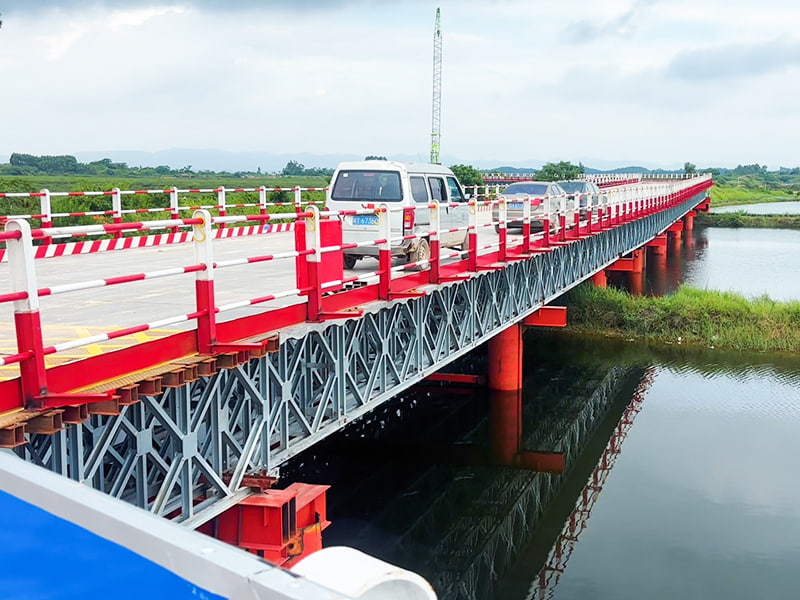
 CB 100 (321) Bailey Bridge Modular System SupplierThe CB 100 (321) Bailey Bridge combines standardized panels with closed-section cross-bracing to lower wind drag and out-of-plane vibration, making it a durable option for single-lane, double-lane, and reinforced temporary bridge layouts.View Product →
The relationship between hollow sections and modular bridges works in both directions. On one side, the bridge system itself uses closed profiles for its support structure and heavy-load members, which is why high-capacity modular bridges are measured not only by the truss depth but also by the closed-section cross-bracing and the load-spreading elements. On the other side, hollow steel profiles are the raw material for many prefabricated bridge components, including pedestrian bridges, pipeline support bridges, temporary ramps, and steel approach bridges. Where a bridge must be corrosion-resistant and easy to transport, the closed cross-section reduces the external surface area per unit of strength, so less paint or galvanizing is consumed for the same performance. For a review of how specifications and load data are handled in a standard modular bridge, the load capacity guide and the system comparison notes are useful starting points before you commit to a section size. For larger crossings, the CB-200 series increases the panel strength and allows longer spans, and the four-row reinforced versions show how modular systems combine the same hollow-section bracing principles with higher truss capacity.
Bailey bridge specification and load capacity guideIn larger bridge structures, hollow profiles carry the wind bracing of the lower deck and the upper lateral system. A rectangular hollow section is often used for the chord members of lattice girders because flat-sided profiles simplify welded connections. The design rules for lattice bridges treat the closed section more favourably than an open angle or channel when the member is subjected to compression plus bending in two directions. In some heavy bridge frames, concrete-filled circular hollow sections are used as columns, combining the high compressive resistance of concrete with the confining effect of the steel tube, which increases the concrete compressive strength under axial load by roughly 10 to 20 percent compared with the same concrete in an unreinforced column. That improvement is documented in international composite column design provisions.
Design Considerations for Hollow Section Members
Using a hollow section correctly means understanding four design areas: cross-section class, buckling curve choice, joint behaviour, and local load introduction. Getting any one of these wrong can turn an efficient hollow section into an unsafe one.
Cross-Section Class and Local Buckling
The wall thickness of a hollow section determines its cross-section class. A Class 1 section can develop a plastic hinge, a Class 2 section can reach its plastic moment, a Class 3 section reaches yield but not plastic moment, and a Class 4 section sees local buckling before the yield stress is reached, so an effective area or effective section modulus must be used. The boundaries are usually expressed as a limit on the width-to-thickness ratio of the flat wall. As a practical rule, a square hollow section with a wall thickness of about 5 percent of the outer dimension remains comfortably in the compact range for S355 steel. For a thin-walled rectangular section, the limiting flat width ratio is governed by the length of the longer flat wall, not the average of the two directions.
Buckling Curve and Manufacturing Route
The manufacturing route affects the buckling curve used in design. Hot-finished hollow sections generally qualify for a more favourable buckling curve than cold-formed sections of the same nominal strength, because the forming process changes the shape of the residual stress distribution and the corner yield strength. This difference matters most for medium-slenderness columns, where the buckling resistance is between 5 and 15 percent higher for the hot-finished member. In a long modular span, using hot-finished sections can reduce the required wall thickness just enough to lower both material cost and transport weight.
Joint Behaviour in Trusses
In a truss made of square or rectangular hollow sections, the joint capacity is usually governed by the chord wall punching shear rather than by the weld. A bracing member that arrives at a moderate angle creates an oval stress zone on the chord face. The design check must confirm that the chord face can carry the local force. In a circular hollow section the same issue appears with a more uniform stress flow, which is why CHS connections are sometimes easier to design for high axial loads, even though the cutting and fitting of round tubes costs more in fabrication. For modular bridge bracing made from hollow sections, using a recent connection design method leads to fewer gusset plates and simpler fabrication.
Local Load Introduction
A hollow section can be subjected to a large concentrated load from a bearing, a pin, or another member. The closed wall deforms locally when the load is introduced over too small an area. Where the bearing force is high, the section should be checked for local yielding and, if needed, reinforced with internal diaphragms or a thicker wall in the connection zone. This is exactly where the CB-450 and heavy-load systems show their advantage: the heavier closed-section members and reinforced panels are designed to accept the concentrated forces from a loaded truck axle or a crane live load.
When a hollow section is concrete-filled, both fire resistance and local bearing resistance improve significantly. The concrete core keeps the steel wall from buckling inward, and the steel tube confines the concrete, giving a composite column much higher axial capacity than the sum of its parts. Filled CHS columns are standard in high-rise construction and are becoming more common in heavy bridge piers and temporary support towers. In temporary bridge substructures, a concrete-filled hollow section can be reused after draining the concrete, although in practice the filled column is usually left in place because cutting the steel to remove the concrete is not economical.
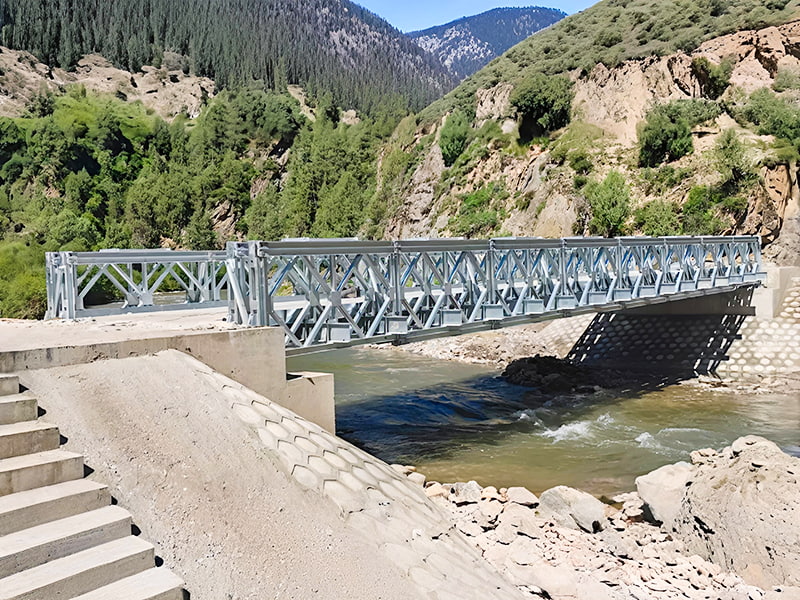
 CB 200 Bailey Bridge for Flexible Span CombinationsThe CB 200 Bailey Bridge adapts to spans from 21 to 60 meters through modular combinations, complies with GB, ANSI, and EN standards, and can be repeatedly dismantled for reuse, suiting emergency and semi-permanent bridge applications.View Product →
Corrosion Protection and Surface Treatment
A hollow steel profile will corrode from the outside and, if the ends are not sealed, from the inside as well. The most common protective system for outdoor bridges and heavy structures is hot-dip galvanizing, in which the fabricated member is cleaned, fluxed, and immersed in molten zinc. The zinc coating forms a metallurgically bonded layer that provides both barrier protection and cathodic protection at scratches and cut edges. According to the widely used ISO 1461 galvanizing specification, the minimum average coating thickness for steel thicker than 6 mm is about 85 micrometres, and a typical bridge member with 8 to 10 mm wall thickness receives between 85 and 115 micrometres of zinc coating. In marine environments, a duplex system of galvanizing plus a paint topcoat extends the maintenance interval to roughly two to three times that of paint alone.
There is a persistent debate about whether to galvanize before or after fabrication. For many hollow section structures, the correct answer is to galvanize after welding and drilling, because every cut edge, drilled hole, and weld seam becomes coated with zinc. If the section is galvanized before fabrication, the weld areas lose their zinc and need a thick zinc-rich paint repair. The hollow section also needs ventilation holes when it is galvanized: the internal and external pressures must equalize so that the hot gas inside does not force the zinc out or cause an explosion hazard. A common detail is two small holes near the ends of a closed section, positioned so that rain cannot enter and collect inside the tube.
For applications where galvanizing is not practical because of size, temperature, or cost, an alternative is a two-pack paint system with a zinc-rich primer. The surface must be prepared to a high standard, such as abrasive blasting to cleanliness Sa2.5 and a surface roughness of roughly 40 to 80 micrometres. The total paint system thickness for a C3 or C4 atmospheric environment is generally in the range of 160 to 240 micrometres, depending on the coating supplier and the expected service life. In highly corrosive environments such as coastal bridges or tunnels, weathering steel is another option, but welded closed sections made from weathering steel require careful attention to the weld filler metal and to water trap details, because trapped water causes the worst type of corrosion inside a closed profile.
For prefabricated bridge products, zinc-galvanized hollow sections are often the default. The galvanized finish protects the member during transport, site storage, and erection, which is exactly when bare steel suffers the most handling damage and rust staining. A factory-applied zinc coating also means that the site needs only touch-up paint at the bolted connections. The galvanized version of the modular bridge and customized galvanized bridge solutions demonstrate how closed stainless steel profiles or galvanized hollow sections can be combined into a full bridge package with a service life target of 50 years or more. One practical point: when a galvanized hollow section must be welded on site, the weld zone loses its zinc protection, so the area should be cleaned and re-coated with zinc-rich paint right after welding.
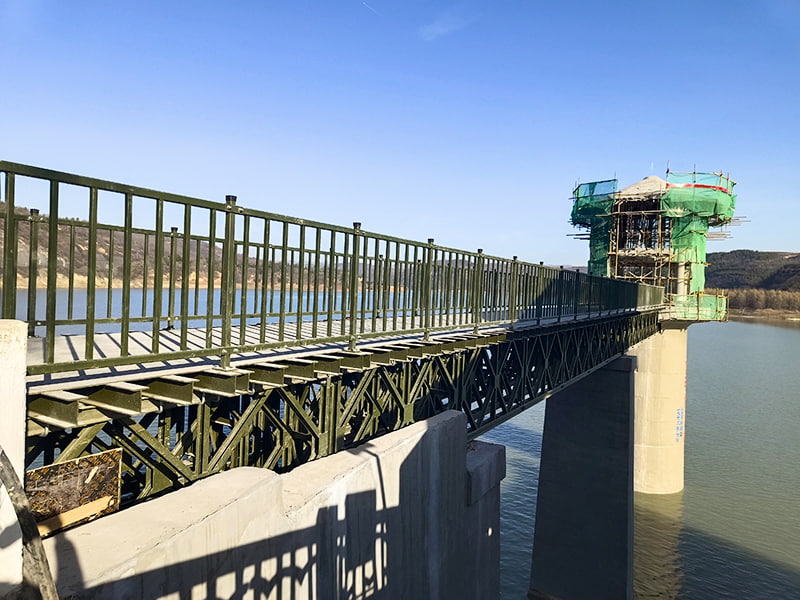
 Galvanized Customized Bailey Bridge for Site-Ready AssemblyThis hot-dip galvanized Bailey bridge is custom-designed and factory pre-assembled to simplify on-site erection, with corrosion-resistant coating that suits challenging natural environments and standardized components for reliable performance.View Product →
Procurement Checklist for Project Engineers
The most common procurement error with hollow steel profiles is ordering a standard mill product without fixing the details that control structural performance. The checklist below covers the points that should be written into any purchase specification for hollow steel sections.
- Confirm the manufacturing route first. Write whether hot-finished, cold-formed, or normalized is acceptable. Do not allow substitution without a design review.
- State the standard and grade exactly. For example, EN 10219 S355J2H, ASTM A500 Grade C, or GB/T 6728 Q355B. Check equivalent grades on the mill test document before acceptance.
- Fix the tolerances. Outer dimension, wall thickness, straightness, and section length all affect fabrication fit-up. A straightness deviation of 0.2 percent of the length is a common requirement for structural hollow sections, but high-tolerance projects may need 0.1 percent.
- Specify the surface preparation. For paint systems define the blasting standard and roughness. For galvanized members confirm the coating thickness requirement and whether the interior holes are needed.
- Define the fabrication scope. Determine whether the supplier cuts to length, prepares bevels, drills holes, and welds end plates. Each added operation changes the inspection plan and the cost.
- List the inspection requirements. For bridge components specify the weld class and the extent of non-destructive testing. A routine building structure may accept visual checks, while a pedestrian bridge or a heavy support frame may require ultrasonic or magnetic-particle examination of critical welds.
- Check the end sealing detail. Decide whether hollow sections need sealed ends or drainage holes. This small detail prevents internal corrosion and freeze-thaw damage in exposed structures.
- Compare quotations on the installed cost, not the per-tonne price. A slightly more expensive hot-finished S355 section may allow a smaller member, fewer stiffeners, and cheaper transport due to reduced weight.
In a bridge context, also confirm that the profile dimensions fit the modular system you are using. An external chord that is 5 mm too wide can disturb the connection geometry for the whole panel line. The safest approach is to select the hollow section sizes from the bridge system documentation, where the connection spacing and pin diameters are already fixed.
Frequently Asked Questions About Hollow Steel Profiles
What is the difference between SHS, RHS, and CHS?
SHS is a square profile with equal width and height, RHS is a rectangular profile with two different outer dimensions, and CHS is a circular profile. SHS is preferred for columns and moment connections, RHS is preferred for beams and members with a strong axis, and CHS is preferred for columns loaded from any direction, marine piles, and architectural exposed structures. The choice affects connection cost, bending efficiency, and torsional resistance.
Are hollow sections cheaper or more expensive than I-sections?
Hollow sections generally cost more per tonne than hot-rolled I-sections because the forming process consumes additional energy. However, for a column or a member loaded in two directions, a hollow section of the same capacity can weigh 10 to 30 percent less, so the total fabricated cost can be lower. The cost comparison must always be made on the installed member cost, including fabrication, transport, surface treatment, and connections.
Can a hollow steel profile be used as a bending beam?
Yes. A rectangular hollow section is a very good beam when the load is primarily in one direction, because the deep-section shape gives a high moment resistance and the closed wall gives torsional stability. Square and circular sections are also used as beams in lattice girders and frames, but their bending efficiency is lower than that of an equivalently wide RHS because the material is not as far from the neutral axis in the direction of bending.
What is cross-section class in hollow section design?
Cross-section class is a classification system that defines how far a member can go before local buckling appears in its walls. Class 1 allows plastic analysis and plastic hinges, Class 2 allows the plastic moment resistance, Class 3 allows only the elastic moment resistance, and Class 4 requires an effective area to be calculated. The class is determined mainly by the width-to-thickness ratio of the flat walls and the steel yield strength. In simple terms, the thicker the wall in proportion to the width, the higher the class and the more bending capacity can be used.
How thick should the wall of a hollow section be?
For a typical square column in a building, the wall thickness is often between 4 and 8 percent of the outer dimension. For a rectangular beam, the wall thickness is usually between 3 and 6 percent of the larger dimension. A thinner wall is permitted if the section is Class 3 or Class 4, but the design becomes less efficient due to reduced effective width. A wall thickness below 3 mm is rarely used in primary bridge structure because it is vulnerable to local damage and geometric imperfections during welding.
Does a hollow section need drainage holes?
Yes, if the section is exposed to weather. A sealed hollow section traps condensation and water that enters through broken seams or improperly sealed welds. Internal water causes corrosion from the inside and can split the tube when freezing occurs. Drainage holes of about 10 to 15 mm diameter at the low points allow water to escape while minimizing the loss of section area. When a hollow section is used as an externally exposed member with galvanizing, the ventilation holes are also needed during the galvanizing process itself.
Are hollow steel profiles suitable for modular bridges?
Yes. Modular panel bridges use closed profiles extensively for secondary members, bracing, parapets, and support frames. The high torsional resistance of a closed profile is valuable for resisting lateral wind loads and load eccentricities. In addition, closed sections reduce the surface area and therefore the coating cost, which matters in a large prefabricated bridge package. The main truss chords of a standard Bailey bridge are not hollow sections because the pin connection design is based on pressed steel panels, but the supporting elements and heavier load-bearing variants use closed profiles to achieve higher capacities. The guide to Bailey bridge load capacity explains how the system is matched to span and load requirements.
Hollow steel profiles are not a single product but a family of structural solutions that must be selected, specified, and protected with the same care as any other engineered component. The manufacturing route, the material grade, the wall thickness, and the surface treatment each influence the final capacity, durability, and installed cost. For a column, a rectangular or square hollow section gives better buckling resistance than an open section of the same mass. For a truss, hollow sections reduce wind area and simplify connections. For a bridge exposed to weather and repeated loads, galvanized closed sections resist corrosion and fatigue better than most open sections. When you specify a hollow steel profile, start with the design scenario, confirm the manufacturing route and grade, then compare on the installed cost per functional unit. That sequence produces consistent results for buildings, temporary works, heavy support structures, and modular bridges.




We respond quickly to all international requests and provide technical support when needed.
Product Category
Bailey Bridge/Modular Bridge Modular Steel Bridge Pedestrian Bridge Modular Pipe Bridge Truss Bridge Steel StructureContact Us

+86-511-84522866
+86-13921582699

zhwm@zjql.com

Building 1,83#, dantu New Town, Yanjiang Road, Dantu District, Zhenjiang, Jiangsu, China
Copyright © Jiangsu Zhonghai Bridge Equipment Co., Ltd. All
Rights
Reserved
China bailey bridge for sale
bailey bridge supplier from china
