
 English
  русский
  Español
  Português

Industry News
Portable Bridge Guide: Span, Load Capacity, Rental and Purchase Options
Content
- 1 What a Portable Bridge Really Is
- 2 Selecting the Right Span Length
- 3 Load Capacity and Safety Factors
- 4 Deck Width and Traffic Configuration
- 5 Materials and Coating: What to Ask For
- 6 Installation, Foundations, and Delivery
- 7 Rental vs Purchase: Cost and Risk
- 8 Portable Bridge Applications in Industry
- 9 Common Mistakes When Specifying a Portable Bridge
- 10 Custom Portable Bridge Solutions: When Standard Lengths Are Not Enough
- 11 Portable Bridge Frequently Asked Questions
- 11.1 How long does it take to install a portable bridge?
- 11.2 Can a portable bridge be moved and reused?
- 11.3 What is the difference between a portable bridge and a temporary bridge?
- 11.4 Can a portable bridge be used in a flood?
- 11.5 Can I refit a portable bridge for a longer span later?
- 11.6 How much maintenance does a portable bridge need?
- 11.7 What is the most common portable bridge size?
These prefabricated steel structures arrive in standard modules, so a crew can assemble a clear span in hours instead of weeks. The decision to use a portable bridge is usually driven by project duration, site constraints, or emergency response time. This guide covers the specifications that matter most, how to choose the right span and load rating, what causes cost overruns, and when custom engineered portable bridges are worth the investment.
What a Portable Bridge Really Is
A portable bridge is a modular steel structure built from prefabricated panels that are pinned together on site. The components are small enough to fit on a flatbed truck, and the same panels can be reconfigured for different spans, deck widths, and load capacities. In the construction and utility sectors, portable bridges are also called temporary bridges, prefabricated bridges, or modular bridges. The key difference from a permanent bridge is that a portable bridge can be disassembled and relocated after the project is finished.
The most common portable bridge type is the Bailey bridge system, developed for military use and now widely used in civil engineering. A Bailey bridge consists of a truss panel that is 10 to 15 feet long, 5 to 6 feet tall, and about 5 feet wide. These panels are arranged in rows and stories to create the required strength. A double-row single-story bridge can carry light vehicles, while a quadruple-row double-story bridge can support heavy trucks and even railway loads.
According to temporary bridge rental providers in North America, the most frequently rented portable bridge lengths are 30, 35, 40, and 50 feet. Longer custom spans are available from manufacturers that specialize in modular steel bridge systems.
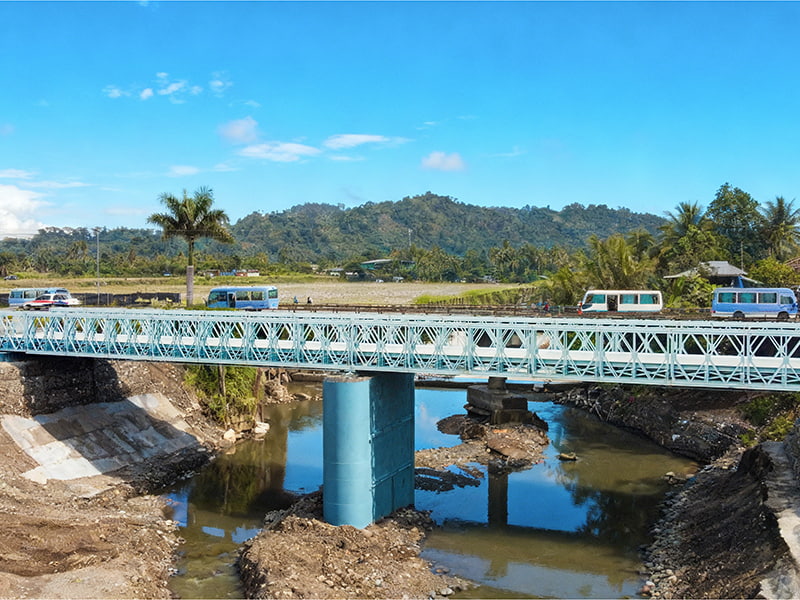 CB 200 Bailey Bridge for Flexible Span RequirementsThe CB 200 Bailey Bridge offers modular configurations for spans from 21 to 60 meters, making it a versatile option for emergency crossings and temporary access. Its design enables rapid assembly, ideal for sites needing adjustable clear span lengths.View Product →
Selecting the Right Span Length
The most important measurement is clear span, not total bridge length. Clear span is the unobstructed horizontal distance between the inner faces of the support structures. If you measure a 40-foot opening and order a 40-foot bridge, the bridge will not fit because the bearing length on each abutment is typically 8 to 12 inches. A bridge ordered for a 40-foot clear span should have a total length of 41.5 feet or more, depending on the connection details.
Standard portable bridge lengths are based on the panel dimensions. For a standard Bailey panel, which is about 10 feet long, a 40-foot bridge is made from four panels in a row. A 50-foot bridge is made from five panels. If you need a 27-meter span, the bridge will require a different number of panels and a reinforced configuration. The CB-200 series from Jiangsu Zhonghai Bridge Equipment, for example, is offered in 27-meter and 48-meter double-row single-layer reinforced configurations.
The following table shows example span ranges and the panel configurations that are commonly used across the portable bridge industry.
| Clear Span | Typical Use | Panel Configuration |
|---|---|---|
| 30 ft | Light vehicles, ATV, pedestrian access | Double row, single story |
| 40 ft | Construction site access, dump trucks | Double row, single story reinforced |
| 50 ft | Heavy utility crossings, loaded timber trucks | Triple row, single story reinforced |
| 27 m / 89 ft | Double lane highway access | Double row, single story reinforced |
| 48 m / 157 ft | Large river crossing or temporary detour | Four row, double story reinforced |
For a 27-meter span, a 27-meter bridge by name will not be suitable. The total length of the bridge must be greater than the clear span. When planning a site, always work with the supplier to confirm the exact total length and approach ramp requirements.
You can also use a portable bridge guide with more specifications on load capacity and uses from our library: Bailey bridge specifications and load capacity guide.
Load Capacity and Safety Factors
Load capacity is the second most misunderstood area. Many buyers assume that if a portable bridge can carry one loaded truck, it can carry two trucks at the same time. This is false. The critical factor is the axle load, not the total vehicle weight. A 30-ton truck with two axles places less stress on the bridge than a 20-ton loader with three closely spaced axles, because the concentrated loads are transmitted to the deck at different points.
In the temporary bridge industry, load ratings are frequently stated as HS-20 or HS-25. HS-20 represents a standard highway semi-tractor trailer with a gross weight of 72,000 lbs. HS-25 is a 25% heavier version. For construction machinery, the bridge must be specified for the heaviest axle, not the total load. For example, an articulated dump truck may have a front axle of 8 tons and a rear axle of 12 tons. This produces a higher bending moment at the mid-span than a standard highway trailer with two axles at 18,000 lbs each. A portable bridge rated for HS-20 may not be enough for a fully loaded cement mixer or a drilling rig.
Safe practice is to apply a dynamic factor of 1.3 to 1.5 for moving loads, and to check the panel pin shear, not just the bending moment. The pin connections are the weakest point in a modular portable bridge. When steel panels are pinned together, the pin must resist shear force. If the pin is undersized or made from low-grade steel, the bridge can fail even when the chords are capable of carrying the load. Always request the panel pin material grade and the maximum allowable shear force from the manufacturer.
For heavy-duty and large-span projects, the CB-450 series is designed for heavier axle loads and larger clear spans than standard CB-100 systems. The CB-450 four-row single-layer reinforced galvanized configuration is a typical choice when the project requires both capacity and corrosion protection.
 CB450 Galvanized Bailey Bridge for Large Spans and Heavy LoadsThe CB450 series features reinforced galvanized construction capable of single spans up to 81 meters and load capacities of 80 tons, meeting strict standards. It suits heavy-duty projects where the clear span exceeds typical portable bridge limits.View Product →
Deck Width and Traffic Configuration
Deck width determines how many lanes and what type of vehicles can use the bridge. For vehicle bridges, a 12-foot clear deck width is the minimum for a single lane of construction traffic. For two-way traffic, 22 feet is common. Many portable bridge systems are built from panels that are 5 feet wide, so a 12-foot deck requires at least two panels side by side plus edge protection. The load capacity is also affected by deck width. A wider bridge distributes the vehicle load over more panels and reduces the load on any single panel.
For temporary pedestrian access, a 48-inch clear walkway width is a standard choice for construction sites and utility maintenance. This width allows a single worker with a hand cart or equipment to pass safely. However, accessible routes for wheelchairs typically require 60 to 80 inches. Modular pedestrian portable bridges are often available with an anti-slip deck and handrails on both sides. Some models are designed to be carried and placed by a small crew without a crane.
When specifying a portable bridge, decide first whether the bridge will carry pedestrians, vehicles, or both. A pedestrian bridge with a 48-inch deck is not designed for a loaded pick-up truck. And a vehicle bridge with a 12-foot deck is too wide to use as a pedestrian walkway without extra barriers.
Materials and Coating: What to Ask For
The steel grade and coating determine how long the portable bridge will last. In Chinese standards, Q355B and Q460C are commonly used for Bailey bridge panels. In North American practice, an equivalent grade is ASTM A572 Grade 50. Higher-grade steel allows a lighter bridge with the same strength, which reduces transport and lifting costs. But high-grade steel also costs more per ton.
Coating system is a bigger factor in total lifecycle cost than steel grade. Hot-dip galvanizing is the most practical coating for portable bridges because it does not require repainting and it protects the steel through sacrificial action. A galvanized coating of 85 microns is common for bridge panels exposed to weather. Painted bridges are cheaper and can be matched to site aesthetics, but the paint film will need maintenance. A painted portable bridge in a humid coastal environment may require repainting every 5 to 10 years.
Corrosion-resistant coating, such as zinc-aluminum alloy coating, is used in marine environments or on bridges that will remain in place for more than 10 years. If the bridge will be stored in the open between projects, galvanized panels are the best choice because abrasion at the edges does not propagate rust as quickly as on painted steel.
To compare coating quality, ask for the zinc coating thickness, the surface preparation method (e.g., pickling or shot blasting), and the minimum coating thickness on threads and pins. The pins that connect the panels are the most vulnerable parts; they should be through-hardened and galvanized or zinc-plated to prevent seizure under load.
Installation, Foundations, and Delivery
One of the main selling points of a portable bridge is fast installation. With prepared abutments, a 40-foot portable bridge can be erected in 4 to 8 hours by a crew of 3 to 4 workers. The bridge is usually assembled on the bank or on a flatbed truck, then lifted into place with a crane. For longer spans, a cantilever launching method is used: the bridge is built on one side and rolled across the gap, supported by a launch nose that extends ahead of the bridge.
Site preparation often takes longer than the bridge erection. The abutments must be level and capable of supporting the concentrated loads and the bridge weight. A misalignment of more than 1/2 inch can cause the panel pins not to align, making installation difficult and creating damage to the panels. For temporary solutions, steel skid abutments, precast concrete blocks, and timber cribbing are common. These can be placed with a backhoe and removed after the project.
Delivery is a separate consideration. A 40-foot double-row portable bridge weighs approximately 8,000 to 12,000 lbs, depending on the panel configuration and deck. This is within the capacity of a standard flatbed truck. But the deck panels may be 10 feet wide, which can require an oversize load permit on some roads. Ask the supplier for transport dimensions, weight, and lifting point locations before scheduling. If you are renting, confirm whether the rental company provides delivery, installation, and removal or if the crew is responsible for all three.
Rental vs Purchase: Cost and Risk
The decision to rent or buy a portable bridge depends mainly on the project duration. If the bridge is needed for less than 6 months, rental is usually more cost-effective. Rental rates for a 40-foot portable bridge in the North American market run between $2,000 and $4,000 per month, depending on configuration, delivery distance, and whether the rental company supplies the abutments. A purchase price for a similar bridge is $35,000 to $80,000, because you pay for the steel, fabrication, coating, and engineering design.
But a purchased bridge has a residual value. If your company regularly needs temporary access channels, buying a portable bridge can pay for itself within 3 to 4 projects. The bridge can be stored, reconfigured, and reused on different sites. For a one-time emergency, rental is safer because you avoid storage, maintenance, and repair costs. Rental companies also handle the removal and the return inspection.
There are hidden costs in both options. With rental, you may be charged for damaged pins or bent panels. With purchase, you need to budget for storage, transport, and refurbishment. The most economical approach for a long-term project is to purchase a portable bridge from a manufacturer and then sell it after the project is completed, since the resale value of a galvanized modular bridge is still 50% to 60% of the original purchase price.
When comparing options, ask for the complete installed cost, including abutment preparation, crane rental, and steel approach ramps. The bridge itself is often less than half of the total project cost.
Portable Bridge Applications in Industry
Portable bridges play a different role in every sector.
- Construction: Portable bridges provide vehicle access over excavation pits, trenches, and water courses. They also support concrete pumps and heavy equipment crossing temporary road closures.
- Logging and forestry: Logging roads often cross streams and ravines. A galvanized portable bridge rated for loaded timber trucks replaces a conventional culvert and adds the benefit of being removable after the harvest.
- Utilities: Portable pipeline bridges support new pipe runs across rivers or existing rights of way. They also give maintenance crews access over buried cables and exposed utilities.
- Agriculture: Farm equipment needs to cross drainage ditches and irrigation channels. A 30- or 40-foot portable bridge with a 12-foot deck is enough for a tractor and a loaded trailer.
- Municipal projects: Temporary pedestrian bridges provide safe pedestrian routes around construction zones, street repairs, and route diversions.
- Emergency response: After floods, storms, or bridge failures, portable bridges restore the critical road connection in a few days. They are designed for rapid deployment and can be shipped by truck or even by helicopter in special rescue kits.
Each application has specific performance requirements. A logging bridge needs a 50-foot span with a 20-ton axle load. A pedestrian bridge needs a 48-inch clear width and anti-slip decking. A pipeline bridge must be designed for the weight of the pipe, the fluid inside, and the installation force, which can be significant when the pipe is attached to the bridge by welded brackets.
Because the same modular components can be reconfigured, one portable bridge can serve as a pedestrian walkway this month and a vehicle crossing next month, provided the deck and side barriers are changed. This is one of the strongest reasons to choose a standard modular system over a one-off custom welded bridge.
Common Mistakes When Specifying a Portable Bridge
The most common failure in a portable bridge project is measuring the wrong gap. You must measure the clear span between the inner faces of the abutments, not the width of the stream or the trench. It is common for a 40-foot gap to actually require a 43-foot bridge because of abutment bearing and connection details.
Under-specifying the load rating is also frequent. Many emergency responders order a passenger-grade bridge and then run a loaded dump truck across it. The result is excessive deflection, damaged deck panels, and potentially a failed bridge. Always list the heaviest vehicle that will use the bridge, including its axle weights, and give that list to the engineer.
Another mistake is ignoring the ground bearing capacity under the abutment. A portable bridge will sink if the soil is not compacted. The bridge is only as strong as the support. If the abutment settles by 1 inch, the load distribution changes and the bridge can become unsafe. A professional site evaluation should include a bearing test or at least a visual inspection of the soil type.
Many buyers also forget to plan for removal. A portable bridge that is bolted or welded to the abutments may be difficult to remove later. Use standard grout or steel skid abutments to keep the bridge re-usable.
Finally, dynamic loads are often ignored. Dust pans and graders hitting the bridge at speed can create forces more than 1.5 times their static weight. The safety factor must account for impact, braking forces, and potential side loads from wind or water.
Custom Portable Bridge Solutions: When Standard Lengths Are Not Enough
Standard portable bridge lengths are based on 10-foot or 15-foot panel modules. If your site requires a 27-meter span, a 48-meter span, or a deck width that is not available in stock, a custom portable bridge is the right answer. Custom engineering allows the bridge to match the exact abutment positions, which reduces site work and avoids expensive foundation changes.
Custom portable bridges are also used when the application has special loading conditions, such as a pipeline bridge that needs extra lateral bracing, or a construction platform that must support a crane and a concrete pump simultaneously. A custom bridge can include a curved deck, a wider clear walkway, or a lower profile for height-restricted sites.
At Jiangsu Zhonghai Bridge Equipment, custom portable bridges are built using the same CB-100, CB-200, and CB-450 panel systems. This means you still get the benefits of standardized components and future reconfiguration. For example, a custom CB-200 bridge can be designed for a 27-meter single span, while a standard CB-200 can still be ordered for a 48-meter double span. Customization starts with a structural calculation and fabrication drawings, and the lead time is usually 4 to 8 weeks longer than standard stock bridges.
If you have a non-standard site condition, request a design consultation before the price is fixed. A portable bridge is a structure, not a pile of steel, and the engineering cost is the best money you can spend.
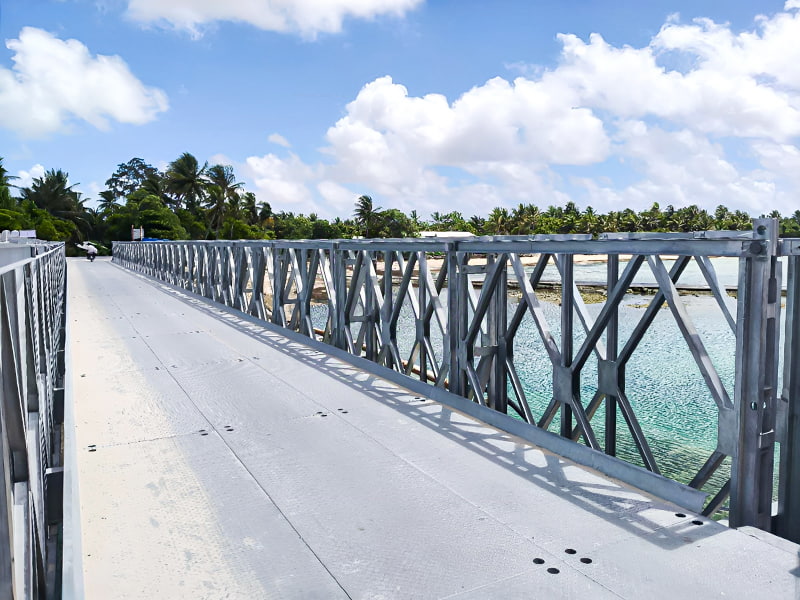 Customized CB200 Bailey Bridge with Hot-Dip GalvanizingThis CB200 bridge is customized for harsh high-humidity climates, using hot-dip galvanizing for corrosion resistance. Its standardized panels ensure easy assembly, making it a reliable choice for locations with specific environmental requirements.View Product →
Portable Bridge Frequently Asked Questions
How long does it take to install a portable bridge?
If the abutments are ready, a 40-foot portable bridge can be installed in 4 to 8 hours. If the abutments need to be constructed, the entire process usually takes 2 to 4 days depending on the site conditions.
Can a portable bridge be moved and reused?
Yes. The main design intent of a portable bridge is to be disassembled and relocated. The components are pinned together, so a properly maintained galvanized bridge can be reused many times across different sites.
What is the difference between a portable bridge and a temporary bridge?
Portable bridge is another name for a temporary bridge that is designed to be moved from one site to another. Some portable bridges are built for permanent service, but they can still be dismantled and rebuilt if needed.
Can a portable bridge be used in a flood?
Yes, if the bridge is secured and the abutments are placed above the expected water level. Fixed and floating steel portable bridges have both been used for flooded crossings. You should check that the deck is not submerged and that the substructure is protected from debris.
Can I refit a portable bridge for a longer span later?
If you use a standard modular system, you can usually add panels to create a longer span. However, the load capacity must be recalculated by an engineer. A longer span requires more rows, stronger reinforcement, or larger chord plates. A bridge that is designed for a 40-foot span cannot simply be extended to 60 feet without checking all components.
How much maintenance does a portable bridge need?
A galvanized portable bridge requires very little maintenance. Clean the deck, check the pin connections, and confirm the abutment level every few months. Painted bridges need repainting every 5 to 10 years depending on the environment.
What is the most common portable bridge size?
The 40-foot portable bridge is the most common size in rental fleets because it covers the typical construction gap, drainage ditch, or trench width. However, 30-foot and 50-foot lengths are also widely available. For larger permanent projects, custom lengths are common.

We respond quickly to all international requests and provide technical support when needed.
Product Category
Bailey Bridge/Modular Bridge Modular Steel Bridge Pedestrian Bridge Modular Pipe Bridge Truss Bridge Steel StructureContact Us

+86-511-84522866
+86-13921582699

zhwm@zjql.com

Building 1,83#, dantu New Town, Yanjiang Road, Dantu District, Zhenjiang, Jiangsu, China
Copyright © Jiangsu Zhonghai Bridge Equipment Co., Ltd. All
Rights
Reserved
China bailey bridge for sale
bailey bridge supplier from china
