
 English
  русский
  Español
  Português

Industry News
Clay Wade Bailey Bridge: Engineering, Maintenance, and Modular Alternatives
Content
- 1 Clay Wade Bailey Bridge: Facts and Engineering Context
- 2 Why the Clay Wade Bailey Bridge Needs Regular Maintenance
- 3 Modular Bailey Bridge Systems: Design Differences and Applications
- 4 Comparing Clay Wade Bailey Bridge and Modular Bridge Solutions
- 5 Selecting a Temporary Bridge During Clay Wade Bailey Bridge Closures
- 6 FAQ: Clay Wade Bailey Bridge and Bailey Bridge Systems
- 6.1 Q1: Is the Clay Wade Bailey Bridge a Bailey bridge?
- 6.2 Q2: Where is the Clay Wade Bailey Bridge located?
- 6.3 Q3: When was the Clay Wade Bailey Bridge built?
- 6.4 Q4: Why did the Clay Wade Bailey Bridge close in June 2025?
- 6.5 Q5: What is a modular Bailey bridge?
- 6.6 Q6: How long does it take to install a Bailey bridge?
- 6.7 Q7: Can a Bailey bridge be used for permanent applications?
- 6.8 Q8: What surface treatment is best for a bridge in the Cincinnati area?
- 6.9 Q9: Is the Clay Wade Bailey Bridge named after someone?
- 6.10 Q10: What is the difference between a cantilever bridge and a modular bridge?
- 7 Conclusion and Next Steps
The search term clay way bailey bridge most often points to the Clay Wade Bailey Bridge, a cantilever bridge that carries U.S. Route 42 and U.S. Route 127 across the Ohio River between Cincinnati, Ohio, and Covington, Kentucky. That bridge is not a modular Bailey bridge—it is a permanent, custom-engineered structure named after a person. The confusion is natural, but the distinction matters when you are planning infrastructure procurement, emergency detours, or permanent replacements. Here is the direct conclusion: if you need a temporary bypass, a construction access crossing, or a quick replacement for a damaged or closed bridge, modular Bailey bridge systems are the strongest option available.
Clay Wade Bailey Bridge: Facts and Engineering Context
The Clay Wade Bailey Bridge connects two cities across one of the busiest inland waterways in North America. According to the bridge's Wikipedia entry, it carries U.S. Route 42 and U.S. Route 127, connecting Cincinnati, Ohio and Covington, Kentucky (Wikipedia, 2025). The current steel superstructure opened in 1974, and it was built along the alignment of the original Chesapeake & Ohio Railway bridge, which was first constructed in 1889. The 1974 bridge still uses one of the original 1889 main span piers (Cincinnati Transit, 2025).
| Attribute | Detail |
|---|---|
| Location | Cincinnati, Ohio / Covington, Kentucky |
| Waterway | Ohio River |
| Routes carried | U.S. Route 42, U.S. Route 127 |
| Structure type | Cantilever bridge |
| Original C&O bridge | 1889 |
| Current structure opened | 1974 |
| Maintenance authority | Kentucky Transportation Cabinet |
Why cantilever design matters
A cantilever bridge works by extending structural arms outward from support towers, with suspended spans connecting the arm tips. This design minimizes the number of piers in the water, which improves navigation safety and reduces riverbed foundation work. But it also creates a structural system that must be monitored carefully over decades. Steel fatigue at the support towers and the expansion joints between the suspended and cantilevered sections are the primary inspection targets.
The reuse of the 1889 pier is another key insight: durable foundations outlive superstructures. When the current 1974 superstructure is evaluated in the future, the pier could potentially serve a third generation of bridges. This lifecycle thinking is exactly what modern modular bridge manufacturers incorporate into their products.
Why the Clay Wade Bailey Bridge Needs Regular Maintenance
Steel bridges deteriorate over time because of a combination of mechanical wear, chemical attack, and environmental exposure. For the Clay Wade Bailey Bridge, the most significant threats are as follows:
- Fatigue cracking from millions of load cycles as trucks and cars cross every day.
- Corrosion from road salts used in winter and humid conditions near the river.
- Bearing wear at the expansion points where the bridge moves with temperature changes.
- Expansion joint degradation because joints absorb constant traffic and thermal stresses.
- Paint system breakdown that leaves steel open to moisture and chloride attack.
The Kentucky Transportation Cabinet (KYTC) schedules regular inspections to monitor these conditions. In June 2025, the Cabinet published a bullet announcement for a 10-day closure starting Friday, June 13, 2025 at 8 p.m., with the bridge expected to reopen on Monday, June 23, 2025 at 5 a.m. The purpose of the closure was to install three modular joints (KYTC District 6, 2025).
However, during the joint installation, the contractor encountered additional repair requirements. The closure was extended to 13 days before it reopened to vehicle traffic (WCPO, 2025). Pedestrian access was maintained throughout. This kind of extension is not unusual in bridge repair projects, which is why contingency planning is essential for transportation agencies and contractors.
| Detail | Information |
|---|---|
| Project | Modular joint installation |
| Closure start | June 13, 2025, 8 p.m. |
| Original planned duration | 10 days |
| Actual duration | 13 days |
| Planned reopening | June 23, 2025, 5 a.m. |
| Pedestrian access | Maintained |
From an engineering procurement perspective, a 10-to-13-day closure creates a serious traffic problem in a dense urban corridor. Vehicles normally using the Clay Wade Bailey Bridge are diverted to other Ohio River crossings, adding congestion and travel time. A temporary modular Bailey bridge can be installed on a nearby alignment to keep traffic moving while the permanent bridge is repaired. This is exactly the kind of scenario where modular steel bridges deliver measurable value.
Modular Bailey Bridge Systems: Design Differences and Applications
A Bailey bridge is a pre-engineered modular steel truss bridge developed by the British military in 1941. The principle is simple: standardized panels are manufactured in a factory, transported to the site, and bolted together into a complete bridge. Because the panels follow strict modular dimensions, any two panels can mate with each other. This gives the system enormous flexibility in span length, load capacity, and width.
Core components
- Panels are the primary truss units that carry the load.
- Transoms are cross beams that support the bridge deck.
- Stringers are longitudinal members that distribute deck loads to the transoms.
- Pins connect the panels together and must be machined to close tolerances.
- Bearing plates transfer the bridge weight to the abutments.
- Reinforcing chords are bolted to the top or bottom of panels to increase load capacity.
In modern manufacturing, modular steel bridges are categorized into product series that allow engineers to select the correct configuration quickly. The three most common series are CB-100 (321 type), CB-200, and CB-450.
| Series | Common Configurations | Surface Finishes | Application Intent |
|---|---|---|---|
| CB-100 | Single/double/triple row | Galvanized, Painted | General-purpose construction |
| CB-200 | Double/four row | Galvanized, Painted | Medium-to-large spans |
| CB-450 | Four row reinforced | Galvanized | Heavy loads, large spans |
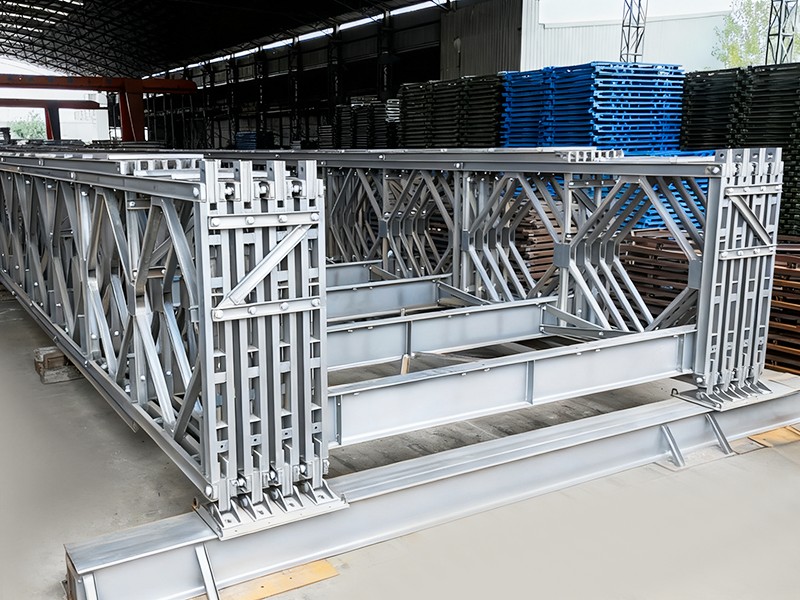
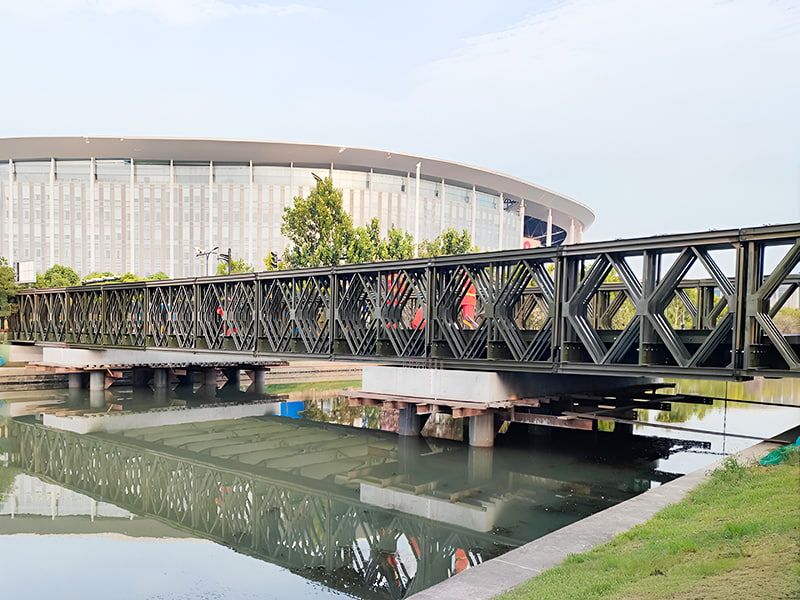 CB-100 Modular Steel Bridge Series for Standard SpansThe CB-100 series is the foundation of the modular bridge system, offering flexible configurations like double-row or triple-row single-layer panels. It is suitable for projects requiring standard span lengths and quick assembly, making it a practical choice for temporary or permanent crossings.View Product →
It is important to understand that these three series are not separate bridge types. They are all built from the same panel system. The CB-100 panels are the foundation, while the CB-200 and CB-450 configurations use more panels, deeper reinforcement, and additional truss lines. For example, a CB-200 bridge can be ordered in a 27-meter configuration or a 48-meter configuration, using the same panel type but different stacking arrangements.
Comparing Clay Wade Bailey Bridge and Modular Bridge Solutions
The Clay Wade Bailey Bridge and a modular Bailey bridge both use steel as their primary material, but that is where the similarity ends. The following comparison table helps you understand the practical differences.
| Comparison Point | Clay Wade Bailey Bridge | Modular Bailey Bridge |
|---|---|---|
| Structure type | Cantilever | Modular steel truss |
| Design approach | Custom-engineered | Standardized panel system |
| Construction time | Years | Days to weeks |
| Foundation requirement | Large piers and abutments | Lighter abutments |
| Relocatability | No | Yes |
| Reconfigurability | Not possible | Panels can be rearranged |
| Route capacity | Multiple lanes | Single or dual lane |
| Maintenance intensity | High, continuous | Moderate, panels can be replaced |
When should you use a modular bridge instead of a permanent cantilever design? The answers include:
- Temporary detours. A permanent bridge is closed for repair or inspection, and traffic must be kept moving on a nearby alignment.
- Construction access. Contractors need a temporary crossing to bring equipment and materials across a river or roadway during major works.
- Emergency response. A flood, earthquake, or accidental impact damages a bridge beyond use, and a rapid restoration is required.
- Remote and rural crossings. A permanent bridge is not financially justified, but a semi-permanent modular bridge can serve a remote community for many years.
- Utility and pipeline crossings. Water pipes, cables, and pipelines need to cross a waterway, and a modular bridge provides a structural platform.
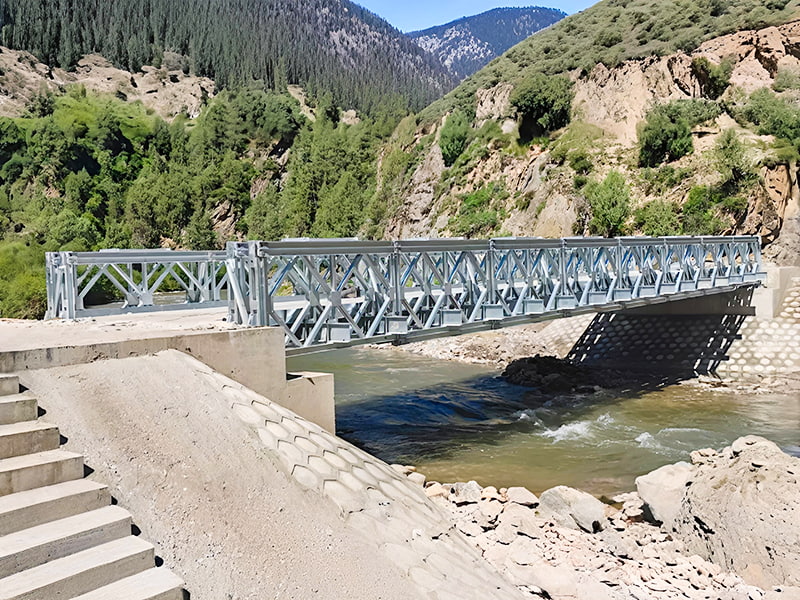
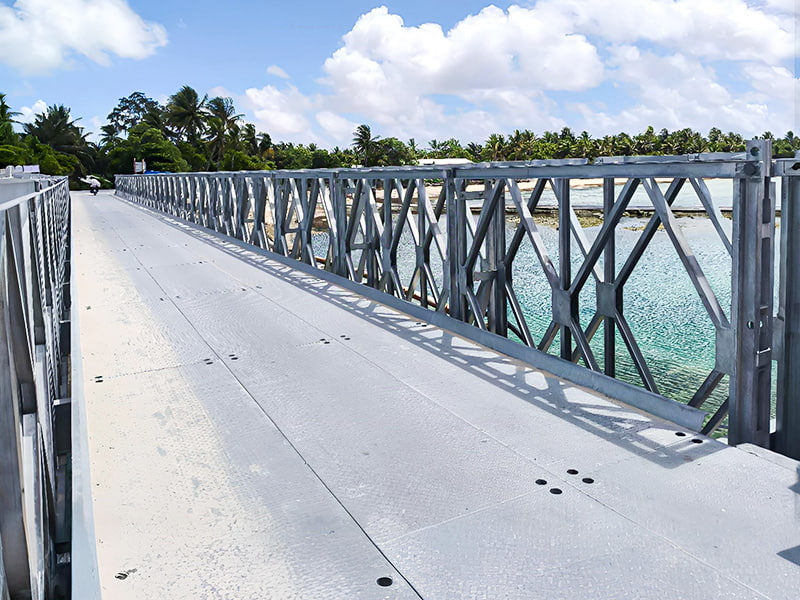
 CB-450 Large Span Heavy Load Galvanized Bailey BridgeDesigned for heavy-duty applications, the CB-450 features a four-lane single-layer reinforced structure with a maximum span of 81 meters and an 80-ton load capacity. Its hot-dip galvanized construction ensures durability, and it complies with multiple load standards, making it ideal for major infrastructure projects.View Product →
Selecting a Temporary Bridge During Clay Wade Bailey Bridge Closures
Planning around a closure like the June 2025 Clay Wade Bailey Bridge repair means you need a practical framework for selecting the right temporary bridge. Here are the critical decisions in order.
- Measure the span. Determine the clear distance between the two abutments. For a 27-meter gap, the CB-200 double-row single-layer reinforced configuration is a proven solution. For a 48-meter gap, a larger panel arrangement is required. The CB-200 series includes a 48-meter double-row single-layer reinforced bridge in the manufacturer catalog.
- Define the load class. You need to know the heaviest vehicles that will use the bridge during the temporary period. This includes standard trucks, construction equipment such as cranes and dump trucks, and emergency vehicles. The load class directly determines the number of panels and the need for reinforcing chords.
- Choose the surface treatment. In a climate like Cincinnati, with freeze-thaw cycles and frequent road salt application, a galvanized finish provides the best corrosion protection. Painted components require regular recoating. For more aggressive environments, corrosion-resistant options are available.
- Plan the installation sequence. The installation team needs site access for truck deliveries, crane capacity for panel assembly, a trained crew, and a load testing plan after assembly. A modular Bailey bridge can be assembled using a military-style launching nose or a mobile crane.
- Check transportation logistics. A good modular bridge can be shipped in standard shipping containers. Panels are nested to save space, and the complete bridge can arrive at the project site in manageable shipments. This is a major advantage for international projects.
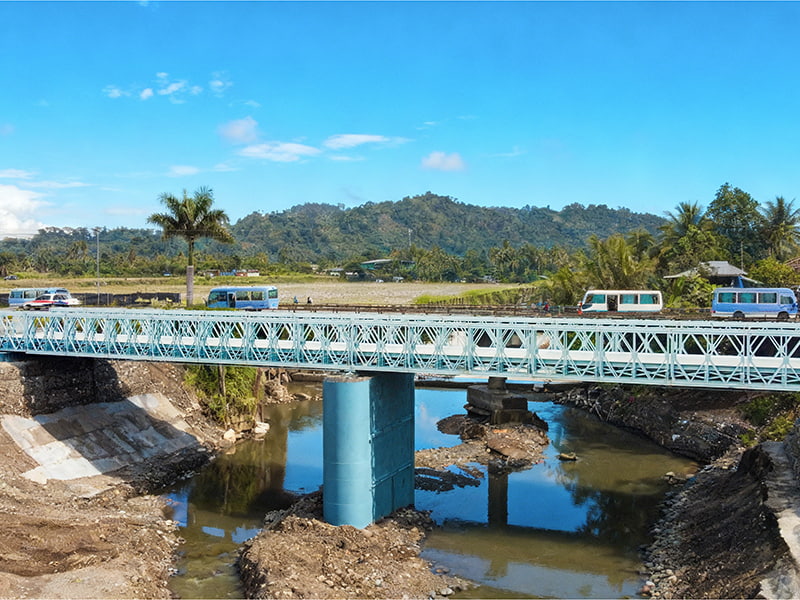
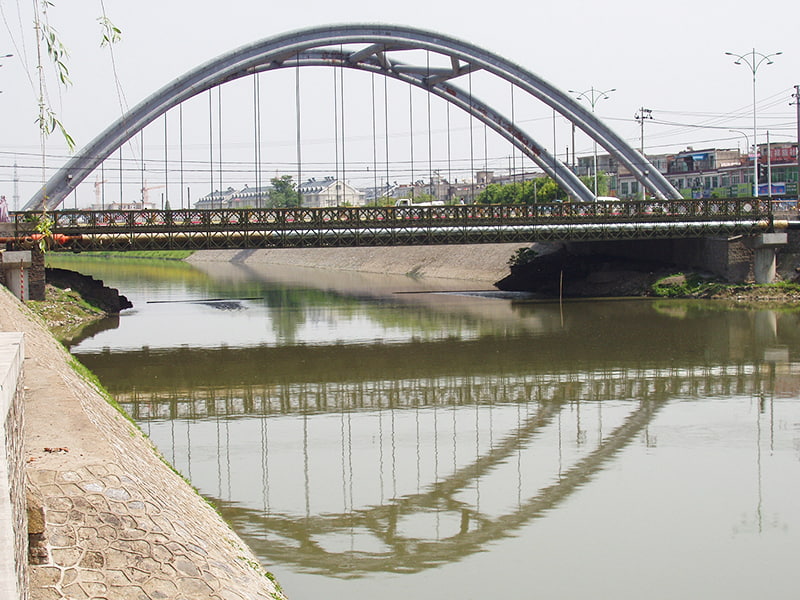
 CB-200 48-Meter Double-Row Single-Layer Reinforced BridgeA proven modular bridge solution from Papua New Guinea, this CB-200 configuration offers a 48-meter span with double-row single-layer reinforcement. It is galvanized for corrosion protection and meets international standards, providing reliable load-bearing capacity for various road vehicles in a cost-effective manner.View Product →
The procurement cost of a temporary bridge must be weighed against the economic cost of a long traffic detour. If a bridge closure adds 20 minutes of travel time for 10,000 vehicles per day over 13 days, the accumulated delay cost is considerable. A modular bridge may pay for itself with the first full traffic day. This is why engineers and transportation planners increasingly treat modular bridges as a standard operating tool, not an emergency-only device.
FAQ: Clay Wade Bailey Bridge and Bailey Bridge Systems
Here are the most common questions about the Clay Wade Bailey Bridge and its relationship to modular Bailey bridge systems.
Q1: Is the Clay Wade Bailey Bridge a Bailey bridge?
No. The Clay Wade Bailey Bridge is a cantilever bridge named after a person named Clay Wade Bailey. It has no engineering connection to the modular Bailey bridge system. The word Bailey appears in the name, but the structures are fundamentally different.
Q2: Where is the Clay Wade Bailey Bridge located?
It spans the Ohio River between Cincinnati, Ohio, and Covington, Kentucky. It carries U.S. Route 42 and U.S. Route 127.
Q3: When was the Clay Wade Bailey Bridge built?
The current steel superstructure opened in 1974. It reuses a main span pier from the original Chesapeake & Ohio Railway bridge constructed in 1889.
Q4: Why did the Clay Wade Bailey Bridge close in June 2025?
The Kentucky Transportation Cabinet closed the bridge to install three modular joints. The work began on June 13, 2025, and was extended from 10 to 13 days because crews found additional repair needs during the joint installation.
Q5: What is a modular Bailey bridge?
A modular Bailey bridge is a pre-engineered steel truss system made of standardized panels. It can be assembled quickly and configured to meet different span lengths and load requirements. The panels are produced in factories and locked together with steel pins.
Q6: How long does it take to install a Bailey bridge?
A single-span Bailey bridge can be erected in a few days to a few weeks. The actual time depends on the span length, panel configuration, site access, crane capacity, and the number of workers on site. Many military applications require an erection time of under 48 hours.
Q7: Can a Bailey bridge be used for permanent applications?
Yes. While modular bridges are commonly used as temporary bypasses, they can also serve as permanent crossings in remote areas. In this case, the bridge is fully galvanized, installed on good foundations, and designed for the intended service life.
Q8: What surface treatment is best for a bridge in the Cincinnati area?
Galvanized steel is strongly recommended. The Cincinnati area experiences freeze-thaw cycles and frequent road salt application. Galvanization creates a self-healing zinc layer that protects the steel from corrosion, even when the surface is scratched.
Q9: Is the Clay Wade Bailey Bridge named after someone?
Yes. The bridge is named after Clay Wade Bailey. It has no connection to the Bailey bridge design system developed in World War II.
Q10: What is the difference between a cantilever bridge and a modular bridge?
A cantilever bridge is a permanent structure with structural arms extending from support towers. A modular bridge is assembled from prefabricated panels and can be moved or reconfigured after initial installation.
Conclusion and Next Steps
The Clay Wade Bailey Bridge is a permanent cantilever structure that provides an essential crossing over the Ohio River. Its 2025 maintenance closure, originally scheduled for 10 days and extended to 13, illustrates how infrastructure repairs can disrupt traffic and why temporary bridge planning matters.
Modular Bailey bridge systems offer a proven alternative for temporary detours, construction access, emergency response, and permanent remote crossings. The right product depends on your span, load class, environmental conditions, and installation timeline. If you want to understand load capacities and configuration details, the Bailey Bridge Guide provides comprehensive specifications.
Take the time to review your requirements before making a procurement decision. With the right modular system, you can maintain traffic flow, reduce downtime, and deliver a bridge solution that is both reliable and cost-effective. The key is matching the bridge configuration to the actual crossing conditions, not the other way around.

We respond quickly to all international requests and provide technical support when needed.
Product Category
Bailey Bridge/Modular Bridge Modular Steel Bridge Pedestrian Bridge Modular Pipe Bridge Truss Bridge Steel StructureContact Us

+86-511-84522866
+86-13921582699

zhwm@zjql.com

Building 1,83#, dantu New Town, Yanjiang Road, Dantu District, Zhenjiang, Jiangsu, China
Copyright © Jiangsu Zhonghai Bridge Equipment Co., Ltd. All
Rights
Reserved
China bailey bridge for sale
bailey bridge supplier from china
