
 English
  русский
  Español
  Português

Industry News
Bailey Bridge Road Applications: Load Capacity, Selection & Installation Guide
Content
- 1 Why Bailey Bridges Are a Proven Choice for Road Engineering
- 2 Choosing the Right Bailey Bridge Series for Road Projects
- 3 Load Capacity and Span Requirements for Road Bridges
- 4 Surface Treatment and Corrosion Protection
- 5 Installation Process and Timeline
- 6 Procurement Considerations for Road Bailey Bridges
- 7 Frequently Asked Questions about Bailey Bridge Road Applications
- 7.1 How much traffic can a Bailey bridge carry?
- 7.2 How long does it take to install a Bailey bridge?
- 7.3 Can a Bailey bridge be used permanently?
- 7.4 What is the lifespan of a galvanized Bailey bridge?
- 7.5 Can Bailey bridges be reused in different locations?
- 7.6 What maintenance does a Bailey road bridge require?
A Bailey bridge is one of the most effective solutions for establishing a road crossing, whether you need a temporary detour, a permanent small-to-medium span bridge, or a heavy-load bypass. The real question is not “can it handle road traffic?” but “which panel configuration matches my traffic volume, span length, and load class?” Getting that answer right saves weeks of construction time and avoids costly over-engineering.
The Bailey system has proven itself in military and civilian road applications for more than 80 years. Its modular truss panels are standardized, interchangeable, and require no welding. This means a small crew with basic hand tools can assemble a road-ready bridge in days, not months. For road engineers, project managers, and contractors, the Bailey bridge is a practical, field-tested answer to crossing challenges.
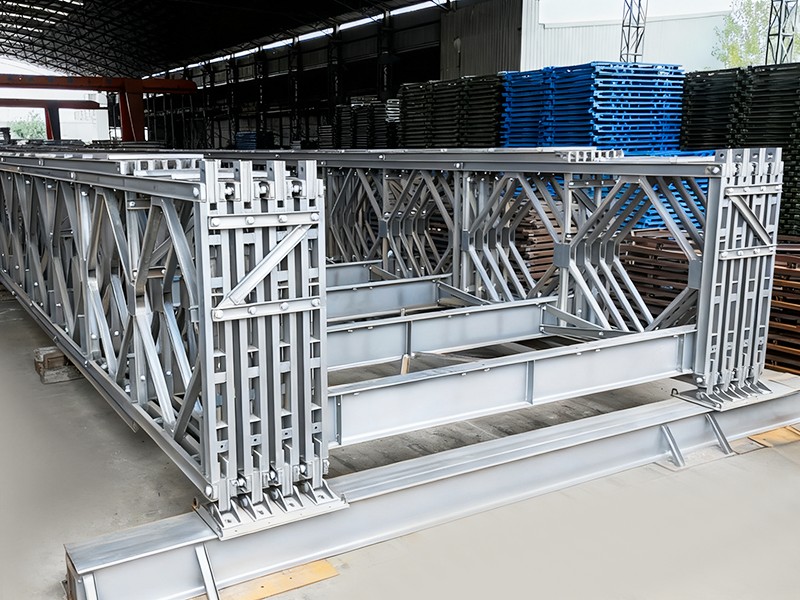
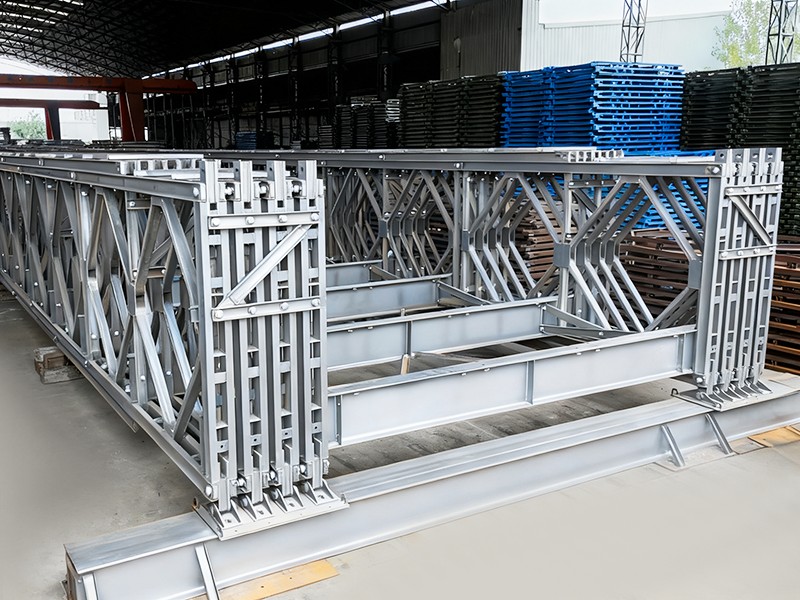
 CB 100 Bailey Bridge Double-Row Single-Layer Reinforced GalvanizedThis modular steel bridge uses standardized panels with pin connections, enabling rapid assembly without welding. Its hot-dip galvanized finish ensures corrosion resistance and long-term durability, suitable for temporary or permanent crossings.View Product →
Why Bailey Bridges Are a Proven Choice for Road Engineering
The Bailey bridge was developed in 1940–1941 by Sir Donald Bailey for the British Army. It was designed to be portable, pre-fabricated, and strong enough to carry tanks and artillery. After the war, the design found wide application in civilian infrastructure because it could be rapidly installed and reused across multiple sites.
For road construction, the benefits are straightforward:
- Standardized components — every panel, pin, and bracket follows the same design language, allowing on-site assembly without custom fabrication.
- No heavy cranes needed — the bridge can be assembled on the ground and launched across a gap using the cantilever method, which reduces the need for large equipment.
- Rapid deployment — a 30-meter double-lane bridge can be installed in 7 to 14 days with a crew of 8 to 10 people.
- Reusable and relocatable — after a temporary project is complete, the panels can be dismantled and moved to a new location, significantly lowering the overall cost of a construction program.
- Interchangeable panels — the same spider-like panels from a CB-100 series can be combined into a CB-200 or even a CB-450 configuration by adding rows and layers.
These design characteristics are why government agencies and contractors across the world turn to Bailey systems for road projects including temporary detours, bridge replacements, emergency repairs, and semi-permanent crossings.
A key technical advantage is the ability to scale the bridge to the specific road requirement. Single-row configurations suit footpaths and light loads; triple-row and four-row configurations carry heavy trucks. The full engineering background of these systems is explored in the engineering versatility of the Bailey bridge.
Choosing the Right Bailey Bridge Series for Road Projects
Bailey bridge manufacturers classify their products into series based on panel height and load capacity. The three are the CB-100 (321-type), CB-200, and CB-450. Each has a defined envelope for span length, traffic loading, and structural depth.
CB-100 (321-Type)
The CB-100 is the lightest and most widely used series. Its panel height is approximately 1.5 meters. In a road context, the CB-100 can carry two lanes of light-to-medium traffic, including passenger vehicles, municipal service trucks, and standard freight vehicles.
Common configurations include double-row single-layer (DS), triple-row single-layer (TS), and reinforced variants. A typical span range starts at 9 meters and can extend to 45 meters with the correct reinforcement. For example, a CB-100 double-row single-layer reinforced galvanized bridge is well suited to a 24-meter single-lane road span.
CB 100 Bailey Bridge Double-Row Single-Layer Reinforced GalvanizedThis modular steel bridge uses standardized panels with pin connections, enabling rapid assembly without welding. Its hot-dip galvanized finish ensures corrosion resistance and long-term durability, suitable for temporary or permanent crossings.View Product →
CB-200
The CB-200 is the workhorse for heavier road loads. With a panel height of roughly 2.1 meters, it handles larger spans and heavier truck traffic without the need for excessive bracing. Configurations such as double-row single-layer and four-row double-layer allow spans up to 70 meters.
A 48-meter double-row single-layer reinforced CB-200 is a common choice for a two-lane permanent road bridge. The four-row double-layer CB-200 can be used where heavy articulated trucks and construction machinery operate frequently.
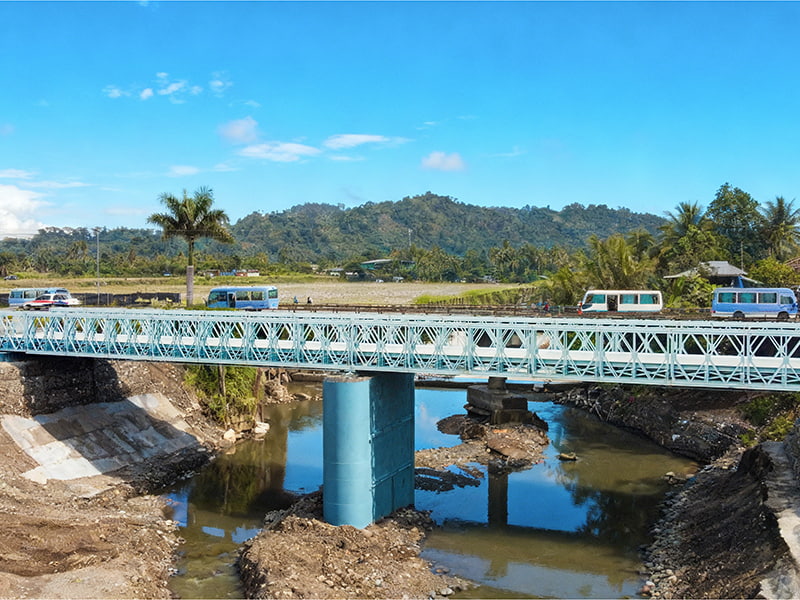
 CB 200 Bailey Bridge 48-Meter Double-Row Single-Layer ReinforcedDesigned for a 48-meter span, this reinforced Bailey bridge supports two-lane traffic. Its prefabricated panels and galvanized coating provide reliability in remote or challenging environments, as demonstrated in Papua New Guinea.View Product →
CB-450
The CB-450 is the heavy-duty class. Its taller panels provide significant stiffness, making it the preferred solution for large-span road crossings, military convoy bridges, and industrial haul roads. A well-designed CB-450 can reach 100 meters or more when combined with reinforcement.
For a road project that needs to cross a wide river or a deep valley, the CB-450 offers the highest single-span capability without investing in permanent steel girder fabrication.
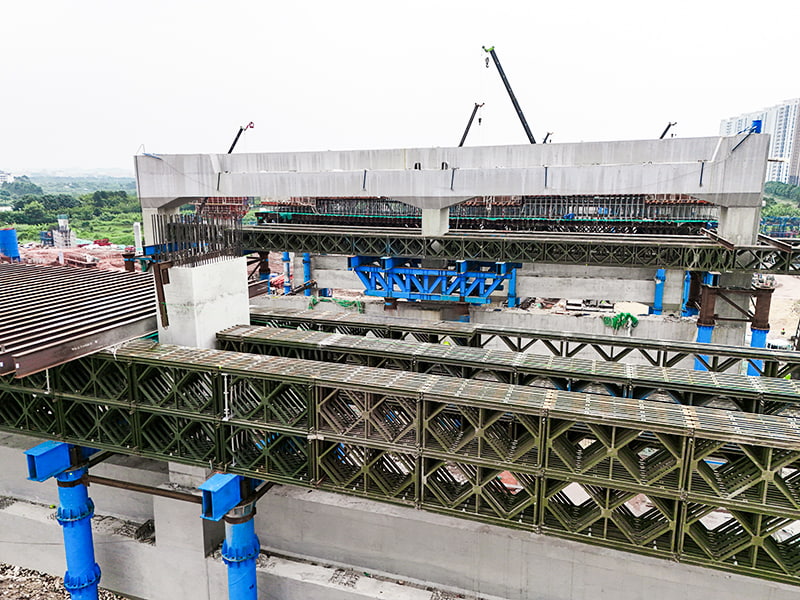
 CB 450 Large Span Heavy Load Galvanized Bailey BridgeFor wide river crossings, the CB450 offers an 81-meter maximum single span and an 80-ton load capacity. Its four-lane reinforced structure meets diverse load standards, making it ideal for heavy-duty road projects without permanent fabrication.View Product →
| Feature | CB-100 (321-Type) | CB-200 | CB-450 |
|---|---|---|---|
| Panel height | 1.5 m | 2.1 m | 2.5 m+ |
| Typical span | 9–45 m | 30–70 m | 45–100 m+ |
| Lane capacity | 1 lane | 1–2 lanes | 2 lanes |
| Load class | Light to medium | Medium to heavy | Heavy to super-heavy |
| Typical traffic | Cars, municipal trucks | Freight, buses | Heavy trucks, convoys |
Selecting the right series requires a two-step analysis. First, calculate the maximum span. Second, match the design load class. A mismatch between these two will result in excessive deflection, overstressed panels, or an unnecessarily expensive bridge. The full selection methodology is explained in the Bailey bridge guide to specs and load capacity.
Load Capacity and Span Requirements for Road Bridges
A road bridge's primary function is to carry traffic safely over an obstacle. For Bailey bridges, the load capacity is determined by the number of rows, the number of layers, whether reinforcement is installed, and the panel height of the series. The span also affects load capacity—longer spans reduce the effective safe load unless additional truss panels are added.
Common design load classes for road applications are:
- HS-20 — a 20-ton truck load per lane, typical for municipal roads and rural highways.
- HS-25 — a 25-ton truck load per lane, common for trunk roads and arterial routes.
- Militarized load classes — 60 to 80 tons for tracked vehicles, used in defense bridging.
- Construction load — 40 to 50 tons for dump trucks and concrete mixers.
The geometry of the road deck is equally critical. A two-lane road bridge has a deck width of 7.2 to 7.5 meters; a single-lane bridge is usually 4.2 to 4.5 meters. Wider decks require more transverse bracing and in some configurations a parallel truss arrangement.
Here is a practical set of configuration snapshots:
| Scenario | Span | Load Class | Recommended Configuration |
|---|---|---|---|
| Temporary road detour | 15 m | HS-20 | CB-100 DS reinforced |
| Permanent rural crossing | 24 m | HS-20 | CB-100 TS reinforced |
| Highway slip road | 40 m | HS-25 | CB-200 DS reinforced |
| Heavy haul road | 60 m | 60 tons | CB-450 four-row reinforced |
These examples illustrate an important rule: span length is the dominant variable. As span increases, the same configuration will carry less weight. Always confirm the final design with the manufacturer's engineering team before ordering.
Surface Treatment and Corrosion Protection
Road bridges are exposed to a constant cycle of moisture, de-icing salts, freeze-thaw conditions, and ultraviolet radiation. The surface protection on a Bailey bridge is not a cosmetic add-on—it is a life-cycle decision that directly affects maintenance frequency and service life.
Hot-Dip Galvanizing
Hot-dip galvanizing is the predominant protection for permanent road bridges. The panels are dipped in molten zinc, creating a metallurgical bond that resists corrosion even when scratched. In most environments, a hot-dip galvanized Bailey bridge can achieve 50 to 70 years of service life before recoating is needed.
For road authorities, the initial higher cost of galvanizing is paid back through dramatically lower maintenance costs over the bridge's life.
Painted Systems
Painted systems are lighter and less expensive than galvanizing. They are a sound choice for temporary installations where the bridge will be dismantled and moved. A typical painted system lasts 10 to 20 years before requiring recoating, depending on the paint type and climate.
Municipalities often choose painted systems if the bridge is intended for a short-term detour or for staged construction.
Anti-Corrosion Coatings
For coastal areas, industrial zones, and high-humidity environments, anti-corrosion coatings provide an additional layer of protection. These systems deliver 15 to 25 years of performance in severe conditions and are often used in combination with galvanizing.
| Treatment | Service Life | Best Fit | Cost Trend |
|---|---|---|---|
| Hot-dip galvanizing | 50–70 years | Permanent crossings | Highest upfront |
| Painted system | 10–20 years | Temporary / relocatable | Lower upfront |
| Anti-corrosion coating | 15–25 years | Coastal / industrial | Moderate |
Installation Process and Timeline
The installation of a Bailey bridge is a carefully staged process that relies on the modular nature of the system. The method is proven: the entire bridge structure is assembled on one side of the gap, then gradually launched across the span.
Standard Installation Sequence
- Site preparation — clear the area, grade the abutments, and pour concrete seating strips for the bridge to rest on.
- Assembly on the ground — connect the panels into a full truss structure next to the gap. The deck is added layer by layer.
- Launching — the assembled bridge is rolled or pushed across the span using rollers, a launching nose, and sometimes a counterweight.
- Seating — the bridge is lowered onto the far abutment and secured.
- Deck installation — the road surface, curbs, rails, and any pedestrian handrails are installed.
- Load testing — the bridge is verified for structural integrity before the road is opened to traffic.
The timeline is highly favorable. A 30-meter double-lane CB-200 bridge can be installed in 7 to 14 days with a crew of 8 to 10 people and a mobile crane for panel positioning. For comparison, a conventional reinforced concrete bridge of the same span requires:
| Construction Stage | Bailey Bridge | Concrete Bridge |
|---|---|---|
| Foundation | 2–3 days | 8–12 weeks |
| Superstructure | 3–5 days | 20–30 weeks |
| Curing and testing | 1–3 days | 4–6 weeks |
| Total | 7–14 days | 32–48 weeks |
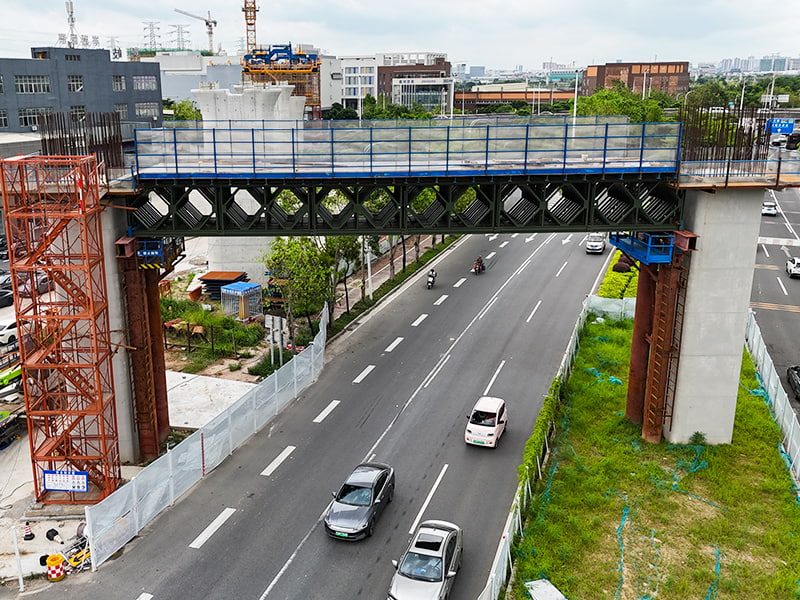
Because the Bailey bridge can be installed quickly, it is often the preferred option for widening existing roads, creating temporary bypasses, and responding to storm-damaged infrastructure.
Procurement Considerations for Road Bailey Bridges
When you are buying a Bailey bridge for a road project, the procurement decision should be based on engineering requirements, not just the price per ton. Here is a direct checklist of what factors matter most:
- Traffic volume and composition — annual average daily traffic (AADT), percentage of heavy goods vehicles, and axle load distribution.
- Span between abutments — measured center-to-center, including any allowances for future road widening.
- Road deck width — determine whether the bridge needs to accommodate one or two lanes of traffic, plus pedestrian paths.
- Local climate and exposure — heavily salted roads, coastal environments, and high rainfall all influence the choice of surface treatment.
- Assembly resources — how many crew members are available, and what lifting equipment can access the site.
- Spare parts inventory — whether you need to stock pins, panels, and deck components for future relocation or maintenance.
A key procurement point is the ability to customize. Standard Bailey bridge series cover most road needs, but certain projects demand a modified approach. For instance, a pipeline may need to cross the same road corridor, requiring a pipe bridge alongside the vehicle deck. Or the abutment spacing may be unusually long, needing a four-row reinforced configuration.
A reputable manufacturer should provide:
- Engineering drawings stamped for the specific bridge configuration.
- A load capacity table based on the span and panel layout.
- Fit-for-purpose surface treatment and quality inspection reports.
- On-site installation guidance or supervision.
- A clear warranty and maintenance schedule.
Frequently Asked Questions about Bailey Bridge Road Applications
How much traffic can a Bailey bridge carry?
A standard CB-100 single-row bridge handles light vehicles and municipal service trucks. A double-row reinforced CB-200 can carry full highway truck loads (HS-20 to HS-25) on a 24-meter span. A four-row reinforced CB-450 is designed for 60-ton and above heavy convoys. The exact capacity depends on the span and the number of panels.
How long does it take to install a Bailey bridge?
For a 30-meter double-lane bridge, the typical installation time is 7 to 14 days. A shorter single-lane bridge can be installed in 3 to 5 days. The speed depends on abutment readiness, crew size, and whether the bridge is assembled on the ground before launching.
Can a Bailey bridge be used permanently?
Yes. With hot-dip galvanizing and proper maintenance, a Bailey bridge can last 50 to 70 years. Permanent installations are common for rural roads, pedestrian crossings, and secondary highways. The modular panels are not a limitation for permanent use as long as the design load is matched to the traffic.
What is the lifespan of a galvanized Bailey bridge?
A hot-dip galvanized Bailey bridge has a 50 to 70 year service life in most inland environments. In coastal areas or with heavy road salting, the lifespan can be reduced to 35 to 50 years unless additional anti-corrosion coatings are applied.
Can Bailey bridges be reused in different locations?
Absolutely. The entire structure can be dismantled and relocated. Panels, pins, and deck components are designed for repeated assembly and disassembly. This makes the Bailey system ideal for temporary bypasses, staged construction, and emergency road access where the bridge will later be moved to another site.
What maintenance does a Bailey road bridge require?
Routine maintenance is straightforward:
- Visual inspection of pins and panel connections every 6 months.
- Tightening or replacement of loose bolts as needed.
- Repainting pressure spots every 2 to 5 years for painted systems.
- Cleaning drainage points on the road deck.
- Load testing after any major event such as a flood or earthquake.

We respond quickly to all international requests and provide technical support when needed.
Product Category
Bailey Bridge/Modular Bridge Modular Steel Bridge Pedestrian Bridge Modular Pipe Bridge Truss Bridge Steel StructureContact Us

+86-511-84522866
+86-13921582699

zhwm@zjql.com

Building 1,83#, dantu New Town, Yanjiang Road, Dantu District, Zhenjiang, Jiangsu, China
Copyright © Jiangsu Zhonghai Bridge Equipment Co., Ltd. All
Rights
Reserved
China bailey bridge for sale
bailey bridge supplier from china
