
 English
  русский
  Español
  Português

Industry News
Bolted Steel Explained: Advantages, Lifespan, and Practical Design Guidance
Content
- 1 Bolted Steel: The Direct Answer
- 2 How Bolted Steel Connections Work
- 3 The Advantages of Bolted Steel in Real Projects
- 4 Bolted Steel vs. Welded Steel: Comparison
- 5 How Long Does Bolted Steel Last?
- 6 Bolted Steel in Modular Bridges and Heavy Support Structures
- 7 Design and Procurement Considerations for Bolted Steel
- 8 Bolted Steel FAQ
- 8.1 Is bolted steel as strong as welded steel?
- 8.2 How long does bolted steel last?
- 8.3 Do bolted connections loosen over time?
- 8.4 What is the difference between ordinary bolts and high-strength bolts?
- 8.5 Can bolted steel be dismantled and reused?
- 8.6 Are bolted steel structures suitable for seismic areas?
- 8.7 Does bolted steel require special maintenance?
- 8.8 Can bolted steel be used for permanent structures?
- 8.9 When is bolted steel the wrong choice?
Bolted Steel: The Direct Answer
Bolted steel is a structural framing method in which prefabricated steel members are joined with high-strength bolts, nuts, washers, and splice plates instead of on-site welding. It is the standard connection format for modular steel bridges, relocatable structures, storage tanks, temporary bridge supports, and heavy-duty falsework, because it shifts quality control from the job site to the factory and converts complicated welding work into simple assembly tasks.
For most bridge and building applications, a correctly designed bolted connection develops the full strength of the members it joins. In fatigue-sensitive locations, preloaded slip-critical bolts transfer load through friction, giving behavior that is fully calculable and inspectable. The real decision for engineers and contractors is therefore not about strength; it is about site conditions, schedule, coating protection, and whether the structure will ever need to be moved.
The scale of bolted steel is not limited to lightweight frames. According to Sprinkler Age, a fire-protection industry publication, bolted steel tanks are commonly supplied in capacities from 5,000 to 3,500,000 gallons, which confirms that the bolted format handles both small and very large structures.
Bolted steel is the better choice when a project involves any of the following conditions:
- Site erection that must finish in days rather than weeks.
- Restrictions on open flames, such as work near traffic, fuel, or protected coatings.
- A structure that may be disassembled, relocated, or expanded later.
- Galvanized or pre-coated members that would lose protection at weld lines.
- Simple field inspection that checks torque and hardware rather than weld quality.
How Bolted Steel Connections Work
A bolted connection transfers load through three mechanisms: shear in the bolt shank, bearing between the shank and the plate hole, and friction between the clamped plates. The connection type determines which mechanism carries the primary load.
Bearing-Type vs. Slip-Critical Connections
In a bearing-type connection, the bolt shank bears against the wall of the hole and the joint is designed either to resist slip or to slip into bearing under load. In a slip-critical connection, bolts are tensioned to a prescribed preload so the plate faces are pressed together hard enough to transfer load by friction. Slip-critical connections are preferred for bridge splices, deck trusses, and any structure subjected to repeated loading, because they prevent movement at the connection.
Standard Components of a Bolted Steel Joint
- High-strength bolts and nuts, commonly in metric property classes 8.8 or 10.9, selected by diameter and by shear or tensile capacity.
- Hardened washers beneath the bolt head and nut to spread clamping force and prevent galling.
- Splice plates and gusset plates that transfer forces between beam flanges, webs, or diagonal members.
- Base plates and anchor bolts that connect columns or truss chords to concrete foundations.
Hole Geometry, Tightening, and Inspection
Standard bolt holes are typically about 1.6 mm (1/16 in) larger than the bolt diameter, which allows field alignment while keeping slip resistance predictable. In slip-critical connections, the contractor reaches the specified preload with a calibrated torque wrench, tension-control bolts, or the turn-of-nut method. Tightening starts at the stiffest point of the connection and works outward so the plates close evenly.
Field inspection of a bolted connection is straightforward: check that all bolts are present, confirm the bolt grade marking, and verify torque or a direct tension indicator. Missing hardware is visible, over-tightening is rare with torque control, and damaged bolts can be replaced individually. This simplicity is one of the main reasons bolted steel is favored in remote sites and emergency work.
The Advantages of Bolted Steel in Real Projects
Bolted steel changes the construction workflow in ways that go beyond the connection itself. The benefits below appear consistently on actual bridge and industrial projects.
On-Site Erection Is Fast
Bolting removes weld setup, inter-pass cooling, and weld inspection from the critical path. Crews align, insert, and tension bolts; modular bridge panels can be assembled on the ground and launched into position within days. A road closure that would take three or four weeks with a welded structure can often be reopened in several days with a bolted modular bridge.
No Dependency on Qualified Welders
Welded connections require qualified welders, hot-work permits, fire watches, and weather protection. Bolted connections require only basic training in torque tools. Projects can continue under light rain and at low temperature, conditions that would stop a welded structure.
The Structure Can Be Reused
Every bolt is removable. Temporary structures, emergency stockpiles, and rented bridge systems therefore have a second service life: the same panels return to the yard, get inspected, and move to the next site. With proper documentation, bolts and splice plates are reused over many cycles.
Factory Conditions Control Quality
Members, holes, and coatings are produced in a factory where drilling jigs and coating processes are consistent. Site work is restricted to joining. This is why modular systems can be manufactured in large batches while still fitting together in the field.
Inspection Is Simple and Maintenance Is Easier
An inspector can confirm bolt presence, marking, and torque in seconds. Damaged members are unbolted and replaced rather than cut out. For permanent structures, re-tightening at key connections is part of routine maintenance, something that cannot be done for a cracked weld.
Protective Coatings Stay Intact
Hot-dip galvanized steel arrives with full zinc coverage. Because connections are bolted, the coating is not burned or ground away as it is along weld lines. Touch-up work is limited to bolt ends and minor scratches, which directly extends the life of the structure.
Bolted Steel vs. Welded Steel: Comparison
The table below compares bolted and welded connections using the criteria that usually determine the choice on real projects.
| Criterion | Bolted Steel | Welded Steel |
|---|---|---|
| Installation speed | Fast; align, bolt, tension | Slower; weld, cool, inspect |
| Skilled labor requirement | Semi-skilled crews with torque tools | Qualified welders required for every weld |
| Hot work and site permits | None on site | Fire watch and hot-work permits needed |
| Weather sensitivity | Low; bolting continues in rain | High; moisture and wind hurt quality |
| Field inspection | Visual check plus torque verification | Visual and ultrasonic or magnetic particle testing |
| Disassembly and reuse | Full; components return to stock | Permanent; cutting required for removal |
| Fatigue performance | Predictable with slip-critical bolts | Good, but dependent on weld details |
| Coating protection | Factory zinc coating preserved at joints | Coating burned at weld; field touch-up needed |
| Visual appearance | Visible bolts and splice plates | Smooth, continuous joint surface |
| Typical cost profile | More hardware, less field labor | Less hardware, higher labor and QC |
Welding wins where rigid moment connections, minimal material weight, or flush surfaces matter most. Bolted steel wins where the project needs speed, reuse, reliable coating protection, and simple inspection. This is why modular bridges, temporary supports, and water tanks are almost always bolted, while permanent high-rise frames and some bridge decks are welded.
How Long Does Bolted Steel Last?
A bolted steel structure, with appropriate coating and maintenance, typically provides 30 to 50 years of service, and heavy industrial equipment such as falsework can last many decades under repeated use. The limiting factor is almost never the bolt itself; it is corrosion control and maintenance discipline.
An industry technical note from High Performance Coatings observes that a bolted steel tank may have a shorter lifespan of 20 to 30 years, depending on design and maintenance. The same source emphasizes that coating specification, not the connection method, is the factor that decides whether a bolted tank meets its expected life.
| Structure Type | Typical Service Life | Main Controlling Factor |
|---|---|---|
| Hot-dip galvanized modular bridge | 30-50 years | Coating condition and inspection schedule |
| Bolted steel water tank | 20-30 years | Internal lining and coating (Source: High Performance Coatings) |
| Bolted falsework and support towers | 10-25 years with multiple reuse cycles | Panel condition and bolt replacement policy |
The weak points that shorten the life of bolted steel are consistent across applications:
- Lap joints and splice plates, where capillary moisture can enter the faying surfaces.
- Bolt heads, nuts, and washer edges, which create small pockets that are difficult to coat.
- Horizontal surfaces that trap water and lose coating first.
- Zinc damage around bolt holes caused by careless field work.
- Crevice corrosion where dissimilar metals are in direct contact.
Each of these weaknesses has a proven countermeasure. Hot-dip galvanizing with a typical coating thickness of 85 micrometers or more protects bridge components in most atmospheres for decades. Sealant applied to faying surfaces blocks capillary ingress. Drainage details shed water quickly, and an annual visual inspection with coating touch-up keeps the connection intact. Slip-critical bolts, once tensioned, hold their preload over the life of the structure, and periodic torque checks are limited to a sampling of critical joints.
Bolted Steel in Modular Bridges and Heavy Support Structures
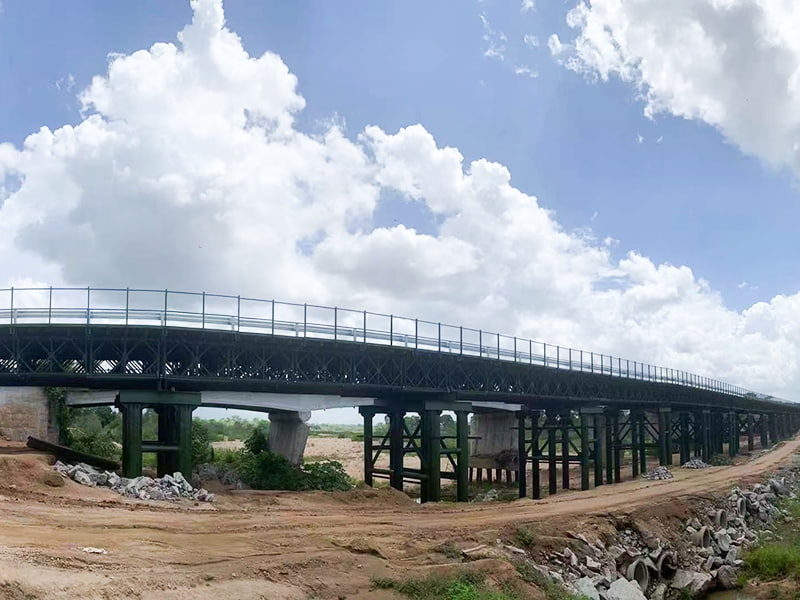
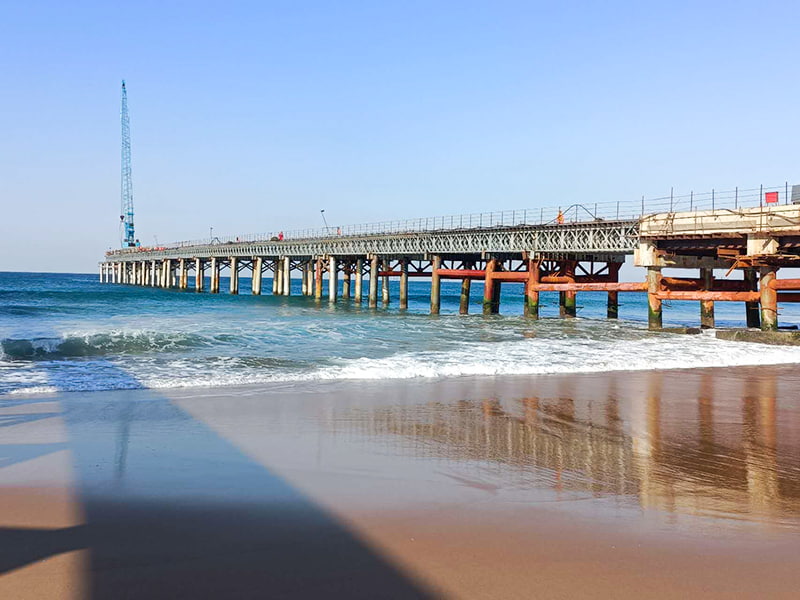
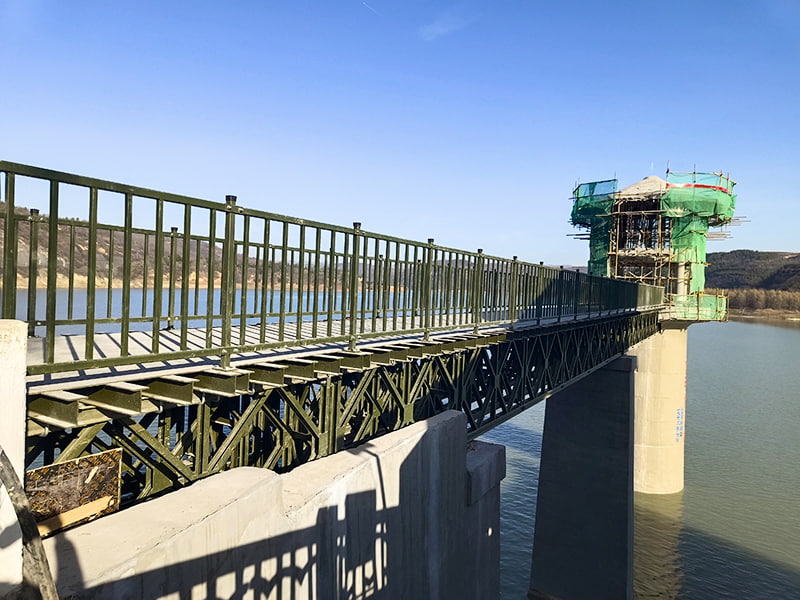
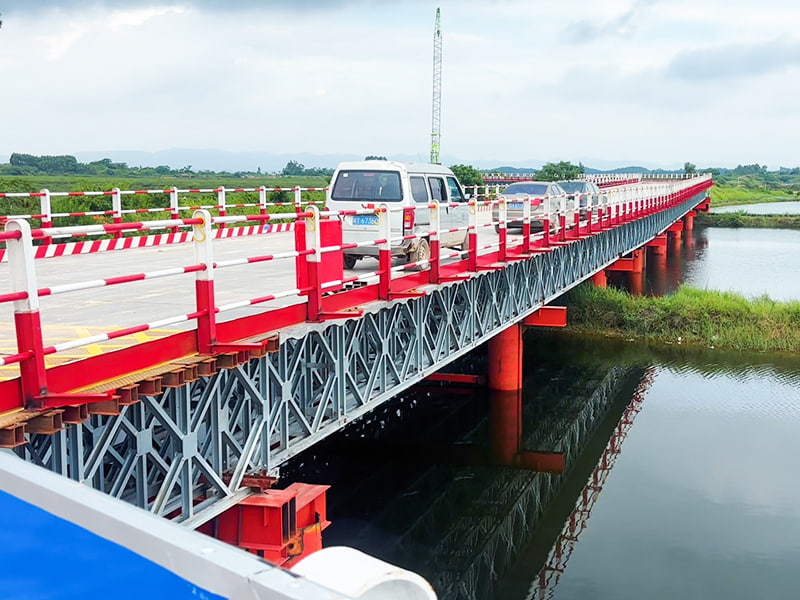
The clearest demonstration of bolted steel in action is the modular steel bridge. Panelized systems, known as Bailey bridges or modular steel bridges, consist of high-strength steel panels connected by pins and bolts. They are delivered as flat-packed kits, assembled without welding, and moved when the job changes.
Typical applications of bolted modular steel structures include:
- Emergency route restoration after floods, landslides, or earthquakes.
- Temporary detours during motorway, railway, and interchange works.
- Utility crossings for water, gas, or cable pipelines.
- Pedestrian and bicycle access over roads and rivers.
- Construction platforms for bridge deck works.
- Heavy falsework for railway and high-speed railway construction.
For a standard access road or rural crossing, a CB-100 double-row single-layer reinforced galvanized Bailey bridge is a workable configuration. It is quick to erect, handles regular construction traffic, and the galvanized coating reduces maintenance for the first two decades of service.
 Wholesale CB 100 Bailey Bridge Double-Row Single-Layer Reinforced Galvanized BaiJiangsu Zhonghai Bridge Equipment Co., Ltd. is a China CB 100 Bailey Bridge Double-Row Single-Layer Reinforced Galvanized Bailey Bridge m...View Product →
Where the span or loading increases, the truss layout upgrades to a heavier bolted panel system such as the CB-450 four-row single-layer reinforced galvanized Bailey bridge. The connection principle stays the same, but the number of bolt lines and panel chords increases to match the design moment and shear.
 Wholesale CB 450 Bailey Bridge Four-Row Single-Layer Reinforced Galvanized BaileJiangsu Zhonghai Bridge Equipment Co., Ltd. is a China CB 450 Bailey Bridge Four-Row Single-Layer Reinforced Galvanized Bailey Bridge man...View Product →
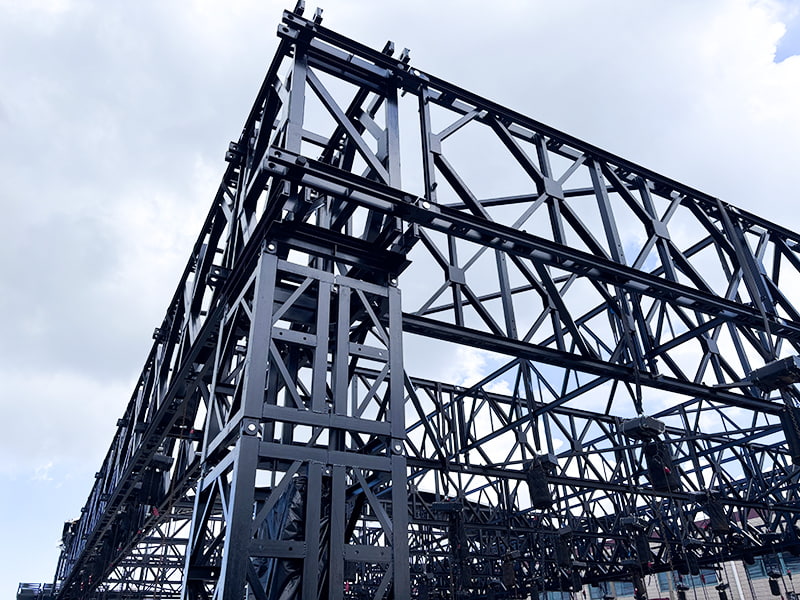
Bridge and viaduct construction also relies on bolted steel falsework. A 900-ton rated super Bailey construction support system acts as a movable, reusable support tower that carries heavy concrete or steel erection loads while keeping the site free of welding operations.
 Wholesale Customized Large Span 900 Ton Load Super Bailey Construction Support MJiangsu Zhonghai Bridge Equipment Co., Ltd. is a China Customized Large Span 900 Ton Load Super Bailey Construction Support manufacturers...View Product →
Teams moving from concept to specification can work from related technical resources. The modular steel bridge construction guide explains the reasoning behind member selection, while the Bailey bridge load capacity guide compares common span and load combinations.
For emergency planners, the Bailey panel solutions for emergency engineering article documents how bolted panel stocks are deployed quickly in disaster response scenarios.
Design and Procurement Considerations for Bolted Steel
The performance of a bolted structure is decided before the first bolt goes in. The following design and procurement steps have the largest impact on cost and reliability.
Connection Design Essentials
- Define the load path for every connection and identify whether shear, tension, or combined forces dominate.
- Select the bolt grade and diameter, balancing hardware count against the risk of galling during installation.
- Choose between bearing-type and slip-critical; reserve slip-critical for bridge splices and fatigue-load locations.
- Confirm hole geometry, including the tolerance for field alignment and the effect of oversized holes on slip resistance.
- State the tightening method and pattern in the specification, using torque control, tension-control bolts, or direct tension indicators.
Cost Drivers on Site
- Number of bolts per ton of steel; hardware cost grows quickly with connection density.
- Panel weight, which drives crane size and rigging time.
- Site crew experience with torque tools and alignment procedures.
- Fit-up quality; panels that are not interchangeable cause shimming and delays.
- Galvanizing thickness and the amount of touch-up painting needed after erection.
Procurement Checklist for Bolted Steel Systems
- Verify bolt grade markings and matching nuts before shipment.
- Check galvanizing thickness on samples from each production batch.
- Confirm that splice plates and gusset plates are drilled with the same jig as the panels.
- Request a bolt count and torque specification matched to the assembled structure.
- Buy spare hardware equal to 2 to 3 percent of the total bolt set.
- Plan for storage protection so threads and coated surfaces are not damaged during transport.
Because bolted systems depend on predictable geometry, the manufacturer's ability to hold tolerances is the main procurement risk. A dependable supplier produces members that line up without site grinding, ships the complete hardware set, and documents the grade and coating of every component.
Bolted Steel FAQ
Is bolted steel as strong as welded steel?
Yes, when the connection is properly designed. High-strength bolts in bearing-type or slip-critical configurations are calculated to develop the full capacity of the connected members, and bolted moment connections are standard in bridge construction.
How long does bolted steel last?
With a suitable coating system, bolted steel bridges typically perform for 30 to 50 years. Industry guidance from High Performance Coatings places bolted steel tanks at 20 to 30 years, with design details and maintenance as the controlling factors.
Do bolted connections loosen over time?
Preloaded high-strength bolts do not loosen under normal static loading. Vibration and repeated load cycling can cause a small reduction in preload, so periodic torque checks and a re-tightening pass after the first load cycles are standard practice.
What is the difference between ordinary bolts and high-strength bolts?
Ordinary bolts, typically in lower property classes, are used for light framing and non-slip connections. High-strength bolts in classes 8.8 or 10.9 are tightened to a controlled preload and are required for structural splices, bridge connections, and heavy support systems.
Can bolted steel be dismantled and reused?
Yes. This is the main reason bolted systems are used for temporary bridges and supports. After each service period, bolts are inspected for thread damage, plates are checked for deformation, and the complete system returns to stock for the next project.
Are bolted steel structures suitable for seismic areas?
Yes. Bolted moment frames and bolted braced frames have been used extensively in seismic regions. Slip-critical connections provide predictable stiffness and ductility, and the ability to replace a damaged connection after a seismic event is an advantage over welded frames.
Does bolted steel require special maintenance?
No special skills are required beyond bolt inspection. The maintenance program includes an annual visual survey, torque sampling of critical connections, galvanizing touch-up, and cleaning of drainage areas at connections.
Can bolted steel be used for permanent structures?
Yes. Many permanent highway bridges, industrial buildings, and utility structures use bolted connections exclusively. The presence of bolts does not reduce the design life; coating protection and maintenance do.
When is bolted steel the wrong choice?
When the design requires perfectly smooth flush surfaces for architectural reasons, when future access to connections is impossible, or when the contractor has no experience with torque-controlled hardware. In those cases, welded connections can be simpler to manage.
Bolted steel continues to be the preferred system for modular bridges, temporary works, tanks, and heavy construction supports because it turns unpredictable site work into repeatable assembly work. From a CB-100 access bridge to a CB-450 heavy-load crossing and a 900-ton construction support system, the bolted format delivers a combination of speed, reuse, and inspectability that field welding cannot match.

We respond quickly to all international requests and provide technical support when needed.
Product Category
Bailey Bridge/Modular Bridge Modular Steel Bridge Pedestrian Bridge Modular Pipe Bridge Truss Bridge Steel StructureContact Us

+86-511-84522866
+86-13921582699

zhwm@zjql.com

Building 1,83#, dantu New Town, Yanjiang Road, Dantu District, Zhenjiang, Jiangsu, China
Copyright © Jiangsu Zhonghai Bridge Equipment Co., Ltd. All
Rights
Reserved
China bailey bridge for sale
bailey bridge supplier from china
