
 English
  русский
  Español
  Português

Industry News
Steel Contractor: What They Do, How to Choose One, and Procurement Risks to Avoid
Content
- 1 What Does a Steel Contractor Actually Do?
- 2 Steel Contractor, Steel Fabricator, or Steel Erector: Know the Difference
- 3 How to Select a Steel Contractor: Criteria That Actually Matter
- 4 Where a Steel Contractor Adds Real Value: Project Types
- 5 Procurement Risks and How to Manage Them
- 6 Questions to Ask Before You Commit
- 7 Steel Contractor FAQ
What Does a Steel Contractor Actually Do?
Steel contractors exist to convert raw structural steel into a framework you can build on. That sounds simple, but the real work spans engineering, fabrication, surface treatment, logistics, and erection. The practical difference between an average and a dependable steel contractor shows up in three places: how parts fit at site, how much rework the project absorbs, and whether the program holds.
When you appoint a steel contractor, you are buying accountability for the full delivery chain. In most projects, the contractor receives either a structural model or concept drawings, then takes responsibility for connection detailing, member sizing, shop drawing production, steel purchasing, cutting, drilling, welding, surface protection, delivery sequencing, and site erection. Some firms stop at fabrication; others manage the whole chain including site supervision. That distinction matters more than the size of the company or the number of years it has been in business.
A full-scope steel contractor should give you a single point of responsibility. If a beam arrives with a wrong connection plate, you do not want to negotiate between the detailer, the workshop, and the transport company. You want one party that solves the problem. For this reason, integrated contractors avoid the most common failure pattern in steel projects: unclear ownership of tolerances.
| Phase | What Happens | What You Should Receive |
|---|---|---|
| Engineering and detailing | Connection design, model checking, clash review, shop drawings | Approved shop drawings and material schedules |
| Material procurement | Steel section purchasing, plate cutting, welding consumables | Confirmed rolling dates and documented material traceability |
| Fabrication | Cutting, drilling, welding, assembly under controlled shop conditions | Members manufactured to tolerance with inspection records |
| Surface treatment | Abrasive blasting, painting, or hot-dip galvanizing | Specified coating thickness and adhesion checks |
| Delivery and erection | Trucking, crane planning, bolting, and welding at site | Match-marked components and a clear erection sequence |
Steel Contractor, Steel Fabricator, or Steel Erector: Know the Difference
The label on the contract changes who carries the risk. The quickest way to avoid miscommunication is to distinguish a fabricator, an erector, and a contractor before you send out an enquiry. They are often used as interchangeable words, but each one represents a different scope boundary.
Steel Fabricator
Fabricators work inside the shop. They cut, drill, weld, and assemble steel into transportable members, then deliver them to site. They rarely manage foundations, cranes, or bolting sequences. Choose a fabricator when your own team or a separate erector will handle site work and when the engineering has already been approved.
Steel Erector
Erectors work only at site. They receive fabricated members, lift them into position, align them, and complete bolting or field welding. A pure erector typically does not redesign connections, order material, or produce shop drawings. Choose an erector when design and fabrication are already complete and your main concern is installation speed and safety.
Full-Scope Steel Contractor
Full-scope contractors own engineering, fabrication, and erection. They carry the interface risk between the shop and the site, which is precisely the risk that causes most steel project delays. This model works best for fast programs, remote sites, and structures with tight tolerances such as modular bridges and heavy temporary works. If you only want one party to chase when something goes wrong, this is the structure to use.
| Model | Core Responsibility | Best Used When | Main Risk Carrier |
|---|---|---|---|
| Fabricator | Shop production only | Site work is handled by others | Project owner coordinates interfaces |
| Erector | Site assembly only | Design and shop work are complete | Project owner manages fit-up issues |
| Full-scope contractor | Engineering, fabrication, erection | Fast, complex, or remote programs | Contractor owns the interface risk |
For modular steel products such as Bailey bridges, the same rule applies. A manufacturer that provides engineering, delivery, and erection supervision behaves like a full-scope steel contractor rather than a pure supplier. Before comparing prices, compare scope boundaries. If one quote includes site technical support and another stops at the factory gate, the cheaper number is not cheaper. Study the Bailey bridge specification and load capacity guide to see where the engineering responsibility usually sits.
How to Select a Steel Contractor: Criteria That Actually Matter
Judge a steel contractor on engineering depth, manufacturing control, and site support, in that order. These three criteria predict project outcomes more reliably than a company's age or the number of machines it shows in a promotional video. A contractor that scores well on all three will usually deliver steel that fits, a coating that lasts, and a site team that is not waiting around.
Engineering Depth Decides Fit-Up Quality
Ask who produces shop drawings and final connection details. For all-bolted structures, small changes in hole location, member straightness, and plate thickness create field issues that are expensive to solve after fabrication. Many problems that appear as erection errors actually originate in detailing. Confirm that the engineering team checks member sizes, joint geometry, and interaction with concrete substructures before steel goes into cutting. Treat engineering as the highest-leverage item in the budget, not an optional extra.
Manufacturing Control and Trial Assembly
Fabrication quality rests on process control, not on the brand of welding equipment. Look for a facility that maintains material traceability, documented welding procedures, dimensional checks, and trial assembly for modular or bolted structures. Trial assembly is especially valuable for Bailey-type bridges and large trusses because it exposes mismatched bolt holes and squareness errors before expensive transport. For large-span products, this single step prevents most site delays. When the workload includes custom frames, plate girders, or non-standard connections, confirm that the shop handles these shapes rather than only standard panels. A dedicated steel structure fabrication line is a strong indication that bespoke work receives the same quality attention as catalog products.
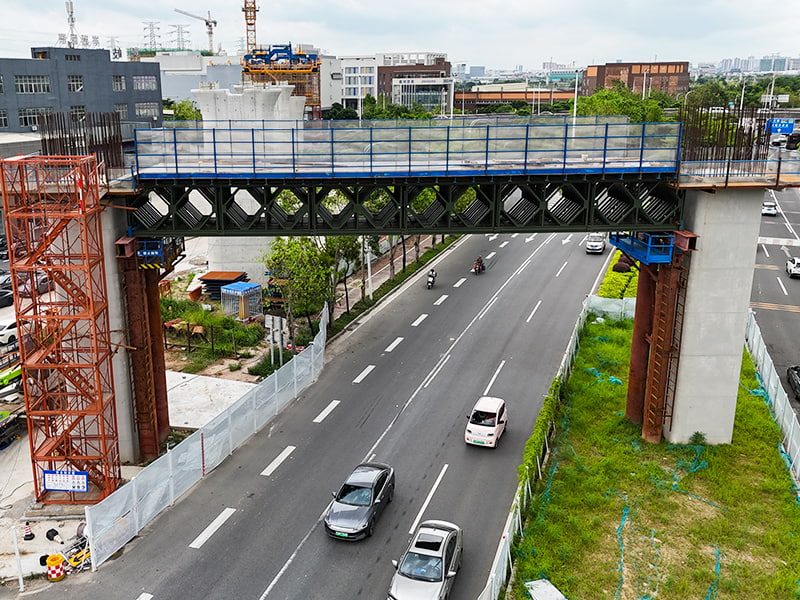 Custom Steel Structure Manufacturers, Steel Structure System FactoryAs China steel structure manufacturers and steel structure system OEM factory, Zhonghai Bridge Equipment Co., Ltd specialize in custom an...View Product →
Delivery Discipline and Site Support
Delivery discipline decides whether your site team idles. Ask for a rolling fabrication schedule, not just a completion date. Confirm how components are packed and marked: match-marked parts with bolting kits organized by location dramatically reduce site labor. Check whether the contractor can send an erection supervisor or a commissioning engineer to site, especially for temporary works and bridge launching. A 900-ton rated Bailey construction support is only useful if the installation team understands the jacking, seating, and sequencing plan. Site support is not a cost center; it is the factor that turns a steel delivery into a completed structure.
Where a Steel Contractor Adds Real Value: Project Types
Steel contracts vary by sector, but the same engineering logic applies: the more repetition and standardization, the lower the risk. This is why modular steel systems perform well in infrastructure and emergency work. They combine factory quality with simple site assembly, and they give a steel contractor precise control over tolerances.
Bridges, Bypasses, and Heavy-Load Crossings
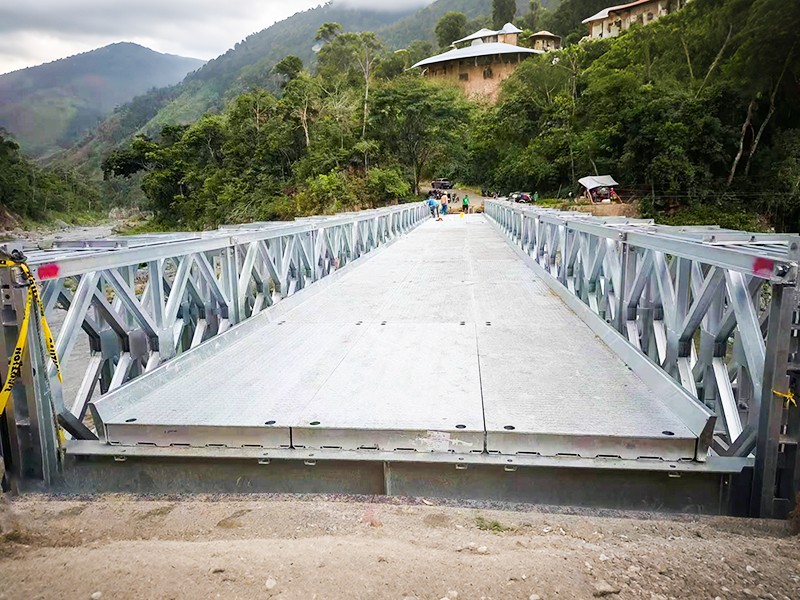
For temporary or permanent bridges, a steel contractor with modular systems can cut both design time and site work. Panel-type bridges such as the CB-100 series suit lighter vehicle and pedestrian loading; the CB-200 series extends to longer spans, with the manufacturer's catalog listing configurations from a 27-meter double-row single-layer reinforced bridge to a 48-meter double-row single-layer reinforced bridge; and the CB-450 series covers heavy loads where additional rows and reinforcing components are required. The key advantage of the modular route is that components are standardized, inspected in the factory, and assembled on site with simple equipment. When comparing options, check the span, the load class, the assembly labor hours, and whether the contractor provides launching guidance. A reliable reference is the modular steel bridge construction guide for how these systems are specified and erected. For projects that need a quick, engineered crossing, prefabricated modular steel bridge systems replace bespoke fabrication with factory-made components and a much shorter site program.
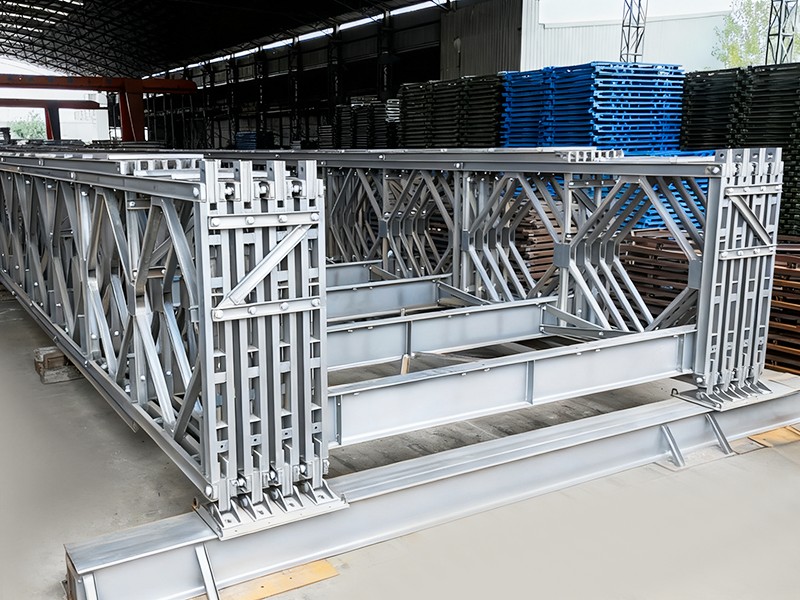 Modular Steel Bridges Manufacturer, OEM Temporary Steel Bridge FactoryAs China modular steel bridges manufacturer and temporary steel bridge OEM factory, Zhonghai Bridge Equipment Co., Ltd specialize in cust...View Product →
Temporary Works, Falsework, and Support Structures
Temporary works are where a steel contractor earns or loses its fee. Falsework, launching girders, struts, and propping systems must carry construction loads plus dynamic factors, and they must do so without restricting the permanent structure. Modular super Bailey supports have been used in high-speed rail and other heavy construction programs where large loads combine with tight footprint constraints. The manufacturer's range includes a customized large-span 900-ton load super Bailey construction support, which indicates an engineering level far beyond standard job-site shoring. If your program requires high-capacity temporary support, the customized 900-ton super Bailey construction support is a useful reference point for how these systems are designed and rated.
 Wholesale Customized Large Span 900 Ton Load Super Bailey Construction Support MJiangsu Zhonghai Bridge Equipment Co., Ltd. is a China Customized Large Span 900 Ton Load Super Bailey Construction Support manufacturers...View Product →
Approach Structures, Platforms, and Special Steel Items
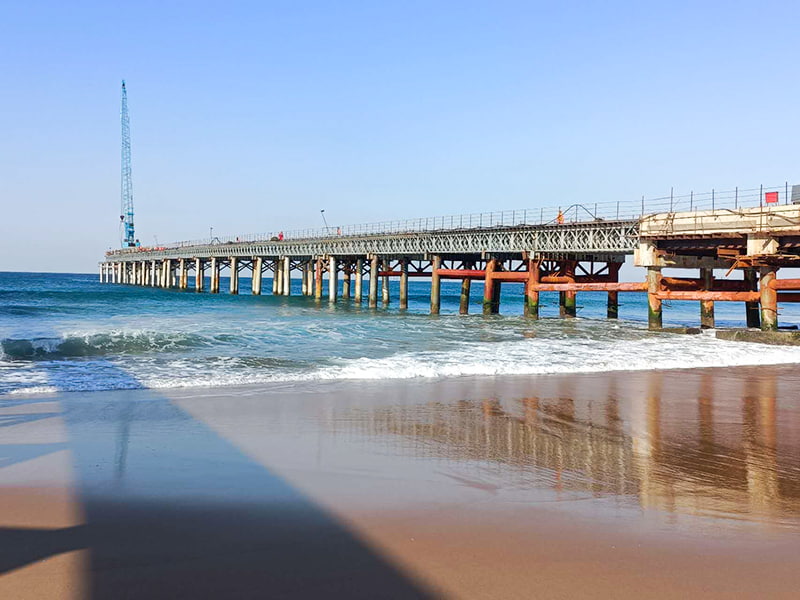
Beyond the main span, steel contractors supply approach bridges, working platforms over bridges, pipe supports, and pedestrian access structures. These elements are often underestimated during budgeting. A steel approach bridge may need a different surface treatment from the main structure; a construction platform over a river or road must be designed for live working loads, wind, and removal access. Including these items in the same contract as the main structure avoids interface disputes and keeps the quality requirements consistent. The practical scope of such elements is well illustrated by the bridge construction platform applications covered in recent industry notes. For coastal or humid sites, hot-dip galvanizing is usually preferred over paint; for visually sensitive projects, a paint system may be specified. Call out the environment explicitly in your enquiry so the surface treatment budget is realistic.
Procurement Risks and How to Manage Them
Most steel projects do not fail because the material is weak. They fail because of coordination, tolerance, and timing. These risks should be managed in the contract, not after the crane arrives at site. The table below lists the five most common problems and the practical controls that prevent them.
| Risk | Why It Happens | How to Control It |
|---|---|---|
| Late steel delivery | Material purchasing starts only after drawing approval | Require a rolling fabrication schedule and start procurement early |
| Fit-up problems | Members are fabricated without trial assembly or damaged in transit | Mandate trial assembly for bolted structures and protect members during transport |
| Coating failures | Surface preparation and coating specification are ambiguous | Define the coating system, film thickness, and inspection points in the enquiry |
| Erection errors | Site team lacks proper drawings or experienced supervision | Require match-marked parts, erection drawings, and supervisor attendance |
| Scope creep in change orders | Scope boundaries are ambiguous at the award stage | Freeze scope boundaries and list exclusions clearly in the contract |
These five risks account for the majority of disputes observed in steel and bridge projects. Each one can be mitigated by contract clauses, but a contractor with integrated engineering and manufacturing control has fewer reasons to pass the risk back to you. When the same team designs, fabricates, and supervises, problems are solved at the source rather than negotiated after the fact.
Questions to Ask Before You Commit
Use this checklist at the shortlist stage. The answers reveal how a contractor operates and where the risk sits. A contractor that answers clearly and provides documented evidence is usually a safer partner than one that relies on general assurances.
- Do you carry out shop drawings, connection design, and final detailing in-house?
- Which fabrication and trial assembly steps apply to bolted modular structures?
- How are components marked, packed, and sequenced for site assembly?
- What surface treatment lines do you operate, and how do you verify coating thickness?
- Can you provide erection supervision or launching guidance at the site?
- What is your typical response time for a site technical issue during assembly?
Add one more question that many buyers forget: how will delivery be planned if steel sections, bridge panels, and loose fasteners come from the same contract? The answer tells you whether the contractor thinks in terms of a complete erection sequence or simply a list of products to be shipped.
Steel Contractor FAQ
Q1. What is the difference between a steel contractor and a steel supplier?
A steel supplier sells steel products such as beams, panels, and fasteners, usually on an ex-works basis. A steel contractor takes responsibility for engineering, fabrication, delivery, and often site erection. In modular bridge procurement, a manufacturer that provides design support, trial assembly, and erection supervision behaves as a contractor rather than a pure supplier.
Q2. Can a steel contractor handle temporary works and bridge structures in one contract?
Yes. Many contractors combine permanent structures with temporary works such as falsework, launching systems, and support frames. This reduces interface risk because the same engineering team designs both. A typical example is the use of modular Bailey components as temporary support in high-speed rail construction, where both the crossing structure and the support system are engineered from the same panel system.
Q3. How important is trial assembly for bolted steel structures?
Critical. Trial assembly replicates the geometry of the final structure in the workshop and exposes mismatched holes, squareness errors, and fit-up problems before delivery. For modular Bailey bridges and large trusses, it is the single most effective quality step a contractor can take. Do not skip it for long-span or multi-bay structures.
Q4. Should I choose galvanizing or painting for a bridge in a humid coastal environment?
Hot-dip galvanizing generally provides longer service life for structural steel in humid or marine environments and requires less maintenance over time. Painting can be specified where appearance matters or where the slip characteristics of a galvanized surface are a concern. Ask the contractor to confirm coating thickness, application method, and inspection points before fabrication starts.
Q5. How early should I contact a steel contractor?
The earlier the better, especially for modular products. Contact the contractor before the structural design is frozen so that standard panel configurations can be used instead of costly custom details. For prefabricated modular bridges, lead times depend on surface treatment and transport distance; a reliable contractor will state the lead time clearly during the enquiry and confirm it in the offer.
Q6. Do steel contractors provide erection supervision?
Usually yes for modular steel products. The manufacturer typically provides a technical supervisor or remote guidance for launching and assembly of Bailey-type bridges. Confirm in the quotation whether supervision is included in the price or offered as a separate service, and whether travel and accommodation costs are covered.

We respond quickly to all international requests and provide technical support when needed.
Product Category
Bailey Bridge/Modular Bridge Modular Steel Bridge Pedestrian Bridge Modular Pipe Bridge Truss Bridge Steel StructureContact Us

+86-511-84522866
+86-13921582699

zhwm@zjql.com

Building 1,83#, dantu New Town, Yanjiang Road, Dantu District, Zhenjiang, Jiangsu, China
Copyright © Jiangsu Zhonghai Bridge Equipment Co., Ltd. All
Rights
Reserved
China bailey bridge for sale
bailey bridge supplier from china
